


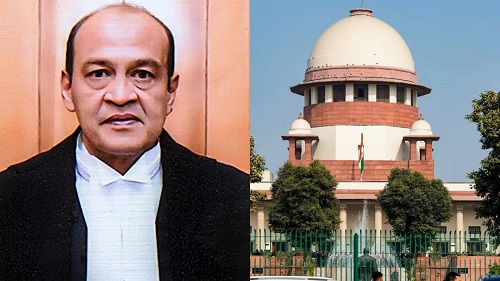
In a decisive ruling that underscores the constitutional framework for judicial accountability, the Supreme Court has dismissed a petition filed by Allahabad High Court Judge Justice Yashwant Varma. The petition challenged the parliamentary panel investigating corruption allegations against him and contested the Lok Sabha Speaker’s decision to admit a motion seeking his removal.
A bench led by Justice Dipankar Datta rejected Justice Varma’s plea, bringing to a close a significant legal challenge against the ongoing removal process. The Supreme Court had previously agreed to hear the petition on December 16, but after reserving its verdict, it has now upheld the authority of the parliamentary mechanism established under the Judges (Inquiry) Act, 1968.
Justice Varma, represented by senior advocate Mukul Rohatgi, had argued that the Lok Sabha Speaker’s decision to unilaterally constitute an inquiry committee was flawed and violated his right to equality under the law. His contention stemmed from the fact that notices for the removal motion were issued in both Houses of Parliament on the same day. He alleged that the Speaker’s subsequent formation of the committee under Section 3(2) of the Act, without corresponding action from the Rajya Sabha Chairman, rendered the process unconstitutional.
The Supreme Court’s dismissal affirms the procedural steps taken thus far, allowing the parliamentary inquiry to proceed unimpeded.
The case originates from a controversial incident on March 14, when burnt wads of currency notes were reportedly discovered at Justice Varma’s official residence in New Delhi. Following this, he was transferred from the Delhi High Court back to the Allahabad High Court.
In response, then Chief Justice of India Sanjiv Khanna initiated an in-house inquiry. A three-judge committee comprising Chief Justice Sheel Nagu (Punjab & Haryana HC), Chief Justice G. S. Sandhawalia (Himachal Pradesh HC), and Justice Anu Sivaraman (Karnataka HC) was formed. This committee submitted a report on May 4, finding Justice Varma guilty of misconduct.
After Justice Varma declined to resign, the CJI forwarded the report, along with the judge’s response, to the President and the Prime Minister, setting the stage for formal removal proceedings.
Subsequently, on August 12, Lok Sabha Speaker Om Birla admitted a multi-party motion for the judge’s removal. He constituted a three-member inquiry committee as mandated by law, consisting of Supreme Court Justice Aravind Kumar, Madras High Court Chief Justice Manindra Mohan Shrivastava, and senior advocate B V Acharya.
Justice Varma’s petition had sought to quash the Speaker’s actions, the admission of the motion, and all notices from the inquiry committee, claiming the process was unconstitutional. The Supreme Court’s refusal to intervene validates the current pathway for addressing allegations against judges—a pathway that carefully balances judicial independence with accountability.
The ruling reinforces the distinct roles of the judiciary and the legislature in such matters. While the in-house committee was an internal judicial mechanism, the motion before Parliament represents the constitutional process for removal, which involves both Houses and a high-level inquiry.
With this legal hurdle cleared, the parliamentary committee is expected to continue its investigation. Its findings will eventually be presented before both Houses of Parliament. For a removal motion to succeed, it must be passed by a special majority in each House—a high threshold designed to protect judges from frivolous complaints while holding them accountable for proven misconduct.
The case continues to be a closely watched test of India’s judicial accountability procedures, highlighting the intricate dialogue between constitutional organs in upholding the integrity of the judiciary.



















Leave Your Comment