


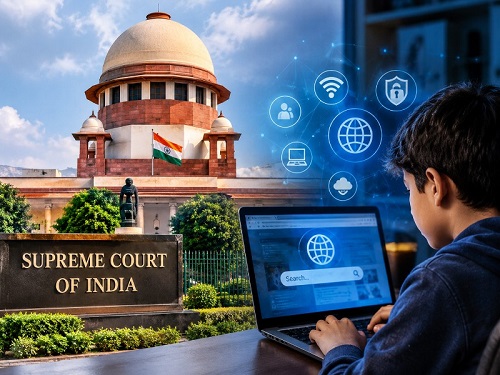
In a significant interpretation of constitutional freedoms in the digital age, the Supreme Court has recognised access to and use of the internet as a fundamental right of every individual, including children regardless of age. Emphasising that safety cannot become a justification for suppressing freedom, the court has cautioned against blanket restrictions on children’s internet access, arguing that such measures could deprive them of educational opportunities, personal expression, privacy and avenues to seek assistance when confronted with online abuse. The ruling places the responsibility on policymakers to develop effective safeguards that protect children from digital threats without excluding them from the opportunities offered by the online world.
The Supreme Court’s observation marks an important development in the evolving relationship between constitutional rights and digital technology. A bench comprising Justices JB Pardiwala and KV Chandran, in an order dated October 15, held that the right to access and use the internet flows from Article 21 of the Constitution, read with the freedom of speech and expression guaranteed under Article 19(1)(a).
The court was examining measures to identify and remove child sexual exploitative and abuse material (CSEAM) from the internet when it addressed the broader question of protecting children in an increasingly digital environment. Against the backdrop of growing international demands for age-based restrictions on social media, the bench drew a distinction between protecting children from online harm and denying them access to the internet altogether.
The judges made their position clear: the interests of children cannot be served by treating their freedom and safety as competing objectives. Their observation that children are entitled to both challenges the assumption that restricting access is necessarily the most effective way to protect young users.
The judgment also rejects the notion that children, because of their age, should be excluded from constitutional freedoms enjoyed by adults. Instead, it recognises that childhood requires appropriate protection without extinguishing individual rights.
This distinction is particularly important at a time when governments, technology companies and parents are debating whether minimum-age requirements or outright prohibitions on social media can adequately address the dangers of the digital world.
1. Internet access recognised as a fundamental right: The Supreme Court held that the right to access and use the internet flows from Article 21, read with Article 19(1)(a) of the Constitution.
2. Children enjoy constitutional freedoms: The bench emphasised that children cannot be denied these rights solely because of their age.
3. Blanket bans may create new risks: Restrictions could push children towards less regulated online spaces instead of effectively protecting them from exploitation and abuse.
4. Digital connectivity promotes inclusion: The internet is an important source of education and information, particularly for children in remote areas and those with special needs.
5. Safety and freedom must coexist: The court’s observations support a balanced approach involving effective safeguards, responsible platforms and targeted action against online abuse rather than indiscriminate restrictions.
The Supreme Court acknowledged that concerns about children’s online safety are genuine. Social media and other internet platforms can expose young users to exploitation, cyberbullying, inappropriate content and manipulation. However, the bench cautioned that a blanket ban may not resolve these problems and could push children towards less regulated digital spaces.
Restrictions that prevent access to mainstream platforms may appear straightforward, but their practical effectiveness remains a concern. Children determined to access online content could use alternative accounts, unregulated applications or platforms with weaker safeguards. Such displacement could make monitoring more difficult and expose vulnerable users to greater risks.
One of the most significant aspects of the Supreme Court’s reasoning is its recognition that the internet serves purposes extending far beyond social networking. It has become an essential channel for learning, accessing information, communicating with others and participating in society.
The bench observed that for many children, particularly those living in remote areas, the internet may be the only available source of learning and information. A blanket prohibition could therefore deepen existing inequalities by placing additional barriers between disadvantaged children and educational opportunities.
Digital access can enable students to consult learning materials, explore subjects beyond their school curriculum and connect with educational resources that may not be available locally. For children in areas with limited educational infrastructure, these opportunities can be especially valuable.






















Leave Your Comment