


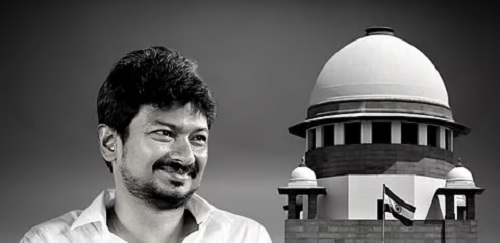
In a significant development, the Supreme Court has intervened to halt the registration of new cases against Tamil Nadu minister and DMK leader Udhayanidhi Stalin without its explicit permission. This decision comes in response to Stalin's controversial remarks made in September 2023, where he equated Sanatan Dharma with diseases like dengue and malaria, calling for its eradication.
Stalin's incendiary comments sparked widespread protests and triggered legal actions across various states, leading to multiple FIRs being filed against him. The recent Supreme Court order provides legal respite to the DMK leader, who has been grappling with mounting complaints and legal challenges.
During the court proceedings, senior advocate AM Singhvi, representing Stalin, highlighted the filing of a fresh complaint in Bihar, alongside existing FIRs in multiple states. The court responded firmly, stating, "You can’t keep filing new complaints," underscoring its stance against the proliferation of cases.
Chief Justice of India (CJI), after hearing arguments from all parties, emphasized that the apex court would not delve into the merits of the case, asserting, "As the apex court, we can’t react to comments." The bench subsequently issued a notice on Stalin’s application and extended the interim protection previously granted.
Furthermore, the Supreme Court has permitted the states where FIRs have been lodged, including Bihar, to be parties in the case, soliciting their responses. The matter is now slated for a hearing in the week commencing April 28, 2025, with the interim order safeguarding Stalin from further legal actions until the scheduled proceedings.
This judicial intervention marks a pivotal moment in the legal trajectory surrounding Udhayanidhi Stalin's controversial statement, setting the stage for deliberations on the scope and boundaries of free speech in India's constitutional framework. The outcome of the upcoming hearing will likely influence future discourse on religious sensitivities and the permissible limits of expression in public discourse.




















Leave Your Comment