


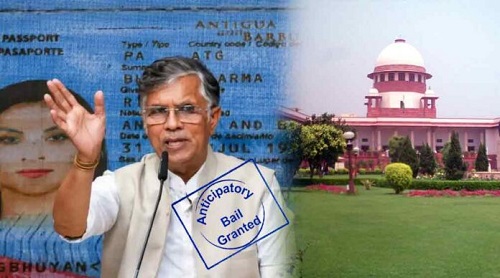
Senior Congress leader Pawan Khera received significant relief on Friday after the Supreme Court of India granted him bail in a case linked to allegations involving Riniki Bhuyan Sarma. The case stems from Khera’s claim that Sarma possessed multiple passports—an allegation strongly contested by the Assam government.
A two-judge bench comprising Justices Maheshwari and A.S. Chandurkar set aside the earlier order of the Gauhati High Court, which had denied anticipatory bail to the Congress leader. The apex court’s decision marks a crucial legal reprieve for Khera amid a politically charged dispute.
While granting bail, the court did not hold back in its observations, noting that remarks from both Khera and Himanta Biswa Sarma crossed acceptable limits. It remarked that Khera’s statements appeared aimed at gaining political advantage in the run-up to elections, while Sarma’s comments were also “not in line with parliamentary language.”
The bench emphasized the importance of maintaining a balance between investigative needs and individual freedoms. Referring to Article 21 of the Constitution of India, the court underlined that personal liberty cannot be compromised unnecessarily during legal proceedings.
During the hearing, Khera argued that custodial arrest would be unwarranted and humiliating, especially since the charges against him are largely bailable. Represented by senior advocate Abhishek Singhvi, he contended that the case lacked grounds for arrest.
Singhvi sharply criticized the conduct of constitutional authorities, invoking B. R. Ambedkar to stress the importance of dignity and restraint in public office. He described the case as “unprecedented” and questioned the necessity of arrest even in a hypothetical conviction scenario.
Opposing the bail plea, the Assam Police—represented by Solicitor General Tushar Mehta—argued that the allegations involved fabricated and doctored documents. The prosecution insisted that a thorough investigation was needed to determine how the alleged fake passports and seals were created and who might have assisted in the process.
The case was registered under multiple provisions of the Bharatiya Nyaya Sanhita at the Guwahati Crime Branch.
Before approaching the apex court, Khera had briefly secured relief from the Telangana High Court, which granted him a seven-day transit anticipatory bail after he cited residence in Hyderabad. Subsequently, the matter reached the Supreme Court, which directed him to seek relief from the Gauhati High Court—an attempt that initially failed before the latest intervention.
The Supreme Court’s ruling not only grants temporary relief to Khera but also highlights the judiciary’s role in navigating politically sensitive cases. By cautioning both sides on the use of language and emphasizing constitutional protections, the court has sent a broader message about accountability and restraint in public discourse.
As the investigation continues, the case is likely to remain under close watch, given its intersection of politics, law, and questions around institutional conduct.




















Leave Your Comment