


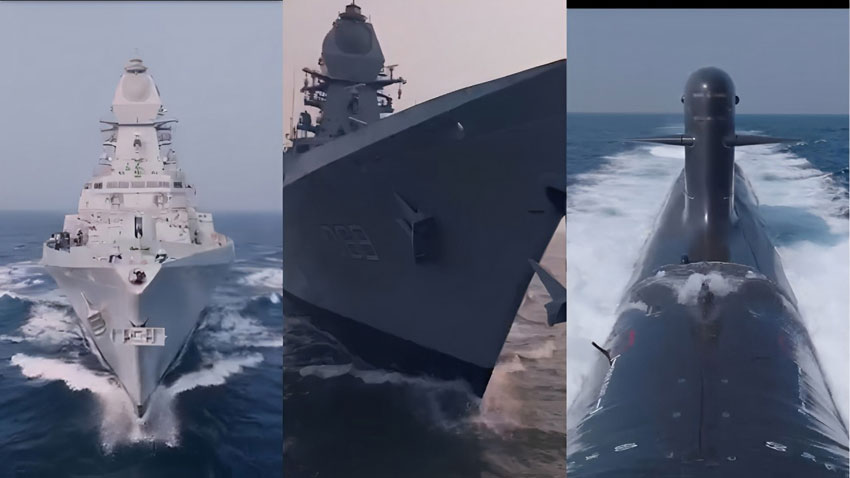
In a landmark moment for India's naval capabilities, Prime Minister NarendraModi recently commissioned three formidable assets—INS Surat, INS Nilgiri, and INS Vaghsheer—into the Indian Navy. This move underscores India's commitment to enhancing its maritime security and asserting its presence in the Indo-Pacific region. These state-of-the-art vessels represent the pinnacle of India's indigenous shipbuilding efforts under the 'Atmanirbhar Bharat' initiative. Here is an exploration of their key features and the impact they are expected to have on India's maritime security.
INS Surat is the fourth and final ship of the Project 15B stealth guided-missile destroyers. Built by Mazagon Dock Shipbuilders Limited (MDL) in Mumbai, the ship is a testament to India's capability in constructing advanced warships. It incorporates radar-absorbing materials and an angular design to reduce radar cross-section, making it less detectable. The ship is equipped with advanced BrahMos supersonic cruise missiles and Barak-8 surface-to-air missiles, along with state-of-the-art electronic warfare systems, modern surveillance radar, and advanced sonar capabilities. Capable of reaching speeds of up to 30 knots and with an operational range of 4,000 nautical miles, INS Surat is a versatile asset designed for anti-air, anti-surface, and anti-submarine warfare, significantly enhancing India’s blue-water naval capabilities.
INS Nilgiri, the first of the Project 17A frigates, is designed to replace the ageing Shivalik-class frigates and integrates advanced technologies, stealth features, and multi-role capabilities. The vessel features a low radar signature due to its sloped superstructure and special hull design, which enhances its stealth capabilities. It is armed with BrahMos and other precision-guided munitions, along with a sophisticated anti-submarine warfare suite. The frigate is powered by a Combined Diesel and Gas (CODAG) propulsion system, which provides improved fuel efficiency and speed. Highly automated systems onboard reduce crew workload and increase operational efficiency, making INS Nilgiri a versatile asset for tasks ranging from escort missions to high-intensity combat operations. This ensures robust protection of India’s maritime interests.

INS Vaghsheer, the final Scorpene-class submarine under Project 75, is a diesel-electric attack submarine built by MDL in collaboration with France’s Naval Group. It is designed for silent underwater movement with advanced noise suppression techniques, making it a silent predator beneath the waves. The submarine is armed with torpedoes, Exocet anti-ship missiles, and precision-guided munitions for lethal strikes. It is capable of extended underwater operations thanks to its Air Independent Propulsion (AIP) system and features cutting-edge sonar and periscopic systems for superior situational awareness. INS Vaghsheer bolsters India’s underwater combat capability, essential for countering hostile submarines and securing key maritime trade routes.
The commissioning of these three vessels—INS Surat, INS Nilgiri, and INS Vaghsheer—is expected to have a profound impact on India’s maritime security. Their deployment enhances India’s deterrence against potential adversaries, particularly in the Indo-Pacific, and extends the Navy’s operational reach, which is crucial for securing the Indian Ocean Region (IOR). These assets also provide a significant boost to operational flexibility, allowing for simultaneous multi-theater engagements. Symbolizing the success of the Make in India initiative in defense, these vessels reduce dependence on foreign imports while showcasing India’s capability in advanced shipbuilding.
The commissioning of INS Surat, INS Nilgiri, and INS Vaghsheer marks a significant milestone in India’s journey towards becoming a self-reliant maritime power. These "three titans" not only strengthen the Indian Navy’s capabilities but also send a strong message about India’s resolve to protect its maritime interests. As global power dynamics shift towards the Indo-Pacific, these assets will play a pivotal role in ensuring regional stability and safeguarding India’s sovereignty.day india bureau.
UDAY INDIA BUREAU















Leave Your Comment