


A courtroom drama unfolded at Patiala House Court on Saturday morning as Delhi Police sought a five-day remand of four Indian Youth Congress (IYC) workers arrested over their provocative demonstration at the AI Impact Summit, claiming the protest was part of a deliberate conspiracy to embarrass India before an international audience.
The four accused — Krishna Hari, Kundan Yadav, Ajay Kumar, and Narasimha Yadav — were brought before the court after being arrested in connection with Friday's incident at Bharat Mandapam, where the Global AI Summit was being held in the presence of international leaders and dignitaries.
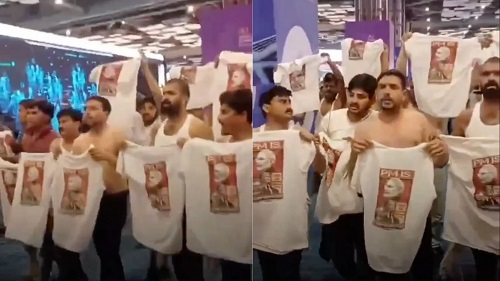
Drama erupted inside the AI Impact Summit exhibition hall on Friday when the IYC workers walked through the venue carrying T-shirts bearing slogans critical of the government and the India-US trade deal. Security personnel swiftly removed them from the premises before the situation could escalate further. The protest, described by participants as deliberately shirtless and visually provocative, was designed to draw maximum attention in front of an audience of global technology and policy leaders.
Delhi Police did not mince words in court, framing the incident as far more than a spontaneous act of political dissent. The prosecution argued that the nature and staging of the protest bore striking similarity to demonstrations that had taken place in Nepal — a parallel they said pointed to deliberate orchestration with the intent to defame India on an international platform.
Seeking five days' custody, police told the court that anti-national slogans were raised in the presence of prominent international figures, that three police personnel sustained injuries during the incident, and that the accused's mobile phones needed to be examined to determine whether any external funding was involved. Investigators also pointed to the coordinated nature of the protest — four individuals converging from four separate locations to arrive at the high-security venue with pre-printed T-shirts — as evidence of deeper planning.
"Their custody is necessary to arrest other accused who fled the scene," the prosecution stated, adding that further investigation into the alleged conspiracy required physical access to the accused.
The defence pushed back firmly. The accused's lawyer argued before the court that the protest was entirely peaceful, that no video footage showed any violence, and that the FIR amounted to nothing more than a politically motivated move against members of an opposition party. The lawyer highlighted that all four accused are educated individuals with careers and futures at stake, and that the maximum punishment for the alleged offences — up to seven years — was disproportionate to what was, at its core, an act of political dissent.
"There should be a reason for custody. They are young, they have careers, and political dissent shouldn't be crushed like this. It was a peaceful protest," the defence lawyer argued while moving bail applications on behalf of the accused.
The lawyer also submitted that the accused had been severely beaten following their arrest — an allegation that added a serious dimension to the proceedings — and that they were being targeted solely because of their affiliation with an opposition party.
The case sits at a charged intersection of national security optics, political rivalry, and the right to protest. That the demonstration occurred at a high-profile international technology summit — attended by global leaders and watched by the world — has given the government's response an urgency that a routine street protest would not have attracted. Delhi Police's invocation of international conspiracy language signals that authorities intend to pursue this case aggressively, using the setting of the summit as the cornerstone of their argument for serious criminal liability.
For the Congress party and the IYC, the arrests present an opportunity to portray the government as intolerant of dissent and willing to weaponise the security apparatus against political opponents. The accused's lawyers were quick to frame the entire episode in those terms before the court.
The court is yet to rule on the remand application. However the judge decides, this case is unlikely to fade quietly — it has already become a flashpoint in the ongoing battle between the ruling establishment and an increasingly assertive opposition looking for every opportunity to make its voice heard, even, it seems, in the halls of an AI summit.




















Leave Your Comment