


The Jyoti Malhotra espionage case is a chilling revelation of how 21st-century intelligence operations are increasingly embedded in romance, media, and influence rather than shadow and steel. This report unpacks how emotional proximity, encrypted communications, cultural diplomacy, and narrative manipulation formed a seamless civilian espionage channel. From romantic grooming to digital propaganda, from soft surveillance at expos to radicalisation in pilgrim corridors, the case illustrates the five sub-fronts within a half-front war now waged inside India. It reveals how soft targets, lifestyle influencers, and vulnerable individuals are converted into tools of subversion. Through detailed timelines, operational patterns, and national security responses, this study shows that in the era of psychological warfare, seduction is not just a tactic—it is the most veiled but potent weapon.
1. The 3S Strategy of Espionage: Seduction, Subversion, Surveillance:
Jyoti Malhotra espionage case now presented to the open world as a paradigmatic example of 21st-century intelligence operations, where state actors no longer rely solely on covert field agents but instead manipulate civil spaces, digital personas, and emotional vulnerabilities. Through the lens of the "3S Strategy"—Seduction, Subversion, Surveillance—it reveals how seemingly benign public personas can be co-opted into tactical nodes of espionage. From romantic grooming to encrypted communications, cultural diplomacy to narrative propaganda, the Malhotra case maps the architecture of an emerging espionage frontier. With detailed accounts of operational patterns and state responses, this study underscores the urgent national imperative to counter internal hybrid threats before they manifest in kinetic or strategic fallout. In the era of psychological warfare, seduction is not just a tactic—it is the first weapon.

2. Seduction as Strategy—The Art of Emotional Subversion
"In her own video, Jyoti Malhotra is seen attending an Iftar dinner at the Pakistan High Commission, warmly greeting espionage suspect Ehsan-ur-Rahim alias Danish, and repeatedly asking for help in securing a visa to Pakistan." — NDTV, May 17, 2025, May 17, 2025
It began with a smile and a camera. A seemingly harmless travel vlogger known to her followers as "Travel With Jo," Jyoti Malhotra was just another face in the crowd. But as India’s intelligence agencies now reveal, her presence at an Iftar hosted by the Pakistan High Commission in New Delhi was more than social engagement—it was covert initiation.
The video begins with Malhotra beaming into the camera, visibly animated as she describes the decorations as "superb" and expresses how "mesmerised" she feels. Her repeated exclamations—“Main to hil gayi! (I am so impressed!)”—are interspersed with casual familiarity as she greets Rahim warmly, asks after his well-being, and jokes about how busy he seems. The ease in her body language, her tone of voice, and the fluency with which she moves through the gathering suggest more than one-off acquaintance; they imply emotional rapport and social ease born of repeated engagements.
She is seen introducing herself confidently, name-dropping her YouTube channel with the same fluency that Rahim uses to introduce her to others. The mutual recognition is not formal—it is familiar. She meets Rahim’s wife and invites the couple to her home in Hisar, saying, “Come see the hospitality in our village. It’s very similar.” These are not words of a first-time guest—they are the verbal cues of someone who already sees herself woven into the diplomatic-social fabric of the mission.
Her constant requests for a visa, made to nearly every person she encounters in the video, betray a deeper motivation—a visible eagerness to embed herself further into Pakistan’s social and political orbit. What viewers may have seen as enthusiasm now appears, in hindsight, as performative signalling: a soft-bid for deeper access. The Iftar wasn’t just a dinner—it was, as now interpreted by counterintelligence professionals, a self-recorded affidavit of allegiance in the making. And with every warm word and repeated visa plea, a deeper, darker alliance unfolded.
3. From 'Travel with Jo' to Travels with Operatives
"She got in touch with Ehsan-ur-Rahim alias Danish, a staffer at the Pakistan High Commission in 2023. He became her handler, introducing her to Pakistani Intelligence Operatives (PIOs)." — OneIndia, May 17, 2025 Report, May 17, 2025
This was no accident. Rahim was not just a diplomat—he was a trained ISI asset-placer operating under diplomatic cover. Jyoti Malhotra's repeated visits to the High Commission, and her interactions with Rahim’s wife, followed a known trajectory in Pakistani recruitment doctrine—one that builds familiarity, lowers suspicion, and slowly binds the subject into a social trust loop before ideological activation begins.
This method of grooming is drawn directly from decades-old ISI tradecraft. A similar approach was documented in the case of Kulbhushan Jadhav, whose entrapment in Balochistan stemmed from an initial phase of professional outreach followed by soft surveillance. In Malhotra’s case, Rahim applied the civilian variant of this protocol—courting influence through affection, visibility, and cross-cultural mirroring.
Once trust was established, Rahim activated the next tier: exposure to known operatives. He introduced Malhotra to active Pakistani Intelligence agents—Ali Ehwan, Shakir, and Rana Shahbaz. These were not merely informal cultural contacts; they were field officers embedded in a propaganda-cum-surveillance wing. Malhotra didn’t simply befriend them—she embedded them in her communications circle, saving Shahbaz under the alias "Jatt Randhawa" to avoid suspicion. This act, though minor on the surface, is a classic behavioural marker of covert civilian operatives who begin adapting their digital habits for clandestine purposes.
The story was no longer about travel. It had morphed—subtly, systemically—into tradecraft.
4. A Soft Weapon in the Hands of Hard Operators
"While portraying herself as a travel enthusiast, authorities allege she was part of a covert influence campaign promoting a favourable image of Pakistan on social media." — OneIndia
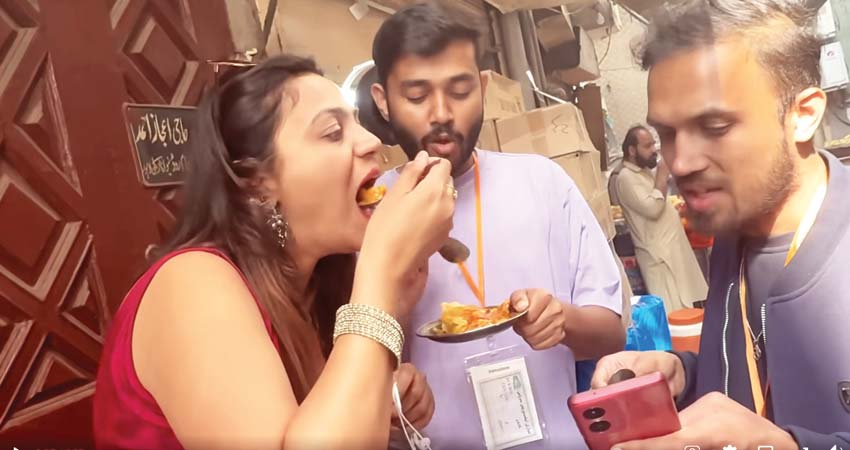
This was narrative warfare. Jyoti’s reels from Lahore’s Anarkali Bazaar, Katas Raj Temple, and street food stalls weren’t just travel content—they were soft propaganda wrapped in lifestyle aesthetics. Her captions praised Pakistani hospitality with phrases like “Ishq Lahore,” “Peaceful vibes,” and “Sufiyana soul in Pakistan.” She often used Urdu couplets, borrowed from local Sufi poetry, and paired them with filtered visuals of ornate mosques and temple steps—an aesthetic designed to provoke nostalgia and cultural relatability rather than caution.
In one video, she declares, "You will fall in love with the peace here," while panning across an empty corridor near Katas Raj. Another clip shows her joyfully sampling street food with the voiceover, "We are not so different." These snippets are not inherently problematic—until placed in context: they were released during peak tensions, directly after incursions and ceasefire violations, subtly countering national sentiment through emotionally disarming language.
With over 377,000 subscribers, she gave adversaries a civilian-coded distribution node—one that slipped past digital censors and resonated with everyday viewers. Her influence was not editorial—it was empathic, precisely why it escaped suspicion. This wasn’t reporting. This was calibrated perception architecture, woven through the language of cultural curiosity and algorithmic relatability. It was psychological tampering with a soft touch.
5. Romance and Recruitment—The Bali Escapade
"She formed an intimate relationship with one Pakistani operative and even travelled with him to Bali." — NDTV
Romance has always been a tool of espionage, but here it became a leash. Malhotra’s relationship wasn’t spontaneous—it bore all the hallmarks of a psychological entrapment sequence common in ISI playbooks. Like in historical Cold War-era ‘Romeo operations,’ the operative used affection to override ideological boundaries and instil a sense of emotional dependency.
The Bali trip, while disguised as a personal getaway, was likely a phase-two loyalty calibration. These foreign excursions often serve multiple functions: isolating the subject from familiar territory, deepening intimacy under controlled conditions, and subtly introducing new expectations. It is during such controlled travels that operatives test willingness to deliver, monitor behavioural reliability, and tighten control. In Malhotra’s case, the Bali engagement is now interpreted as a pivot from emotional grooming to actionable assignment.
She may have believed herself a partner, but she was already under tasking. From affection to assignment, the distance was merely a passport stamp apart.. Malhotra was not coerced—she was conditioned. Operatives like Rahim deploy affection to override ideological safeguards. Bali was not a holiday. It was a loyalty test. It marked her transition from sympathiser to asset. What began as content creation was now calibrated cooperation.

6. Disguised Identities and Encrypted Threads
"She saved their names using fake aliases… She communicated with them through encrypted apps." — OneIndia
These were not random acts of secrecy. Saving names under aliases and using encrypted messaging platforms like Telegram and WhatsApp with disappearing messages indicates operational compliance. This is standard ISI doctrine—minimise traceability, enforce operational security, and fragment information trails.
More crucially, it reflects a clear understanding by Malhotra of the need to shield the nature of her contacts. Saving Rana Shahbaz as “Jatt Randhawa” is more than a nickname—it is a signal that she was aware of scrutiny, and was willing to obstruct it. In the language of espionage, such concealment behaviours often precede operational tasking.
According to cybersecurity researchers, this form of digital masking—aliases, decoy contacts, VPN use—is increasingly employed in civilian espionage, making it more difficult for agencies to pre-empt threats without behavioural surveillance. It’s no longer plausible deniability. It’s structured concealment, adapted to a civilian lifestyle….. Saving names under aliases and using encrypted messaging platforms indicates operational compliance. This is standard ISI doctrine—minimise traceability, enforce operational security, and fragment information trails. It’s no longer plausible deniability. It’s structured concealment.
7. Defence Expo Penetration and Pilgrimage Reconnaissance
"Arman, from Nuh, supplied Indian SIMs, transferred funds, and attended Defence Expo 2025 on Pakistani handlers’ instructions." — OneIndia
"Devinder Singh Dhillon, a Sikh student from Kaithal, was recruited during a Pakistan pilgrimage and is accused of filming Patiala's military cantonment." — OneIndia
Arman and Devinder show how the ring diversified. From telecom espionage to military surveillance, each node had a function. Arman, a logistics runner, infiltrated India’s defence-tech showcase—Defence Expo 2025—posing as a civilian delegate. Events like these have historically drawn foreign attention due to their aggregation of cutting-edge weapons systems, vendor demonstrations, and behind-the-scenes policymaker interactions. Globally, expos such as Eurosatory (France), IDEX (UAE), and Zhuhai Airshow (China) have reported instances of suspicious surveillance activity, particularly by state-linked delegations or freelancers working for rival governments. India itself witnessed prior alerts during DefExpo 2018 in Chennai, where unauthorized photographing and anonymous queries raised alarms.
Devinder, a soft recruit during a religious trip to Pakistan, performed technical reconnaissance by allegedly filming sensitive zones around Patiala's military cantonment. This practice of blending religious tourism with tactical surveillance has been observed in ISI strategies since the early 2000s—most notably in attempts to radicalise or activate Sikh pilgrims visiting Nankana Sahib. By appealing to cultural identity and exploiting emotional vulnerability, these operations camouflage data acquisition under the cover of faith and reconciliation.
This was no isolated incident—it was systemic infiltration using emotional, religious, and nationalistic guises.
8. The Widow Network—Guzala and Nasreena
"Guzala, a 32-year-old widow, was lured into the spy ring… Danish cultivated a romantic relationship with her… Payments were made via PhonePe and Google Pay." — India Today, May 17, 2025
This layer of the network reveals ISI’s psychological calculus: exploit grief, isolation, and financial strain. Guzala’s vulnerability—being a widowed, digitally active woman—was the precise profile used in what counterintelligence officials term 'sentiment-led recruitment.' She was not simply paid—she was emotionally financed. The ₹30,000 total across small tranches was less a bribe and more a behavioural test: loyalty built one transaction at a time.
After establishing rapport with Danish, their conversations were shifted to encrypted platforms like Telegram, reinforcing the covert design of the relationship. When she returned to the Pakistan High Commission with another widow, Banu Nasreena, it signalled not just personal trust—but operational propagation. She had moved from asset to recruiter, knowingly or otherwise.
The widow recruitment cell exposes the terrifying elasticity of modern espionage: where grief becomes gateway, and dependency turns into dissemination.… Danish cultivated a romantic relationship with her… Payments were made via PhonePe and Google Pay.” — India Today
This layer of the network reveals ISI’s psychological calculus: exploit grief, isolation, and financial strain. Guzala’s story mirrors Malhotra’s—with romance as bait, Telegram as the corridor, and small digital payments as behavioural binders. When she returned to the High Commission with another widow, Banu Nasreena, the operation evolved from recruitment to replication.
9. The Pahalgam Massacre and Operation Sindoor
"The arrests come amid heightened India-Pakistan tensions following the April terror attack in Pahalgam… 26 people—primarily Hindu men—were executed. India blames Pakistan-backed groups… and launched ‘Operation Sindoor’ in retaliation." — OneIndia
The timing is not coincidental. As Pakistan-backed militants massacred Indian civilians in Pahalgam, internal ISI assets were likely placed on tactical alert, either to activate pending assignments or to provide disinformation cover. In the weeks prior, several nodes in the espionage network had already shown signs of escalated activity—Jyoti Malhotra’s proximity to military zones, Arman’s access to Defence Expo 2025, and Devinder’s surveillance on Patiala’s cantonment area.
Operation Sindoor was not merely an act of military retaliation. It was a coordinated national response that included targeted airstrikes, cyber shutouts, and counterintelligence arrests. Historically, India has responded to provoked civilian massacres with a multi-domain framework—Balakot post-Pulwama being a critical precedent. But what sets Sindoor apart is that it unfolded alongside an intensified domestic crackdown.
Within hours of the Pahalgam massacre, a high-priority surveillance directive was issued by central intelligence units to unroll digital behaviour maps of potential sleeper assets. What followed was a rolling series of arrests in Hisar, Nuh, Kaithal, and Malerkotla—suggesting that these infiltrators were not dormant—they were synchronised.
Malhotra’s data, Arman’s footage, Devinder’s scouting files—none of it was benign. They were field-ready inputs. They may have been planned to support further incursions or terrorist propaganda cycles. In this sense, Sindoor was not just punitive—it was pre-emptive. As bombs fell on Lashkar hubs across the border, India's surveillance grid deepened across its own soil, marking a clear doctrinal evolution from retaliation to simultaneous internal defence.
10. The Architecture of Infiltration
Each arrest—from Jyoti Malhotra in Hisar to Arman in Nuh—reveals not isolated incidents but a tightly woven lattice of civilian espionage. These were not rogue actors; they were calibrated cogs in a stealth apparatus designed for internal subversion. What emerges is a chilling architecture of infiltration:
• Malhotra: Perception warfare, emotional compromise, and soft infiltration
• Yameen Mohd: Financial channels and visa facilitation networks
• Arman: SIM card provisioning and reconnaissance at defence expos
• Devinder Singh: Surveillance of pilgrim corridors and cantonment areas
• Guzala & Nasreena: Recruitment through emotional entrapment and social vulnerability
Together, they outline a new doctrine of psychological warfare—where national bleeding occurs not through battlefield clashes but through emotional access, financial loopholes, and digital manipulation. In the modern battlespace, espionage no longer wears a uniform; it walks among us, unmonitored and intimate.
11. The Tip of the Iceberg: Five Sub-Fronts of the Internal Half-Front
The Jyoti Malhotra case is not a deviation; it is an aperture into a far deeper crisis. Her movements, once dismissed as personal wanderings, are now decoded by intelligence agencies as markers of an invisible war—a psychological infiltration crafted by hostile states to destabilise India's civil core.
This internal matrix functions across five converging sub-fronts:
1. Perception Warfare: Social media influencers subtly glorify adversarial states while sowing ambiguity about India’s strategic posture.
2. Emotional Entrapment: Romantic grooming is employed by foreign handlers to compromise loyalty and gain sensitive access.
3. Soft-Surveillance Networks: Civilians are deployed as passive observers across expos, pilgrim circuits, and supply nodes to gather low-level but critical information.
4. Logistical & Financial Facilitators: Agents in visa offices and financial hubs manipulate permissions, funds, and IDs to support covert cross-border movements.
5. Vulnerability Recruitment: Isolated youth, widows, and jobseekers are radicalised or seduced into cooperation through fabricated empathy and economic promise.
This architecture must be recognised not merely as a law enforcement challenge, but as a strategic half-front within India’s evolving 2.5 front warfare doctrine. The theatre has shifted—from physical borders to emotional interiors; from military conflict to cognitive subjugation. Arrests are insufficient. What is needed is a national
response mechanism as agile and adaptive as the threat itself.
12. Towards a National Counter-Infiltration Doctrine
To dismantle this embedded espionage network, India must erect a civilian-centric counterintelligence regime. This calls for a layered national doctrine:
1. National Civilian Defence Orientation (NCDO): A mass training initiative for influencers, outbound travellers, and at-risk professionals in digital hygiene, narrative resistance, and psychological awareness.
2. Counter-Narrative Warfare Command (CNWC): A multi-ministerial unit to pre-emptively disrupt foreign propaganda using indigenous storytelling, sentiment-AI tools, and culture-coded information warfare.
3. Hybrid Intelligence Fusion Grid (HIFG): An inter-agency data fusion protocol that integrates telecom, financial, travel, and social media streams to track behavioural flags in real time.
4. Citizen Vetting Protocol (CVP): Mandatory security screenings for civilians engaging with high-risk foreign embassies or travelling to nations flagged for hybrid threats.
5. Digital Cold Start Doctrine (DCSD): A rapid-response policy-driven cyber warfare architecture to dismantle enemy-led influence operations and narrative offensives before they gain domestic traction.
This is no longer a war of tanks and trenches. It is a war of touchpoints—a dinner invite, a private message, a concert ticket. Espionage today flows through romantic proximity, encrypted chats, and cultural diplomacy, quietly converting civilians into vectors of compromise.
Pakistan’s intelligence doctrine has evolved from infiltration to internal infection. The line between civilian and agent is blurred, the weapon is often affection, and the battlefield is the Indian mind. What begins as a soft handshake ends as a hard breach.
The next war will not announce itself with sirens or missiles—it will begin with a like, a chat, and an emotional doorway. And, the References—tells a bigger story. This wasn’t a group of rogue agents. It was a layered, deliberate architecture. Together, they illustrate a terrifying truth: that in today’s battlespace, you don’t need uniforms to bleed a nation—you need unmonitored civilians, digital wallets, and romantic proximity.
1. Economic Times. 23 minutes to avenge 26 deaths: How India’s Akash missiles and suicide drones pounded Pakistani airbases during Operation Sindoor, (2025, May 14). The Economic Times. https://economictimes.indiatimes.com/news/defence/23-minutes-to-avenge-26-deaths-how-indias-akash-missiles-and-suicide-drones-pounded-pakistani-airbases-during-operation-sindoor/articleshow/121167696.cms
2. NDTV News Desk. In own video, proof of 'spy' YouTuber’s ties with Pak official, (2025, May 17). NDTV. https://www.ndtv.com/india-news/jyoti-malhotra-jyoti-rani-travel-with-jo-youtuber-pakistan-high-commission-iftar-in-video-proof-of-spy-youtubers-ties-with-pak-officer-expelled-from-i-8438882
3. OneIndia News. Who is Jyoti Malhotra? YouTuber arrested for spying for Pakistan, (2025, May 17). OneIndia. https://www.oneindia.com/india/who-is-jyoti-malhotra-youtuber-arrested-for-spying-for-pakistan-4156099.html
4. Hindustan Times. Who is Jyoti Malhotra? YouTuber arrested for allegedly spying for Pakistan, (2025, May 18). Hindustan Times. https://www.hindustantimes.com/india-news/who-is-jyoti-malhotra-youtuber-arrested-for-allegedly-spying-for-pakistan-101747476371445.html
5. India Today. Pakistan spy game busted: Women, money used to lure Indian officers, Pak high commission staff involved, (2025, May 17). India Today. https://www.indiatoday.in/mail-today/story/pakistan-spy-racket-women-money-indian-officers-pak-high-commission-staff-348955-2016-10-27
6. The Tribune. Student arrested in Kaithal for spying; Patiala police launch probe, (2025, May 17). The Tribune. https://www.tribuneindia.com/news/patiala/patiala-student-arrested-in-kaithal-for-spying-sharing-sensitive-information-with-pakistan/

By Dr. Padmalochan Dash
(The content of this article reflects the views of writers and contributors, not necessarily those of the publisher and editor. All disputes are subject to the exclusive jurisdiction of competent courts and forums in Delhi/New Delhi only)















Leave Your Comment