


Arun Malhotra
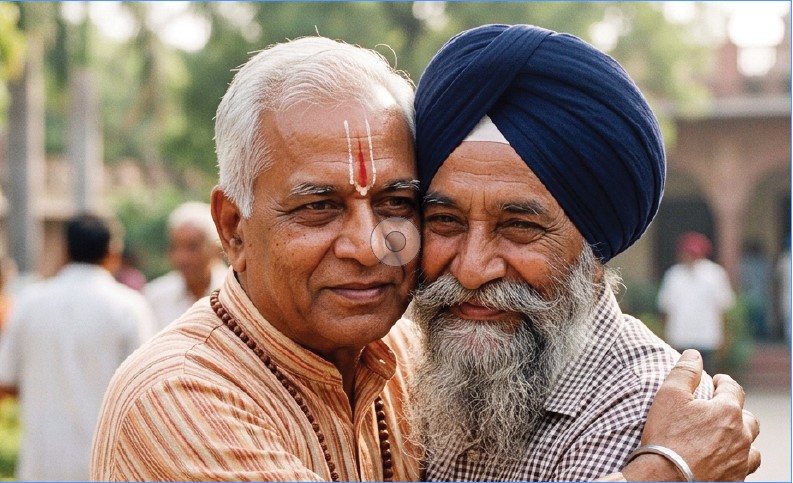
No civilization outside India has managed what Hindus and Sikhs have jointly demonstrated across a millennium on the soil of Punjab. Two distinct religious identities, born of the same land and often the same families. They have successfully outlasted British colonial engineering, withstood Arab, Turkic and Mughal invasions across centuries. And generation after generation, they walk back toward each other the moment tyranny or misgovernance becomes unbearable. It is documented, repeated and it is happening again right now.
Ekam Sat Vipra Bahudha Vadanti (Truth is one, wise ones call it by many names)
The doctrine beneath the history came long before the word ‘secularism’ was coined in a European courtroom. The Rig Veda that emerged from the banks of Punjab rivers, says Ekam Sat Vipra Bahudha Vadanti (Truth is one wise ones call it by many names). That single line is etched into every cell of this civilization's blood. Guru Nanak Sahib gave the doctrine Ik Onkar (Truth is One) and then proved it by examples. When the Qazi Rukan-ud-din found him sleeping with his feet toward the Kaaba and accused him of blasphemy, Guru Sahib's answer dismantled that very geometry, "Turn my feet in a direction where the house of God is not". Every direction the Qazi tried the Kaaba was said to follow. Guru Nanak Sahib proved that God has no Qibla but God is in all directions at the Kaaba.
Guru Arjan Sahib turned that philosophy into architecture. Sri Harmandar Sahib was built with four doors, not one, because the Guru's own words survive, "The low-caste and the high-caste, the Hindu and the Muslim, the rich and the poor, all are equal here". Guru Sahib compiled the Adi Granth as a scripture carrying the verses of Bhagats and Muslim Sufis alongside the Sikh Gurus. Sikhism’s inclusivity codified into eternity built in stone and bound in scripture.
When Tyranny Crossed the Line
Whenever tyranny crosses the line, communities in Punjab talk in a new grammar. They walk towards each other. When Aurangzeb's governor gave Kashmiri Pandits the ultimatum of conversion or death, five hundred Pandits whose ancestors had never once needed Sikh protection, walked the entire distance from Kashmir to Anandpur Sahib asking for protection. Guru Tegh Bahadur did not ask about faith. He walked to Chandni Chowk and gave his own head and martyred himself so that Hindus he had never met could keep theirs. Bhai Mati Das, Bhai Dayala and Bhai Sati Das walked beside him into that same execution ground choosing death over betraying a cause fought to protect the religious freedom of all communities. That demonstrated an exceptional and absolute belief in Ik Omkar.
This is Punjab's answer given four hundred years ago to anyone who says Hindu and Sikh destinies are separable. They are not. They never were.
The Lahore’s Punjab First Letter
When Lahore's citizens could no longer bear the misrule of the Bhangi chieftains, they did not sent three different letters. Hindus, Muslims and Sikhs held one meeting drafted one letter and signed it together across faith lines sending it to a nineteen-year-old Sikh chieftain from Gujranwala, the young Ranjit Singh. Sohan Lal Suri, the Maharaja's own court chronicler records their desperation directly, "the people of Lahore being extremely oppressed, raised their voices of wailing to the skies". The signatories, Mian Ashiq Muhammad, Mufti Muhammad Mukarram, Hakim Rai, Bhai Gurbaksh Singh were not asking a Sikh to rescue his community. They were asking a Punjabi to deliver a Punjabi city.
When Ranjit Singh entered through Lahori Gate, with Sada Kaur entering simultaneously through Delhi Gate, thousands stood on rooftops showering flowers on them. In his kingdom, roughly fifty percent of subjects were Muslim and Sikhs themselves were a minority of about seven percent. Yet Ranjit Singh never weaponized his own faith the way Sunni orthodoxy emperor Aurangzeb and others attempted and failed to do on this very land.
How, the young Maharaja walked towards his Hindu subjects is that in 1803, the 23-year-old Maharaja brought back the sandalwood doors of the Somnath Temple looted eight centuries earlier by Ghazni's raiders. They rest today at Darshini Deori inside the Golden Temple itself. Such is the civilizational understanding between Sikhs and Hindus that a Sikh emperor restoring a Hindu temple's honour and installing it inside Sikhism's holiest shrine. There is no clearer physical monument to Hindu-Sikh oneness anywhere on earth.
A century later, when colonial rule’s pressure threatened north Indian religious life Sikhs and Hindus reformed together not apart. It was Sikh leaders Vikram Singh, Jayamal Singh, Dayal Singh Majithia who personally invited Swami Dayanand Saraswati to Punjab in 1877 and helped plant the Arya Samaj there. Religious separateness in Punjab was substantially a colonial-era invention, not an ancient reality.
The Ghadar Party
When British rule in Punjab and across the diaspora became intolerable, the response was again ‘to organize jointly’. The Ghadar Party, founded in San Francisco in 1913 was built by Sikh migrant workers alongside Hindu and Muslim revolutionaries in common cause Sohan Singh Bhakna, Kartar Singh Sarabha and Lal Har Dayal working beside Bhagwan Singh Gyanee, Abdul Hafiz Mohamed Barakatullah and Rai Nawab Khan. They raised a single flag of red, yellow and green representing freedom, brotherhood and equality deliberately refusing to let religion divide their revolt against a common oppressor.
Pagdi Sambhal Jatta movement
Ajit Singh who led the 1907 Pagdi Sambhal Jatta peasant revolt that forced the British to repeal the Punjab Colonization Bill mandating a retrospective provision that if an allotment holder died without a direct male heir, his land would revert to the colonial government rather than passing to his family.
When Hindu Sikh Legislators Came Together in 1947
Even as the province was being carved apart, Hindu and Sikh political leaders acted as one. On 2 May 1947, weeks before independence, Hindu and Sikh legislators and Constituent Assembly members from Punjab convened jointly under Chaudhary Lehri Singh and passed a unanimous resolution demanding that Punjab's political settlement preserve Sikh integrity as a joint Hindu-Sikh political demand raised in common cause not in competing camps even as the map itself was about to tear.
The First Akali Government Supported by Jana Sangha
The earliest Jana Sangh-Akali Dal cooperation came in April 1952 in PEPSU (Patiala and East Punjab States Union) a separate princely-states union that existed before merging into Punjab in 1956. When a minority Congress government collapsed on its very first day over the Speaker's election, Jana Sangh backed the Akali Dal-led United Front and Gian Singh Rarewala of the Akali Dal became Chief Minister. That became India's first non-Congress government after the first general elections. Jana Sangh held just two MLAs whose support was conditional on party directives from the top.
The BJP-SAD Political Alliance That Started Back Then
Independent India carried this instinct into party politics. Before the BJP existed, the Bharatiya Jana Sangh and Akali Dal discovered their constituencies complemented rather than competed, therefore, even today, one questions keep seeking answer ‘how urban Hindu traders and rural Sikh peasantry unite against Congress’. In 1967, they formed Punjab's first non-Congress coalition government. It was fragile but the logic was lasting. BJP stalwart Balraj Madhok's own thesis held that ‘a real opposition pole needed Hindu and Sikh forces together or it would not exist at all’.
The Historic Meeting of Vajpayee-Badal
Then came 1996. After a decade of militancy that had killed over 50000 people and after 1984's wounds had scarred both communities, Parkash Singh Badal did something quintessentially Punjabi. He walked personally to Atal Bihari Vajpayee's residence and declared unconditional support, no bargaining, no pre-conditions. Vajpayee told him plainly, "You have done me a huge favour by coming here yourself today." From that single gesture grew twenty-four-year alliance Badal called ‘nau-mass-da-rishta’ (of flesh and nail) and which the media rightly described as ‘a symbol of Hindu-Sikh unity and communal harmony forged when Punjab was emerging from decades-long terrorism’. Punjab under that partnership got its first full five-year non-Congress government and something rarer still, proof that 1984's wound need not be inherited as permanent enmity. Later BJP-SAD formed government again in 2007-2012 and an unprecedented 2012-17 consecutive formation of government in Punjab the second time.
This is the unbroken pattern across a thousand years, when tyranny is bearable, Punjab argues within itself. When tyranny becomes absolute, Punjab walks toward itself and all communities the Sikhs and the Hindus walk across every religious line to make a formation to fight the tyranny.
The culture underneath is not Hindu alone nor Sikh alone. It is Punjabi, a frontier civilization that learned at unbearable cost that survival against invaders, empires and misgovernance was never possible inside separate religious camps. The doctrine is tested and proven again and again is to close ranks across faith lines behind whichever leadership delivers justice regardless of that leader's own religion.
Punjab's 2020-21 breakup between SAD and BJP was a policy dispute over farm laws not a religious rupture. That distinction matters. Today, as history repeats again the young Badal has walked towards Prime Minister Modi. Punjab has walked this path before, every single time tyranny crossed the line. The evidence spans a millennium from Anandpur Sahib to Lahore's rooftops to San Francisco's Ghadar headquarters to Delhi.
Bharatiya Jana Sangh(earlier) now Bhartiya Janata Party and the Akali Dal never truly competed against each other, because five centuries of civilizational heritage had already settled that question long before either party was born. Hindu and Sikh Punjab had walked toward each other too many times. It was this deeper fraternity, not electoral convenience, that shaped how constituencies of BJP-SAD evolved. Urban Hindu traders and rural Sikh peasantry growing as complementary halves of one Punjabi political body rather than opposing blocs. Even today, when the two parties attempt to contest against each other, they find they cannot fully separate, because the civilizational bond beneath them keeps pulling their fortunes back into alignment. This is precisely why Parkash Singh Badal went to Vajpyaee to extend unconditional support and also never described the SAD-BJP partnership as mere seat arithmetic. He called it the ‘ideological alliance’ which means that Hindu and Sikh political ambitions in Punjab were never separable.
The only real question now is whether this generation remembers that the doors were always meant to be left open and whether it has the courage to walk through them together. When the party of Sikh identity and the party of Hindu identity choose partnership over separation, they are not simply forming a government, they are re-enacting the core idea of Punjab in the language of contemporary democracy. It is this same civilizational message that Sri Harmandar Sahib proclaims in stone by keeping its four doors open to every direction and every human being.
(The content of this article reflects the views of writer and contributor, not necessarily those of the publisher and editor. All disputes are subject to the exclusive jurisdiction of competent courts and forums in Delhi/New Delhi only)





















Comments (2)
H
Sikh dharam is 350 years old and it's Hindu sect
H
Sikh dharam is 350 years old and it's Hindu sect