


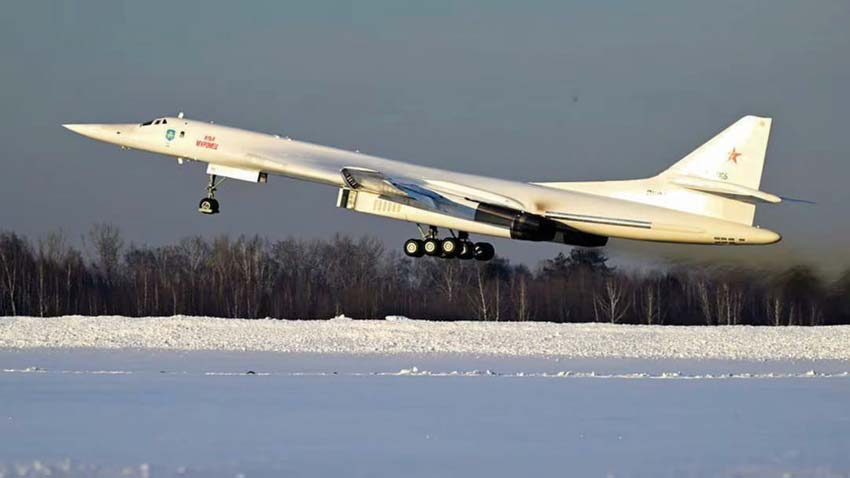
Russia has proposed supplying India with its advanced Tupolev Tu-160M strategic bombers, famously known as the "White Swan." This proposal, if finalized, could significantly boost India’s air power and long-range strike capabilities, aligning with the nation’s aspirations of achieving credible deterrence. As one of the most sophisticated bombers in the world, the Tu-160M stands out for its technological prowess and versatility. A closer look at its capabilities, the specifics of the proposed deal, and the implications for India will provide insights into whether this acquisition aligns with India’s strategic priorities.
The Tu-160M is a formidable asset in modern warfare, recognized as the largest and heaviest supersonic combat aircraft. Its operational range of 12,000 kilometres, coupled with in-flight refuelling capabilities, ensures it can perform intercontinental missions. With a maximum speed of Mach 2.05, the bomber is designed to evade air defence systems while reaching its target efficiently. Its impressive payload capacity of 45 tons allows it to carry a mix of conventional and nuclear munitions, including long-range cruise missiles like the Kh-101 and Kh-102, hypersonic weapons, and precision-guided bombs. The upgraded Tu-160M features state-of-the-art avionics, advanced targeting systems, and electronic warfare suites, enhancing its mission effectiveness. While not a stealth bomber, it incorporates radar-absorbent materials and reduced radar cross-section features to increase survivability.
Russia’s proposal reportedly includes the delivery of 4–6 Tu-160M bombers, potentially forming the nucleus of India’s strategic air command. The deal might also involve technology transfer, enabling India to integrate indigenous systems such as the BrahMos missile onto the platform. In addition to delivering the aircraft, the package could include maintenance support, spare parts, and training programs for Indian Air Force (IAF) personnel. Cost is a critical factor, with each bomber estimated to cost around $250–300 million. While these terms could strengthen India-Russia defence ties, the geopolitical implications of such a deal cannot be overlooked. It could provoke reactions from global powers, particularly the United States, which might view it as a deepening of India-Russia military cooperation amidst rising tensions in global geopolitics.
The strategic implications of acquiring Tu-160M bombers for India would be profound. These bombers would enable India to project power far beyond its borders, providing a credible deterrence against adversaries like China and Pakistan. In the regional context, China’s growing air power, marked by the development of bombers like the H-6K and H-20 stealth platforms, has created a significant asymmetry. The Tu-160M could serve as a counterbalance, ensuring that India retains its strategic edge. Furthermore, such a deal would reinforce India’s independent foreign policy stance, showcasing its ability to engage in high-end defence procurement with global partners without succumbing to external pressures.
However, the acquisition of the Tu-160M comes with challenges. Operating a fleet of these strategic bombers would require India to make substantial investments in infrastructure, personnel training, and logistics. The operational costs of the Tu-160M are notoriously high, given its large fuel consumption and maintenance needs. Additionally, strategic bombers like the Tu-160M require robust support systems, including mid-air refuelling tankers, airborne early warning and control (AEW&C) aircraft, and secure bases. Without these, the bombers’ potential would remain underutilized.
India’s acquisition of the Tu-160M could also raise concerns in its strategic partnerships with the United States and European nations. While India has successfully balanced its relationships with multiple global powers, a deal of this magnitude with Russia might affect ongoing defence collaborations, such as those involving the MQ-9 Reaper drones or the proposed F-21 fighter jets. At the same time, India would need to assess how strategic bombers fit within its nuclear doctrine. Traditionally, India has relied on its triad-based delivery system, emphasizing submarine-launched ballistic missiles (SLBMs) and land-based missile systems. Incorporating strategic bombers would require adjustments in military planning and doctrine.
The debate over whether India should proceed with the acquisition of the Tu-160M revolves around strategic priorities and fiscal prudence. The bombers would undoubtedly enhance India’s air power and deterrence capabilities, complementing its existing assets like the Rafale and Su-30MKI fighters. Additionally, the technology transfer involved could accelerate India’s indigenous defence manufacturing efforts, particularly in the domain of bombers and long-range aircraft. Moreover, possessing such advanced platforms would elevate India’s status as a global military power, enhancing its ability to influence regional and international geopolitics.
However, critics argue that the high operational and procurement costs might outweigh the benefits. India has other pressing defence priorities, such as bolstering its drone capabilities, developing hypersonic missiles, and modernizing its air defence systems. These investments could arguably provide a more significant return in terms of operational readiness and deterrence. Furthermore, introducing strategic bombers into India’s arsenal could heighten tensions with neighbouring countries, potentially triggering an arms race in the region.
In conclusion, the Tu-160M represents a transformative capability that could redefine India’s strategic air power. However, its acquisition must align with India’s long-term defence goals and fiscal realities. If pursued, a limited fleet of Tu-160Ms, complemented by a focus on indigenous production and the development of supporting infrastructure, could provide the best balance between ambition and practicality. Ultimately, the decision should be guided by a clear understanding of India’s strategic needs and its capacity to sustain such a formidable platform.
Uday India Bureau















Leave Your Comment