


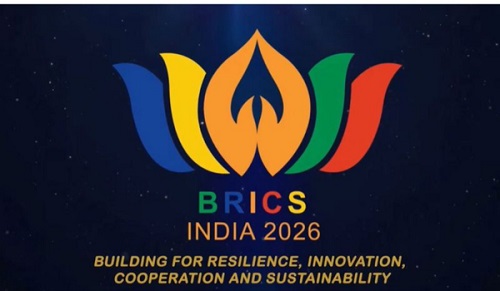
Russia has pledged its active support for India’s chairmanship of the BRICS grouping, endorsing New Delhi’s "modern and highly relevant" agenda with a particular emphasis on counter-terrorism and energy security. The statement, made by Russian Foreign Minister Sergey Lavrov, signals a deepening of strategic coordination between the two long-time partners within the expanding multilateral forum.
In an interview with TV BRICS, Lavrov outlined Russia's alignment with the priorities set by India, which assumed the annual rotating chairmanship on January 1. He described India’s approach as one that "addresses current global challenges while preparing for the future."
A Unified Front on Counter-Terrorism
A central pillar of India’s agenda, and one Lavrov explicitly highlighted, is the fight against terrorism. He pointed to the "persistent threats in the region" as making the issue critically relevant. The Russian Foreign Minister revealed that the two countries are working closely at the United Nations to push for a Comprehensive Convention on International Terrorism (CCIT), a long-standing Indian initiative aimed at creating a global legal framework to combat terrorism.
This joint push underscores a shared perspective on security threats and a desire to shape international norms, positioning BRICS as a platform for non-Western powers to collaborate on defining and addressing global security challenges.
Prioritizing Multifaceted Security
Beyond counter-terrorism, Lavrov underscored the importance of what he termed "security" in interconnected domains:
Food & Energy Security: In a world grappling with volatility in energy markets and supply chain disruptions, this aligns with both India's growing energy needs and Russia's role as a major resource exporter.
ICT (Information and Communication Technology) Security: This reflects concerns over cyber threats and the desire for resilient digital infrastructure, free from perceived external domination.
Collaboration on AI and Safeguarding Sovereignty
Lavrov also highlighted cooperation on the governance of artificial intelligence (AI) as a key area. He stated that BRICS members support "transparency while safeguarding national sovereignty," a clear nod to the group's foundational principle of non-interference and a distinct approach to global tech governance that contrasts with emerging Western-led frameworks.
Analysis: Strengthening the Strategic Axis
Russia’s vocal backing reinforces the India-Russia strategic relationship within the evolving architecture of BRICS. For Russia, aligning with a leading Global South voice like India provides diplomatic ballast amid its tensions with the West. For India, which is also cultivating closer ties with Western nations, securing Russia's support ensures its agenda maintains consensus within the traditionally non-aligned bloc.
The endorsement also comes as BRICS undertakes its most significant expansion, having welcomed new members including Egypt, Ethiopia, Iran, Saudi Arabia, and the UAE in 2024. India’s chairmanship is tasked with integrating these new voices, and Russia’s active support could be instrumental in steering the enlarged group's focus toward issues of traditional and non-traditional security.
As India hosts a series of BRICS meetings throughout the year, culminating in a summit later in 2024, the partnership with Russia will be a critical factor in its efforts to shape the bloc as a cohesive force advocating for a "multipolar" world order.

















.jpg)


Leave Your Comment