


The reshaping of political governance, business, and economy in the face of technological developments within emerging cyber-physical systems in the fourth industrial age had been a key discussion area in the recently concluded national seminar organized by The Manager, UK’s oldest industry chronicle. The emphasis was on the need for skilling, which had to be kept at the forefront in the fourth industrial age. The event took place in the Constitution Club of India on October 5, 2024, with the participation of industry captains, statesmen, lawmakers, leading academicians, lawyers, veteran journalists, diplomats, bureaucrats, and public intellectuals.
Ravi Karan Sahu, Chairman of Madhya Pradesh Oil Ghani Board and Technical Education & Skill Development and Employment Department, affirmed the need for economic self-reliance. ‘’ This can create the ability of a nation or community to support its own economic needs without depending excessively on external sources—can play a significant role in creating jobs and skilling the workforce,’’
Dilip H. M Chenoy, former Secretary General of FICCI & CEO of National Skill Development Corporation (NSDC) deliberated on workforce Transformation and new age skilling by adapting to new work models and challenges of reskilling, cross-skilling, and upskilling. ‘’As automation and AI transform industries, businesses are investing in reskilling and upskilling their workforce to adapt to new roles that require digital proficiency and critical thinking. Lifelong learning has become a key component of workforce management in the fourth industrial age.’’
Sudhanshu Mittal, President of Kho Kho Federation of India, pointed out how sports had evolved beyond entertainment to become a major driver of economic growth, innovation, and business opportunities. ‘’The sports industry is one of the fastest-growing sectors, encompassing not only live events but also a range of sub-sectors like broadcasting, merchandising, sponsorships, digital platforms, and more.’’
Dr. P. R Datta, Executive Chair, Centre for Business and Economic Research (CBER), UK and Editor JBRMR (Journal of Business and Retail Management Research focused on ‘’Customer-Centricity and Hyper-Personalization in the Delivery of Products and Services in the Industrial Revolution 4.0.‘’ ‘’Businesses are increasingly moving toward platform-based models, where they act as intermediaries that connect buyers, sellers, and other participants in a value-creating network. Platforms facilitate collaboration, data exchange, and the development of ecosystems around core products or services’’
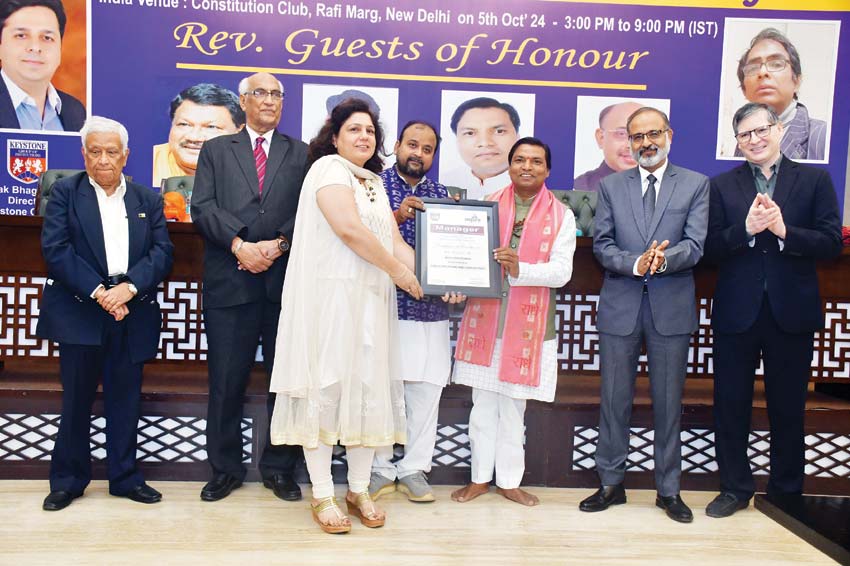
Dilip Cherian, a leading communications & political campaign Advisor and Founder of Perfect Relations (now part of Dentsu Aegis) articulated the evolution of political PR in the fourth industrial age and how strategies are harnessed to technology to influence public opinion, shape narratives, and engage with constituents. ‘’ Today it is all about microtargeting and perersonalization, with access to vast amounts of data, political campaigns can now microtarget specific voter segments with personalized messages. This involves using data analytics to understand voter behavior, preferences, and concerns, allowing campaigns to tailor their messaging to resonate with specific groups, whether based on demographics, geography, or even individual voter history. Political PR now often involves the strategic use of memes, hashtags, and viral content to shape public discourse. Memetic warfare can influence public opinion subtly and effectively, spreading messages that resonate emotionally or humorously with audiences.’’ S. Venkat Narayan, President, of The Foreign Correspondents' Club of South Asia and former executive of India Today mooted the key point, ‘’Media not only shapes public discourse but also acts as a watchdog, an influencer, and a connector between governments, businesses, and the public.’’
Dr Prakash Nanda, the Secretary of the Foreign Correspondents’ Club and former foreign affairs editor of Times of India spoke on the topic ‘’ How is political governance in India evolving to integrate technology in all aspects, from electronic voting to digital identification systems such as land and health records?’’. ‘’ The political governance must evolve to address new realities related to AI ethics, digital infrastructure, data privacy, cybersecurity, and the ethical implications of emerging technologies like artificial intelligence (AI), digital identification systems, land and health records, and biotechnology.’’
Rakesh Sharma, President of the Indian Newspaper Society (INS) and former Publisher of Hindustan Times, spoke about the new mantras of political governance emphasizing the four pillars of smart governance which include Integration, Interoperability, Collaboration, and Trust. ‘’The concept of smart governance is evolving in response to the complexities and challenges of modern society, driven by digital transformation, global interconnectivity, and changing citizen expectations.’’
Dr Dinesh Tyagi, former Managing Director of CSC e-Governance Services India Ltd, and former secretary of education and finance in the State government, spoke about Digital Governance and Policy Making by adapting to fast-paced technological change. ‘’Governments must develop policies that keep pace with the rapid advancement of technology. This includes updating regulations to address issues such as data privacy, AI ethics, digital platforms, and cybersecurity’’.
Rajesh Mahapatra, founder of Odisha Dialogues and former editor of Press Trust of India, and Chief Content Officer of Hindustan Times, spoke about the crying need for sustaining the social order and how governments need to maintain social cohesion in the face of major disruption because of technology changes. He pointed out the instability in the labor market and changes in wealth distribution due to the influx of new technologies.
Dr Rajat K. Baisya, professor emeritus of Jadavpur University and former Dean of IIT (Delhi) & CEO of Emami Group, spoke on the topic ‘’ Business in the Fourth Industrial Age is being transformed by technologies that blur the lines between the physical, digital, and biological worlds.’’ ‘’ In the fourth industrial age, business is undergoing a profound transformation driven by advanced technologies that are merging the physical, digital, and biological realms, and this convergence is reshaping industries, creating new opportunities, and fundamentally changing how businesses operate, compete, and deliver value.’’
Hiren Raval, CEO, C3S Business School, Barcelona, Spain, and Founder & Director, Paragon Care and Locum Partnership Limited (UK), dwelled on the topic ‘’ Edupreneurship underpins EdTech Innovations, Online Learning Platforms, Gamification and Immersive Experience: The Age of Personalized and Adaptive Learning.’’ Edupreneurship—the fusion of education and entrepreneurship—is gaining prominence in the Fourth Industrial Age as rapid technological advancements and evolving workforce needs create new opportunities and challenges in education. The rise of educational technology (EdTech) is a cornerstone of edupreneurship. From AI-driven adaptive learning platforms to virtual and augmented reality experiences, edupreneurs are leveraging technology to create personalized, engaging, and effective learning experiences. ‘’
Deepak Bhagchandani, director of Keystone Group of Institutions, talked about how skilling in the fourth industrial age through education was an essential theme as humanity witnessed rapid technological advancements, automation, artificial intelligence (AI), robotics, and the rise of the digital economy.
Professor Sarat C Das, editor of Manager, said, ‘’In Industry 4.0, where the integration of advanced technologies like artificial intelligence (AI), big data, robotics, and the Internet of Things (IoT) is reshaping industries, the media sector is undergoing a profound transformation,’’ ‘’To keep pace with these changes and harness the full potential of this digital revolution, skilling and upskilling the workforce is critical. Skilling can empower media professionals to adapt to new tools, platforms, and business models, thereby driving innovation, creativity, and efficiency in the sector.’’
Uday India Bureau

















Leave Your Comment