



AMARTYA SINHA
Global statesman Prime Minister Narendra Modi has completed 12 years in office, establishing himself as India’s longest-serving Prime Minister with uninterrupted terms. His strategic foresight aims for India to emerge both as the world’s third-largest economy and as an undisputed global military superpower during his ongoing third tenure. The establishment of a robust, ultramodern domestic defence industrial base will play an indispensable role in materialising the Prime Minister’s vision of a Viksit Bharat (Developed India) in the coming years.
Recent geopolitical shifts, such as the ongoing tariff frictions with the United States and the triumphs of Operation Sindoor (greatly enabled by cutting-edge indigenous assets like unmanned aerial vehicles and advanced air defence systems), have served as powerful catalysts. They have accelerated the march toward Atmanirbharta (self-reliance) in domestic weaponry, significantly curtailing foreign imports while energising private domestic manufacturers. Furthermore, very bold strategic decisions- most notably Mission Shakti in 2019 and Mission Divyastra in 2024- have paved the way for an unmistakable demonstration of the nation's world-class strategic capabilities.
Boosting Defence Exports
Historically characterised as a prominent arms importer, India has decisively stepped out of its traditional comfort zone to secure a distinguished position among the world's top twenty-five arms-exporting nations. Merely seven to eight years ago, India's defence exports barely touched a modest Rs. 1,000 crore. Today, official figures for the Financial Year 2025–26 reveal that these exports have surged to an unprecedented Rs. 38,424 crore. Concurrently, India’s annual defence production for the same fiscal year is approaching Rs. 1,75,000 crore. Projections indicate that by the fiscal year 2028–29, annual defence production will reach Rs. 3,00,000 crore, with annual exports climbing to Rs. 50,000 crore—an objective in which the private sector has played an absolutely critical role.
While the administration continues to back major industrial conglomerates, it simultaneously incentivises young entrepreneurs and innovators to enter the defence domain via dynamic startups, viewing their participation as a vital cornerstone for long-term sustainability. Recent regulatory overhauls designed to liberalise procurement frameworks, ease payment terms, and relax eligibility criteria for startups were formally adopted during a pivotal Defence Acquisition Council meeting.
To streamline foreign trade, the Department of Defence Production (DDP) issues export authorisations for Munitions List items falling under Category-6 of the Special Chemicals, Organisms, Materials, Equipment, and Technologies (SCOMET) guidelines, strictly adhering to refined Standard Operating Procedures (SOPs). Over the past six years, the catalogue of major exported military hardware has grown remarkably diverse, encompassing:
• Weapon simulators and fire control systems.
• Tear gas launchers and armoured protection vehicles.
• Torpedo loading mechanisms and lightweight torpedoes.
• Alarm monitoring and control systems.
• Night vision monoculars and binoculars.
• Weapon locating radars and coastal surveillance radar systems.
• High-frequency radio communication units.
With sovereign states such as Vietnam, the Philippines, and Armenia actively seeking elite, Indian-manufactured strategic assets- including the BrahMos supersonic cruise missile, the Pinaka multiple rocket launcher system, the Akash surface-to-air missile defense system, and the Tejas light combat aircraft- exports are poised to skyrocket over the next three years. The export of these highly sophisticated aerospace and defence platforms will not only generate substantial revenue but will also profoundly reshape India's geopolitical leverage across the Asia-Pacific region and far beyond. This paradigm shift presents an extraordinarily lucrative opportunity for the Indian private sector to participate in and profit from national statecraft.
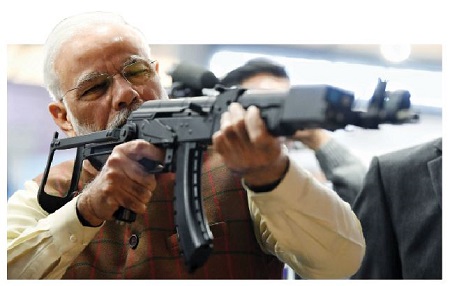
PM Modi during Defence Expo-2020
Increasing defence budget
For the Financial Year 2025–26, an in-principle approval was granted for capital acquisitions exceeding Rs. 2,19,000 crore dedicated entirely to military modernisation. Crucially, 75 percent of this sum (amounting to Rs. 1,39,000 crore) has been strictly reserved for domestic industry players. In the Union Budget 2025–26, the Ministry of Defence was allocated a staggering Rs. 7.85 lakh crore, marking the second-highest budgetary allocation across all union ministries.
Within this framework, the research and development (R&D) allocation designated for the Defence Research and Development Organisation (DRDO) reached an impressive Rs. 29,100.25 crore. The DRDO has increasingly embrace a model of outsourcing R&D, structural design, and precision manufacturing to private Indian corporations. Given the persistent two-front security challenges presented by Pakistan and China, coupled with an increasingly unpredictable political landscape in the United States, a substantial and sustained escalation in capital expenditure within the defence budget is highly anticipated over the next three years.
Focus on Atmanirbharta
A multitude of high-value, indigenous strategic initiatives have been in development since the turn of the millennium. However, they languished for years due to a historic reluctance by previous central governments to aggressively expand capital outlays for military modernisation. The current administration has executed a profound philosophical shift from mere 'Make in India' assembly toward genuine, deep-rooted self-reliance, or Atmanirbharta, recognising that such a transition requires robust, unyielding policy scaffolding.
The institutional groundwork for this transformation commenced with the historic creation of the post of Chief of Defence Staff (CDS) and the subsequent establishment of the Department of Military Affairs (DMA). These structural changes have vastly enhanced jointness, operational synergy, and tri-service coordination. Furthermore, the DMA has been entrusted with the critical responsibility of curating positive indigenisation lists, which explicitly detail the specific products, components, and weapon systems that are permanently barred from future foreign import.
Indigenisation Initiatives
In a series of monumental strides within the domestic manufacturing sector, the Ministry of Defence has notified five positive indigenisation lists for the armed services, spanning 509 distinct items, alongside five complementary lists comprising 5,012 items tailored for Defence Public Sector Undertakings (DPSUs). This ensures that India’s soldiers are equipped with weapons and platforms forged on domestic soil.
The strategic decision to fence off 75 percent of the capital acquisition budget for exclusive procurement from local enterprises is successfully laying the bedrock for a highly resilient domestic defence industrial ecosystem. By launching visionary initiatives like the dedicated Defence Industrial Corridors in Uttar Pradesh and Tamil Nadu, the government ensures that state-of-the-art military hardware is not only conceptualised and manufactured within India but also seamlessly exported to friendly partner nations. The onus now falls squarely upon the Indian private sector to seize this vast potential by multiplying its R&D investments and aggressively scaling up the full-scale manufacturing of aerospace and defence technologies.
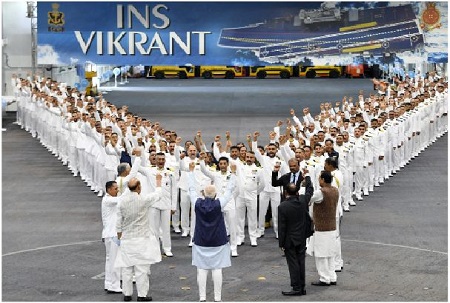
PM Modi during the commissioning ceremony of INS Vikrant
How things are stacking up
In recent years, the Indian private sector has dramatically transitioned from a secondary supporting role to the core driver of national defence production. In the Financial Year 2024–25, private entities accounted for an impressive 23 percent of the total annual production value, contributing Rs. 33,979 crore to India’s aggregate defence production output of Rs. 1,50,590 crore.
While overall national defence production expanded by a healthy 18 percent, the output from the private sector surged by a remarkable 28 percent year-on-year. Furthermore, private firms are actively leading the vanguard of India’s defence exports, generating approximately 60 to 64 percent of the total export value, which crested at Rs. 23,622 crore in the 2024–25 fiscal cycle.
MSMEs and startups
Through the highly successful iDEX (Innovations for Defence Excellence) framework, more than 600 vibrant Indian startups and MSMEs are currently pioneering next-generation military technologies, ranging from advanced artificial intelligence and sophisticated unmanned aerial systems to secure quantum computing networks. Approximately 16,000 MSMEs now constitute the resilient backbone of the domestic defence supply chain, dramatically minimising India's vulnerability to foreign component blockades. Concurrently, premier private firms are cementing strategic partnerships with global Original Equipment Manufacturers (OEMs), facilitating deep technology transfers and the localised manufacturing of highly complex platforms, including advanced fighter aircraft and next-generation submarines.
Teaching Pakistan and China lessons
Among the most defining chapters of the NDA administration's legacy has been its absolute willingness to execute decisive, cross-border military operations. The 2016 surgical strikes executed by the Indian Army deep within Pakistan-occupied Kashmir, alongside the 2019 Balakot airstrikes (codenamed Operation Bandar) conducted by the Indian Air Force, sent shockwaves through adversary networks. More recently, Operation Sindoor- swiftly launched following the Pahalgam terrorist provocation in 2025 effectively shattered the operational backbone of the Pakistani military establishment.
Similarly, the massive, rapid mobilisation of all three wings of the Indian Armed Forces following the high-altitude Galwan Valley clash in 2020 delivered an unambiguous signal to Beijing: any cross-border adventurism or territorial revisionism would be met with overwhelming, lethal force, up to and including a strategic nuclear response. The political leadership in Beijing was left with no illusions that modern India is a far cry from the nation of 1962. It became readily apparent to them that negotiating a diplomatic and military de-escalation was infinitely preferable to a kinetic confrontation with the world's fourth most powerful military force.
Mission Shakti
Conducted on March 27, 2019, Mission Shakti represented India’s inaugural, highly successful anti-satellite (ASAT) missile test. Managed as a deeply classified operation under the codename Project XSV-1, an Indian ground-launched interceptor missile successfully tracked, engaged, and kinetically destroyed a live, fast-moving target satellite positioned in Low Earth Orbit (LEO). The entire sequence- spanning from initial missile ignition and lift-off to high-velocity kinetic impact- concluded in a mere 170 seconds.
With the flawless execution of this mission, India unequivocally established its credentials as an elite global space power, becoming only the fourth nation on Earth to possess an operational ASAT capability, alongside the United States, Russia, and China.
This operational capability introduces an invaluable layer of strategic deterrence, safeguarding India’s rapidly expanding and highly critical space-based assets- including vital communication, navigation, and reconnaissance satellites from hostile interdiction. The mission comprehensively validated a suite of sophisticated, homegrown technologies, including:
• Ultra-high-precision long-range tracking radars.
• Secure, real-time tactical data links.
• Advanced Imaging Infrared (IIR) terminal homing sensors.
• Highly responsive Divert and Attitude Control Systems (DACS).
Prime Minister Narendra Modi personally announced the flawless completion of this historic milestone in a direct address to the nation.
Mission Divyastra
Mission Divyastra stands out as a landmark military milestone under which the DRDO successfully integrated Multiple Independently Targetable Re-entry Vehicle (MIRV) technology into the Agni-5 nuclear-capable intercontinental ballistic missile (ICBM). This achievement marked India’s formal entry into an exceptionally restrictive circle of nations capable of deploying multiple, independently targeted nuclear warheads from a single missile chassis. The maiden trial was executed on March 11, 2024, a breakthrough announced directly to the global community by Prime Minister Narendra Modi. A subsequent, equally successful validation trial of the MIRV-equipped Agni-5 system was conducted on May 8, 2026.
Strategic outlook: The DRDO has already shifted its focus to the conceptualisation and development of the upcoming Agni-6 ICBM. This ambitious, four-stage solid-fuelled missile will be fully capable of delivering a massive 3-tonne nuclear or thermonuclear payload across intercontinental distances up to 12,000 kilometres.
This upcoming weapon system will add yet another remarkable feather to the cap of Prime Minister Narendra Modi’s resolute strategic leadership. Parallel to the Agni-6 development, the highly classified K-5 and K-6 submarine-launched ballistic missiles (SLBMs) are rapidly taking shape to complete India's survivable nuclear triad.
190 nuclear bombs
The landmark 2026 Yearbook released by the prestigious Stockholm International Peace Research Institute (SIPRI) has documented that India has expanded its strategic nuclear stockpile to an estimated 190 warheads, up from the 180 warheads recorded in 2025. Significantly, for the first time during peacetime, India has operationally deployed 12 nuclear warheads, which are believed to be physically integrated with ballistic missiles aboard active Arihant-class nuclear-powered ballistic missile submarines (SSBNs) on deterrent patrols.
While India has formally surpassed the nuclear stockpile of Pakistan (which stands at an estimated 170 warheads), its arsenal remains considerably more compact than that of China, which has grown to approximately 620 warheads. Following the expiration of the New START treaty and amid an accelerating MIRV arms race across Asia, India cannot afford to fall behind in its strategic deterrent capabilities- particularly in the realm of two-stage Hydrogen bombs featuring high explosive yields.
To support this strategic imperative, India’s premier exascale-level supercomputer, Param Shankh, is being brought online, offering the computational power required to simulate complex thermonuclear yields within a controlled laboratory environment. Furthermore, India's Prototype Fast Breeder Reactor (PFBR) at Kalpakkam, Tamil Nadu, is now fully operational, providing the nation with the capability to generate substantial quantities of weapons-grade fissile material. The administration must leverage these significant technological advantages to assemble a robust arsenal of at least 500 nuclear warheads, firmly ignoring the unsolicited counsel of detached pacifist commentators.
Boosting naval capabilities
One of the crowning achievements of the Modi administration has been the sweeping transformation of the Indian Navy from a traditional blue-water force into a modern, technologically superior, network-centric fighting force. On September 2, 2022, Prime Minister Narendra Modi formally commissioned India’s maiden indigenously designed and built aircraft carrier, the INS Vikrant. This massive warship is now fully operational and integrated within active naval fleets.
To equip this prestigious platform, the Indian government has finalised the procurement of 26 state-of-the-art Rafale-M carrier-borne fighter jets from France. Simultaneously, Hindustan Aeronautics Limited (HAL) is actively advancing the development of the indigenous Twin-Engine Deck-Based Fighter (TEDBF) for future deployment aboard Indian carriers.
In the undersea domain, three of the four planned Arihant-class nuclear submarines- namely INS Arihant, INS Arighaat, and INS Aridhaman have been formally commissioned into active service. The fourth boat in this class- INS Arisudan, is currently undergoing advanced sea trials, while the design and construction of the significantly larger, next-generation S5-class of nuclear-powered ballistic missile submarines are moving forward at a steady pace.
The nation is in right hands
With a decisive, resolute administration led by global statesman Prime Minister Narendra Modi at the helm, India's military-industrial complex continues to scale unprecedented heights of excellence each year. Attracting direct private investment into the national defence industrial base was an elusive challenge under the notably inefficient, vision-deficient tenures of the erstwhile Congress-led UPA governments. However, in just 12 years of governance, the BJP-led NDA administration has conclusively demonstrated that when clear policies are paired with unwavering nationalist commitment and transparent intent, every structural hurdle can be completely dismantled.
Through a transformative style of governance that sets a global benchmark for leadership excellence, Narendra Modi is poised to solidify his mandate as Prime Minister of India heading into 2029. This legacy is being earned not merely through success at the electronic voting machines, but by winning the trust and hearts of over a billion patriotic citizens. Today, more than a billion Indians stand proud, confident, and deeply fortunate to witness this profound national renaissance unfold within their lifetimes. This historic chapter of revival will undoubtedly be recorded in golden letters, to be revered and studied by many generations to come.
(The content of this article reflects the views of writer and contributor, not necessarily those of the publisher and editor. All disputes are subject to the exclusive jurisdiction of competent courts and forums in Delhi/New Delhi only)





















Leave Your Comment