


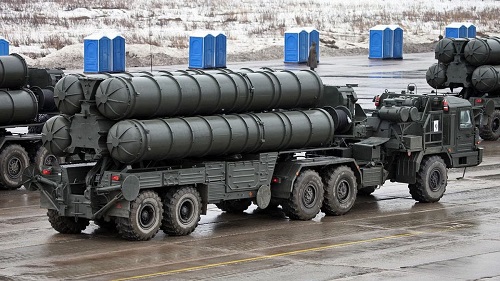
In a significant move to replenish critical war-fighting stocks and bolster the country’s aerial defence architecture, the Defence Acquisition Council (DAC) has cleared the Acceptance of Necessity (AoN) for the purchase of 288 S-400 surface-to-air missiles from Russia. The acquisition, valued at approximately ₹10,000 crore, comes months after the systems were extensively battle-proven during Operation Sindoor in May 2025.
be processed through the Fast Track Procedure (FTP), a mechanism reserved for urgent operational requirements.
Replenishment After Operation Sindoor
The decision to replenish the S-400 arsenal was deemed critical following the high-intensity utilisation of the systems during last year’s cross-border operations. Uday India had first reported in November 2025 that the government was preparing to acquire these missiles to replenish expended inventory and to stock additional long-range and short-range surface-to-air delivery systems.
The S-400 ‘Triumf’ system, capable of engaging aerial targets at ranges of 400 km, 200 km, 150 km, and 40 km, played a starring role in the conflict. Indian Air Force (IAF) batteries deployed in the Adampur and Bhuj sectors successfully engaged Pakistani fighter aircraft, early warning platforms, and swarms of armed drones.
In a landmark strike, India utilized the system’s extended reach to hit a wide-bodied Pakistani aircraft inside Punjab province at a distance of 314 kilometres. The strike reportedly forced Rawalpindi to strategically redeploy the bulk of its operational assets to airbases closer to the Afghan and Iranian borders, effectively clearing the skies of Pakistani retaliation on May 9 and 10.
Expanding the Fleet
While India is already in the process of receiving the final tranche of the original five-regiment deal with Russia—with two more systems scheduled for delivery in June and November this year—the IAF is simultaneously building a case for the acquisition of five additional S-400 systems.
Complementing this long-range umbrella, the Air Force is also pushing for the Pantsir short-range air defence system. Together, the S-400 and Pantsir can be integrated into a formidable two-layer defence grid, specifically designed to counter the growing threat of armed quadcopters and "kamikaze" loitering munitions fired from across the border.
The Acquisition Chain
The AoN marks the beginning of the formal procurement process. As per standard procedure, the proposal originated as a Statement of Case, was vetted by the Defence Procurement Board (chaired by the Defence Secretary), and has now received the DAC’s in-principle approval. The next stages will involve detailed cost negotiations with the Russian vendor, followed by financial approval from the competent authority and final clearance from the Cabinet Committee on Security (CCS).
A ₹3.60 Lakh Crore Defence Haul
The S-400 replenishment was part of a larger, staggering round of approvals. On Thursday, an official statement confirmed that the DAC had accorded AoN for various proposals worth a cumulative ₹3.60 lakh crore—one of the highest value single-day clearances in recent history.
For the Indian Air Force, the DAC cleared the procurement of Multi-Role Fighter Aircraft (MRFA) , including Rafale fighters and combat missiles. Emphasizing the ‘Make in India’ initiative, the ministry stated that the majority of these fighters will be manufactured domestically. The accompanying combat missiles will significantly enhance the IAF’s deep-strike, stand-off attack capabilities with very high accuracy.
For the Indian Army, the council cleared the procurement of Vibhav anti-tank mines and a major overhaul of Armoured Recovery Vehicles (ARVs), T-72 tanks, and BMP-II Infantry Combat Vehicles.
For the Indian Navy, approvals were granted for 04 MW Marine Gas Turbine-based Electric Power Generators and additional P-8I Long Range Maritime Reconnaissance aircraft.
Strategic Implications
The urgency behind the S-400 missile replenishment underscores a shift in India’s defence strategy from mere deterrence to proactive sustainability. By restocking missiles under the FTP, New Delhi is signalling its intent to maintain a high tempo of operational readiness along the Western Front, ensuring that the air defence batteries remain "teeth" even after a short, sharp conflict.
With Russia remaining a steady supplier despite global geopolitical churn, and with indigenous content increasing in parallel fighter deals, India continues to balance its legacy military partnerships with its domestic manufacturing ambitions.





















Leave Your Comment