


Defence Minister Rajnath Singh has called for stronger collaboration between the armed forces, DRDO and industry to make India genuinely self-reliant in defence. Addressing VIMARSH 2026 in New Delhi, Singh stressed that closer dialogue, co-development and co-production are essential to speed up technology adoption, expand domestic manufacturing and reduce dependence on foreign defence imports.
India’s journey towards self-reliance in defence is entering a decisive phase, with the government seeking to bring the armed forces, research institutions, established manufacturers, MSMEs and startups onto a common platform. Defence Minister Rajnath Singh has emphasised that technological capability alone cannot deliver defence self-reliance unless it is supported by seamless cooperation between those who develop military technologies and those who manufacture and deploy them.
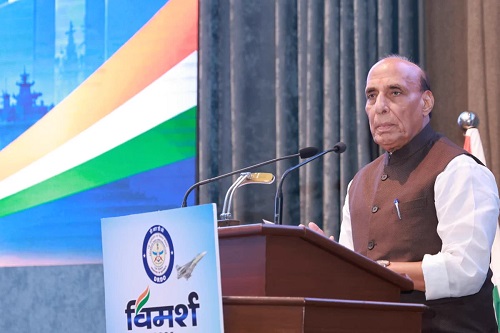
Addressing the DRDO-Industry Synergy Meet, ‘VIMARSH 2026’, in New Delhi, Singh called for greater dialogue, co-development and co-production among the Defence Forces, research and development institutions and industry. He said such collaboration would be critical for accelerating the adoption of emerging technologies while simultaneously strengthening India’s domestic defence manufacturing ecosystem.
The Defence Minister highlighted the wide-ranging capabilities developed by the Defence Research and Development Organisation (DRDO), pointing out that its achievements now span several strategically important areas. From missiles and radars to combat aircraft and submarines, and from electronic warfare systems to Artificial Intelligence, DRDO has built capabilities across a broad spectrum of modern warfare.
The significance of this technological base lies in its potential to reduce India's dependence on imported defence equipment. Modern warfare is increasingly technology-driven, and nations that possess the ability to design, develop and manufacture critical military systems domestically enjoy greater strategic autonomy. For India, therefore, Atmanirbharta in defence is not merely an industrial objective but an important component of national security.
RM Singh underlined that the reforms undertaken in the defence sector during the past few years have been unprecedented. Several initiatives have sought to change the traditional structure of defence procurement and open greater opportunities for domestic companies and innovators.
Among the important measures cited by the Defence Minister were the Positive Indigenisation Lists, Make in India, the Innovations for Defence Excellence (iDEX) programme and ADITI. The decision to earmark 25 per cent of the defence research and development budget for the private sector has also created a significant opportunity for companies outside the traditional government-controlled defence research ecosystem.
These reforms reflect a broader shift in India's defence strategy—from being primarily an importer of military platforms and technologies to becoming a developer and manufacturer of sophisticated defence systems. The objective is to build an ecosystem in which domestic companies can participate not only as suppliers but also as technology developers, system integrators and exporters.
MSMEs are expected to play a particularly important role in this transformation. Describing them as the backbone of the Indian economy, RM Singh stressed their contribution to defence manufacturing through components, sub-systems and essential services. Although they may not always produce complete weapons platforms, their role in creating specialised technologies and critical supply chains can have a major impact on the strength and resilience of the larger defence industry.
However, the Defence Minister also cautioned that greater opportunities bring greater responsibilities. MSMEs must continuously improve quality, ensure timely delivery, promote innovation and meet global standards. He also encouraged them to establish stronger partnerships with large companies so that their capabilities can be integrated into wider defence production networks.






















Leave Your Comment