


At a time when Parliament was in session, the Leader of the Opposition once again chose to leave the country. Rahul Gandhi’s sudden departure for Germany, away from the constitutional responsibility of representing voters inside Parliament, would by itself invite scrutiny. What makes this trip far more troubling, however, is not merely his absence, but the pattern of individuals and institutions he is meeting—and the ideological ecosystem they belong to.
The first name that stands out is Dr. Daniela Schwarzer, who served as Executive Director for Europe and Eurasia at the Open Society Foundations (OSF) between 2021 and 2023. Prior to that, she headed the German Council on Foreign Relations (DGAP), an institution that has received more than €250,000 annually in funding from OSF. Open Society Foundations, founded by George Soros, is no stranger to controversy in India, given the government’s repeated concerns about foreign-funded influence operations targeting domestic political discourse.
Another key figure in Rahul Gandhi’s itinerary is Dr. Thorsten Benner of the Global Public Policy Institute (GPPI). GPPI has openly acknowledged receiving continuous funding from Open Society Foundations between 2014 and 2021. Beyond funding, the institute’s published positions on India are revealing. In 2019, GPPI criticized Prime Minister Narendra Modi’s response to the Pulwama terror attack, calling it “politicized for elections.” In 2025, it went further, describing India’s Kashmir policy as a “government failure in prevention.” These are not neutral academic assessments; they align closely with international narratives that delegitimize India’s sovereign security decisions.
Dr. Benner’s affiliations extend further. He is part of the German Marshall Fund’s expert panel. The GMF advisory ecosystem includes former CIA officials and figures such as Michael McFaul, the former U.S. Ambassador to Russia. Notably, McFaul hosted Rahul Gandhi at Stanford University in May 2023, suggesting a recurring network rather than isolated interactions.
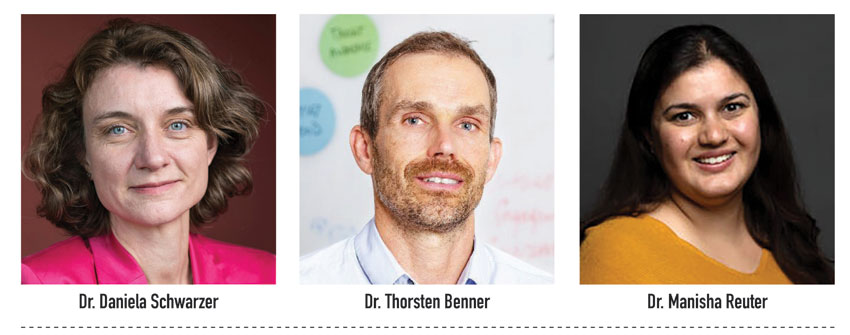
The third major name is Dr. Manisha Reuter of the European Council on Foreign Relations (ECFR). ECFR receives funding from entities such as Open Society Foundations, the European Climate Foundation, and the Children’s Investment Fund Foundation—organisations that have been banned by India’s Ministry of Home Affairs. More concerning is the ideological lineage associated with some of these funding networks. Successor groups linked to Pakistani advocacy organisations within this ecosystem have publicly described Kashmir as an “occupation,” opposed the abrogation of Article 370, and supported “self-determination including secession.”
This ideological alignment is not accidental. The Progressive Alliance ecosystem, which includes bodies such as the Center for American Progress, the Foundation for European Progressive Studies, and the National Democratic Institute, has long-standing financial and operational links with Open Society Foundations. These platforms have consistently amplified narratives critical of India’s constitutional framework, internal security policies, and democratic institutions.
Rahul Gandhi’s meetings are not limited to think tanks alone. Lars Klingbeil, Germany’s Vice Chancellor and Chair of the Social Democratic Party (SPD), is also on the list. Klingbeil has actively participated in CPC–SPD strategic dialogues with the Chinese Communist Party in September 2024 and November 2025, and met Chinese Premier Li Qiang in June 2023. Against this backdrop, his engagement with Rahul Gandhi raises uncomfortable questions about parallel political channels operating beyond India’s democratic oversight.
Further, the Friedrich-Ebert-Stiftung (FES), which officially lists Open Society Foundations as a partner, published a 2022 report equating “cow vigilantism in Modi’s India” with authoritarian regimes elsewhere. Two FES representatives are reportedly part of Rahul Gandhi’s meetings. Similarly, the Heinrich-Böll-Stiftung (HBS) has framed the Citizenship Amendment Act as part of a “Hindu Rashtra agenda undermining secular democracy” and partners with Harsh Mander’s Centre for Equity Studies, whose FCRA registration was suspended by India’s Ministry of Home Affairs. One HBS representative is also scheduled to participate.
The pattern is unmistakable. Every engagement involves either Open Society–funded organisations, institutions linked to entities banned in India, individuals who have published hostile narratives on Kashmir and India’s democratic structure, or political actors maintaining active party-level channels with the Chinese Communist Party.
Even the educational spaces are part of this ecosystem. Rahul Gandhi is scheduled to visit the Hertie School of Governance, which joined the Open Society University Network in 2021—an initiative founded and operated by OSF. This suggests a comprehensive ideological environment rather than coincidental academic outreach.
The most serious question, therefore, is not whether Rahul Gandhi has the right to travel abroad. It is whether the Leader of the Opposition should repeatedly abandon Parliament during critical sessions to engage with a tightly interconnected foreign network that has consistently questioned India’s sovereignty, security decisions, and constitutional order. In a democracy, dissent is legitimate. But when dissent is internationalised through forums and funders hostile to the nation’s core interests, it ceases to be mere opposition and enters the realm of strategic concern.
For a country that has fought hard to safeguard its sovereignty, such associations demand explanation—not silence.
UDAY INDIA BUREAU














Leave Your Comment