


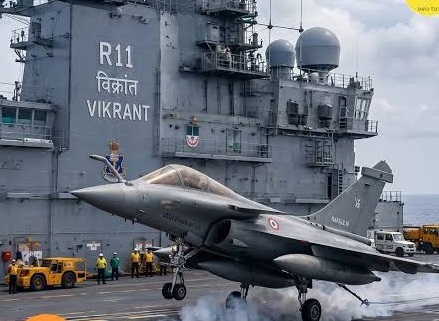
India’s efforts to strengthen its maritime defence have reached an important stage, with trials of the Rafale-M naval fighter underway aboard the indigenous aircraft carrier INS Vikrant in Goa. The tests will assess the aircraft’s ability to operate from a carrier deck, a critical requirement before its induction into the Indian Navy. The acquisition of 26 French-made fighters is expected to enhance carrier-based combat operations, strengthen maritime air defence and expand India’s operational reach across the strategically important Indian Ocean region.
The Indian Navy’s ongoing trials of the Rafale-Marine (Rafale-M) fighter aboard INS Vikrant in Goa mark a significant step towards modernising India’s carrier-based aviation capabilities. The tests are intended to evaluate the aircraft’s take-off and landing performance under aircraft carrier operating conditions, an essential stage in preparing it for deployment from Indian naval platforms. The development also highlights the growing importance of carrier-borne fighter aircraft in safeguarding India’s maritime interests amid intensifying strategic competition across the Indo-Pacific.
India signed an agreement with France on April 28, 2025, worth approximately ₹63,000 crore for the procurement of 26 Rafale-M aircraft. The package comprises 22 single-seat combat aircraft and four twin-seat trainer aircraft, with deliveries expected to begin according to the agreed schedule and be completed around the end of the decade. The new fighters are intended to operate from INS Vikrant and INS Vikramaditya, giving the Navy a modern combat aviation platform suited to a range of maritime missions.
Manufactured by France’s Dassault Aviation, the Rafale-M is a twin-engine, multirole fighter designed specifically for carrier operations. Its reinforced airframe, strengthened landing gear and arrestor hook enable it to withstand the demanding conditions of carrier take-offs and arrested landings. These features distinguish naval fighters from their land-based counterparts, as operations from a moving flight deck require specialised engineering, precise handling and rigorous pilot training. The ongoing trials will therefore be crucial in assessing the aircraft’s compatibility with India’s carrier operating environment.
The Rafale-M’s combat potential is supported by advanced sensors and electronic warfare systems. Its RBE2 active electronically scanned array radar, developed by Thales, enables the detection and tracking of airborne and surface targets. The SPECTRA electronic warfare suite helps identify potential threats and deploy countermeasures, improving survivability in contested environments. Powered by two Safran M88 engines, the aircraft can reach speeds of approximately Mach 1.8 and undertake a variety of air-defence and strike missions.
Its potential weapons capabilities further enhance its operational value. The Rafale family can employ advanced air-to-air missiles, including Meteor and MICA, as well as air-to-surface weapons such as SCALP in suitable configurations. Depending on the weapons authorised, integrated and supplied under the Indian programme, the aircraft could contribute to fleet air defence, maritime strike operations and the protection of naval formations. However, the availability of individual weapons and their operational certification for India’s Rafale-M fleet will be important factors in determining its actual combat role.
The aircraft’s aerial refuelling capability also offers scope for extended missions, while its sensors and networked systems can support coordination with other naval assets. These capabilities could prove valuable in monitoring maritime approaches, protecting sea lines of communication and responding to emerging threats across the Indian Ocean.
The Rafale-M induction, therefore, represents more than a modernisation of the Navy’s fighter fleet. It is an investment in India’s ability to project air power from the sea, protect its maritime interests and strengthen deterrence in a strategically contested region. The success of the ongoing trials will be an important milestone in translating that ambition into operational capability.




















Comments (1)
With radicals taking over France, India needs to be careful for its supplies to its armed forces. In the recent past we have leaned towards France for equipments sourcing required to bolster our military preparedness.