


The foreign ministers of the QUAD nations — India, United States, Australia and Japan — gathered in New Delhi on Tuesday for the high-level Quad Foreign Ministers’ Meeting, reaffirming their commitment to strengthening cooperation in the Indo-Pacific region amid evolving geopolitical and security challenges.
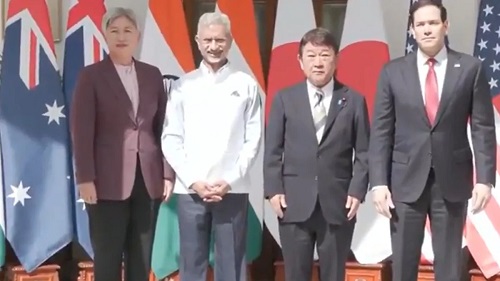
The meeting began with the leaders posing for a symbolic family photograph, reflecting the growing strategic unity among the four democracies. Hosted by India in its capacity as the current chair of the grouping, the summit marks another important step in the Quad’s expanding regional engagement.
India’s External Affairs Minister S. Jaishankar welcomed Australian Foreign Minister Penny Wong, Japanese Foreign Minister Toshimitsu Motegi and US Secretary of State Marco Rubio for the discussions aimed at deepening strategic coordination among the member countries.
The Quad, formally known as the Quadrilateral Security Dialogue, has increasingly emerged as a major strategic coalition in the Indo-Pacific. Initially viewed as a loose diplomatic framework, the grouping has evolved into a significant platform focused on ensuring peace, stability, connectivity and resilience across the region.
The meeting in New Delhi comes nearly a year after the previous Quad Foreign Ministers’ Meeting held in Washington, D.C.. Since then, geopolitical tensions in the Indo-Pacific have continued to intensify, particularly concerning maritime disputes, regional security and supply-chain vulnerabilities.
Over the last few years, the Quad nations have expanded cooperation in multiple sectors, including maritime domain awareness, disaster response, cybersecurity, critical technologies, infrastructure development and healthcare resilience. The grouping has also emphasized the importance of maintaining a free, open and inclusive Indo-Pacific based on international law and respect for sovereignty.
A key focus area of the current discussions is expected to be maritime security cooperation. During the last Quad summit held in Wilmington in 2024, the leaders announced several measures aimed at strengthening maritime coordination and enhancing surveillance capabilities across the Indo-Pacific. The initiatives were designed to address emerging security concerns, protect sea lanes and support regional stability.
Analysts believe the New Delhi meeting assumes greater significance at a time when strategic competition in the Indo-Pacific is rapidly intensifying. The Quad nations are increasingly coordinating their policies to ensure economic security, resilient supply chains and stable maritime routes that are crucial for global trade.
Apart from security cooperation, the ministers are also expected to discuss regional infrastructure projects, emerging technologies, climate resilience and connectivity initiatives. The grouping has repeatedly stressed that its agenda is not directed against any particular country but is intended to support a rules-based international order.
India’s role as the current chair of the Quad highlights New Delhi’s growing diplomatic importance in the Indo-Pacific architecture. Over the years, India has positioned itself as a key player in regional strategic affairs while balancing partnerships with major global powers.
The outcomes of the New Delhi meeting are expected to shape the next phase of Quad cooperation and provide momentum for deeper engagement among the four nations in addressing the challenges confronting the Indo-Pacific region.




















Leave Your Comment