


The violent mob attacks on major media houses in Dhaka particularly the offices of leading newspapers Prothom Alo and The Daily Star amid widening political unrest following the death of student leader Sharif Osman Hadi, signal a deeply troubling turn for Bangladesh. The developments raise concerns that the country may be sliding toward radicalization, potentially influenced by pro-Pakistan and other external actors.
As India marked Vijay Diwas on 16 December commemorating its victory over Pakistan in 1971 and the birth of Bangladesh as an independent nation, Dhaka witnessed scenes of violence just days later. On the night of 18 December, crowds gathered in the Karwan Bazar area and stormed the offices of Prothom Alo and The Daily Star, vandalizing multiple floors, looting equipment, and setting parts of the buildings on fire.
Several journalists were trapped inside for hours. More than 25–30 staff members from The Daily Star were eventually rescued after emergency services and security forces brought the blaze under control in the early hours. The attacks erupted after confirmation of the death of Sharif Osman Hadi, a prominent student leader associated with the 2024–25 protest movement and the so-called “July Uprising” that led to the fall of the Sheikh Hasina government.
Protesters accused sections of the media of biased reporting and alleged alignment with foreign or “anti-Islam” forces, using this narrative to justify direct attacks on news organisations. Eyewitnesses described journalists sheltering in smoke-filled rooms, struggling to breathe as fires burned and mobs raged below, before being evacuated under security escort. Alongside arson and vandalism, individual journalists were reportedly assaulted near protest sites, intensifying fears of targeted violence against media workers.
Former Bangladesh Information Minister Mohammad A. Arafat has indicated that Pakistan’s involvement cannot be dismissed. He stated: “Pro-Pakistan elements are strong now. When we were in power, they wanted change, thinking they would get a better government. But what did they get—extremists?”
Meanwhile, a recent survey titled “National Public Opinion Survey 2025” by a Media Organization indicates growing public anxiety. Nearly half of Bangladesh’s population reportedly feels pessimistic about the country’s future, while slightly more than one-third remains optimistic. As many as 83 per cent believe opportunities for employment or income generation are currently unfavorable, and 77 per cent feel conditions are not conducive to business and trade. The survey suggests that if elections were held in the present situation, the BNP (Bangladesh Nationalist Party) and Jamaat could gain power in the absence of the Awami League. It also indicates widespread public dissatisfaction with the student-led National Citizen Party and the current caretaker government headed by Mohammad Yunus.
The release of this survey is believed to have further inflamed tensions, contributing to protests that escalated into violence. Though the media organization which has released the survey was earlier critical towards the Awami League government too. The attacks are being described as among the most serious assaults on news organisations in Bangladesh in recent years, fitting into a broader pattern of intimidation, killings, and legal pressure on journalists during the ongoing political transition.
In immediate response, Prothom Alo and The Daily Star suspended at least one print edition and curtailed or disrupted online operations, underscoring the chilling effect on independent journalism.
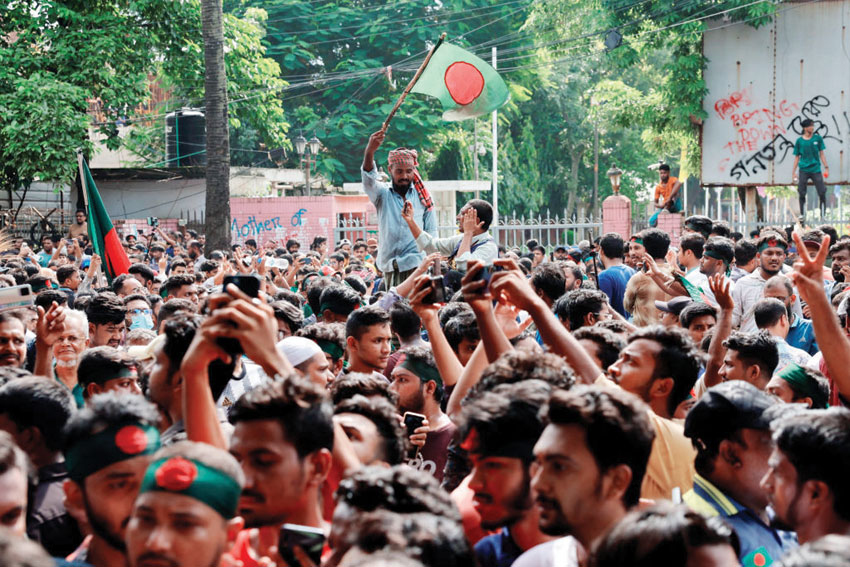
The Media Freedom Coalition in Bangladesh issued a strong joint statement condemning the arson and mob attacks against journalists, editors, and media houses, calling the violence “unacceptable” and a direct assault on press freedom and the public’s right to information.
Amid these developments, India has placed its border with Bangladesh on high alert. A senior Indian Army official from the Eastern Command told Uday India that high-level visits by senior Indian Army delegations to border areas particularly along the Indo-Bangladesh border are significant in light of the evolving situation in Bangladesh.
Senior officials from the Indian Army, Assam Rifles, and the Border Security Force visited forward areas in Tripura’s Belonia sector to assess ground-level preparedness along sensitive border stretches. The delegation, led by Eastern Command Chief Lt Gen R. C. Tiwari, reviewed troop deployments, fencing gaps, and overall vigilance, while also interacting with personnel and commending forces for maintaining alertness amid political turbulence and inflammatory rhetoric from across the border.
These visits are reportedly part of a broader pattern of heightened security reviews and potential new deployments in India’s Northeast, aimed at strengthening India’s posture along vulnerable corridors bordering Bangladesh and Myanmar. Such reviews typically involve assessments of security dynamics, infrastructure, and coordination with state agencies, reflecting an emphasis on integrated border management as unrest and cross-border rhetoric intensify.
Although Bangladesh’s caretaker government has ordered official investigations into those responsible for organizing the attacks including whether Islamist or radical anti-India elements played a coordinating role the outcomes remain uncertain. Whether meaningful security guarantees, emergency protections, or special protocols will be introduced to safeguard journalists and media institutions in Dhaka and other cities remains to be seen. However, the broader role of external actors particularly Pakistan, and possibly Turkey and others in influencing or exacerbating the current instability in Bangladesh cannot be ignored.
By Joydeep Dasgupta
(The content of this article reflects the views of writer and contributor, not necessarily those of the publisher and editor. All disputes are subject to the exclusive jurisdiction of competent courts and forums in Delhi/New Delhi only)














Leave Your Comment