


India’s maritime strength is entering a new phase, driven by indigenous defence production, technological advancement and the growing capabilities of its armed forces. Emphasising the importance of self-reliance in national security, President Droupadi Murmu has said that India is making rapid progress in strengthening its military capabilities and expanding its maritime preparedness. Addressing the Passing Out Parade of Autumn Term 2026 at the Indian Naval Academy in Kannur, Kerala, she called upon the graduating naval officers to remain adaptable, technologically equipped and committed to serving the nation as India moves towards a stronger and more self-reliant defence establishment.
President Droupadi Murmu on Saturday highlighted India's growing military and maritime capabilities, asserting that the country is steadily strengthening its armed forces through indigenous defence manufacturing and technological advancement. She said the increasing number of warships and submarines being designed and constructed in Indian shipyards reflected the country's determination to achieve self-reliance in defence and its growing confidence in domestic engineering, scientific research and industrial expertise.
Addressing the Passing Out Parade of Autumn Term 2026 at the Indian Naval Academy in Kannur, Kerala, the President said India's progress in indigenous defence production was an important step towards building a stronger and more capable military. She observed that the development demonstrated the contribution of Indian engineers, scientists, skilled workers and industries in strengthening national security. The graduating cadets, she said, would become an integral part of this transformation and shoulder the responsibility of advancing India's maritime interests and strategic capabilities.
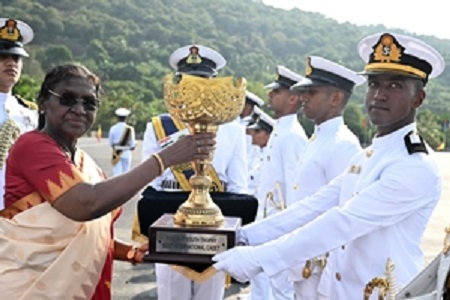
The President took the salute during the ceremonial parade and presented medals to officer trainees who had distinguished themselves through exceptional performance during their training. A total of 427 cadets participated in the parade, including 69 women cadets and 18 trainees from friendly foreign countries, reflecting the academy's growing diversity and its role in developing professional naval officers.
Drawing attention to the rapidly changing international security environment, President Murmu said the world was witnessing unprecedented transformations, with emerging technologies reshaping the character of warfare and maritime security. Modern military operations increasingly demand technological competence, strategic thinking and the ability to respond effectively to evolving challenges. She cautioned that while it was impossible to anticipate every challenge that the future might present, the cadets' rigorous training, adaptability and commitment would equip them to confront difficult situations.
She urged the young officers to maintain a spirit of continuous learning and regularly upgrade their professional knowledge and technical skills. In an era when technological developments are changing the nature of naval operations, professional excellence and the willingness to adapt, she emphasised, would remain essential qualities for officers entrusted with protecting the country's maritime interests.
President Murmu expressed particular happiness over the participation of a large number of women among the graduating cadets. Describing their presence as a matter of pride for the entire nation, she said their achievements demonstrated that determination, courage and competence were not restricted by gender. Their success, she added, would encourage more young women to pursue ambitious careers, accept demanding responsibilities and contribute to national service.
Her message carried significance beyond the ceremonial occasion, reflecting the expanding opportunities available to women in India's defence establishment. Their growing participation in military institutions represents an important development in creating a more inclusive and representative armed forces structure.
The President also congratulated the officer trainees from friendly foreign countries, acknowledging their participation in the academy's training programme. Their presence underlined the Indian Naval Academy's contribution to professional military education and cooperation with friendly nations.
Keralam Governor Om Prakash Mathur, Chief of the Naval Staff Admiral Krishna Swaminathan, Flag Officer Commanding-in-Chief of the Southern Naval Command Vice Admiral Sameer Saxena and Commandant of the Indian Naval Academy Vice Admiral Alok Anand were present at the ceremony.
The passing-out parade marked the culmination of rigorous training for the graduating cadets and the beginning of their professional responsibilities in naval service. President Murmu's address placed their achievement within a larger national objective: building a technologically advanced, self-reliant and combat-ready maritime force capable of safeguarding India's interests in an increasingly complex global security environment.
















Leave Your Comment