


In a significant political development ahead of the special session of Parliament, the Dravida Munnetra Kazhagam (DMK) has decided to support the Centre's proposed Delimitation Bill after the government incorporated provisions addressing the concerns of southern states. The decision, announced by party president MK Stalin following a meeting with DMK MPs, is a major breakthrough in the political negotiations surrounding the legislation. By providing for a uniform 50 per cent increase in parliamentary seats across states and protecting their relative representation for the next 25 years, the revised proposal has addressed the DMK's principal objections. The party's backing could also prove crucial in the government's renewed efforts to implement 33 per cent reservation for women in Parliament and state legislatures.
The DMK's decision represents an important shift in the political arithmetic surrounding the proposed legislation. Delimitation had emerged as a contentious issue between the BJP-led NDA government and several Opposition parties, particularly those representing southern India. The principal concern was that a fresh allocation of parliamentary seats based predominantly on population figures could disadvantage states such as Tamil Nadu, Kerala and other southern states that have made considerable progress in population control. These states feared that their political influence in the Lok Sabha could diminish compared with states experiencing higher population growth.
The revised proposal seeks to address this apprehension by providing for a uniform 50 per cent increase in the number of Lok Sabha seats allocated to every state and Union Territory. It also seeks to preserve the existing proportion of parliamentary representation among states, based on the 1971 Census, for another 25 years, effectively extending the arrangement until 2051.
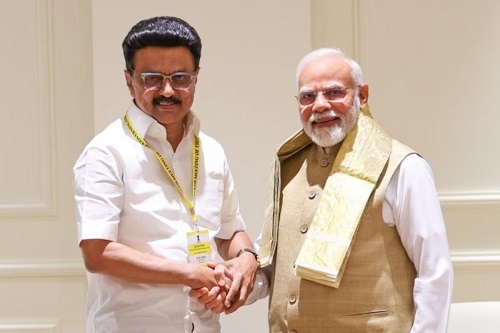
Following the meeting of DMK MPs, party president MK Stalin announced the decision to support the legislation. The development came after the Centre incorporated the party's principal demands into the revised legislative framework. DMK MP Dayanidhi Maran welcomed the government's decision, arguing that the uniform increase in seats had addressed the concerns raised by the party. He said the proposal would also facilitate the implementation of 33 per cent reservation for women, an objective the DMK supports.
For the government, the DMK's backing is politically significant because the constitutional amendment requires a two-thirds majority in both Houses of Parliament. The party's parliamentary strength could therefore become an important factor in securing the necessary numbers for the legislation.
Explaining the party's position, DMK MP A Raja highlighted the importance of protecting Tamil Nadu's existing representation. He referred to the state's 7.18 per cent share in the Lok Sabha and said the party had agreed to the proposed arrangement on the understanding that its interests would remain protected. Under the proposed 50 per cent expansion, Tamil Nadu's Lok Sabha representation is expected to increase from 39 to 59 seats.
Raja also indicated that the DMK leadership had authorised its MPs to pursue any additional amendments considered necessary during the legislative process. He maintained that protecting Tamil Nadu's parliamentary representation had consistently been the party's position, including during its political alliance with the Congress.
The political significance of the DMK's decision extends beyond Tamil Nadu. The delimitation debate has exposed a larger constitutional and federal question: how can India's parliamentary representation reflect changing population patterns without penalising states that have successfully implemented population-control policies? Southern states have repeatedly argued that their developmental achievements should not translate into diminished political influence at the national level.
The revised legislation attempts to strike a balance between these competing considerations. It proposes increasing the maximum strength of the Lok Sabha to 850 members, compared with its present elected strength of 543. The proposed constitutional amendment also provides for an expansion of state legislative assemblies, with their maximum strength rising to 650 members.
The delimitation exercise is closely connected with the government's effort to implement the 33 per cent reservation for women in the Lok Sabha and state legislative assemblies. Although Parliament passed the women's reservation legislation in 2023, its implementation was linked to a future Census and subsequent delimitation exercise. The government is now seeking to accelerate the process through the revised constitutional framework.
The proposed expansion of legislative strength is intended to create additional seats while facilitating the reservation of one-third of the total seats for women. This could significantly increase women's participation in India's legislative institutions and reshape electoral representation across the country.













Leave Your Comment