


With Nitin Nabin at the helm, the BJP finds itself at a familiar yet defining crossroads. The party has mastered the arithmetic of power winning elections, managing majorities, and out manoeuvring opponents with organisational precision. But as Nabin takes charge, the challenge shifts from counting numbers to crafting a legacy. Sustaining electoral dominance is one thing; translating it into lasting institutional strength, inclusive leadership, credible governance, and a coherent loNg-term vision is another. For Nitin Nabin, the real test lies not in short-term victories or tactical alliances, but in shaping a BJP that is remembered not just for how often it won, but for what it ultimately built.
Nehru attempted to do this by propagating the principles of Pancha Sheel, and failed miserably due to misreading the mind of Chinese leadership. Giving away claim to security council seat, Tibet could not save thousands of square kilometres of Indian land from the claws of the dragon. Indian culture and its principles are the only hope against the fractured peace and unity.
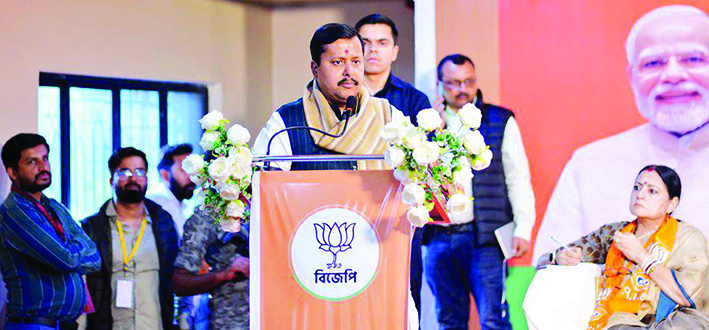
Ideas Over Conquest: Nitin Nabin’s Path to Enduring Legacy
To truly move from power to legacy, the BJP under Nitin Nabin could draw inspiration from Emperor Ashoka, whose influence outlived his reign not because of conquest, but because of ideas. Ashoka transformed authority into a moral and civilisational force, spreading Buddhist values across Asia through diplomacy, dialogue, and symbols rather than domination. In a similar vein, the BJP’s challenge today is not merely to win elections at home, but to project an ideological legacy abroad, especially in Hindu- and Buddhist-majority nations , through soft power, cultural exchange, and ethical statecraft. Ashoka’s legacy endured because it appealed to conscience and culture, not coercion. For the BJP, emulating that model would mean ensuring that its ideology resonates globally as a civilisational vision rooted in harmony, values, and long-term influence , a legacy far harder to build than any electoral majority, but far more enduring.
It is the need of hour in the era of toolkits, deep state and setting the narrative which has kept victimising India, be it Chinese aggression, Tashkent treaty or creation of Bangladesh. Every good gesture has gone haywire. We won the war but lost the negotiations.
The importance of linking the BJP’s future vision to Ashoka’s legacy lies in the shift from short-term power to long-term civilisational influence. Electoral victories, parliamentary numbers, and policy control are transient; they change with time and leadership. What endures is an idea that travels beyond borders and generations. Ashoka remains relevant centuries later not because of the size of his empire, but because he embedded values, tolerance, moral governance, and cultural outreach, into the political imagination of Asia. For the BJP, aspiring to such a legacy elevates its role from a successful political party to a civilisational carrier of ideas, especially in Hindu- and Buddhist-majority regions that share historical and philosophical links with India.
There Are Takers: How India’s Civilisational Vision Can Strengthen Soft Power
This approach also strengthens India’s soft power. Ideological influence rooted in culture, spirituality, and ethical governance creates goodwill that military or economic leverage alone cannot achieve. By invoking Ashoka’s model, the BJP can frame its global outreach not as political export, but as cultural dialogue, one that resonates naturally in societies shaped by Indic traditions. This matters because global leadership in the 21st century is increasingly about narratives, values, and legitimacy. In past 12 years this has been proved beyond doubt during rescue operations in the war zone, saving ships from pirates and supplying vaccine during COVID 19.
For the BJP under Nitin Nabin, drawing from this legacy offers a way to respond to modern global anxieties without adding to them. In a world threatened by jihadist terror that thrives on rigid ideology and perpetual conflict, an Indic civilisational narrative, rooted in pluralism, spiritual humanism, and balance, can serve as a counterweight. Spreading such ideas, especially across Hindu- and Buddhist-majority nations, is not about exporting politics but about offering an alternative worldview that rejects both violent extremism and moral relativism. The importance lies in positioning India, and by extension the BJP’s ideological tradition, as a source of civilisational stability.
Ultimately, what the world needs today is not just power blocs, but ideas that reduce conflict rather than multiply it. By aligning its global vision with Ashoka’s legacy, the BJP can attempt to meet this need, shifting from the language of dominance to that of ethical influence. In doing so, it can aspire to build a legacy that speaks not only to Indian voters, but to a world searching for meaning, restraint, and peace amid chaos.
PM and Home Minister Lead, Nitin Nabin Builds the Party
The BJP faces multiple challenges as it seeks to expand and consolidate its influence across India, from strengthening its weak organisational presence in the South and East to retaining power in strongholds like Assam. Upcoming assembly elections in states such as Tamil Nadu, Kerala, West Bengal, and Puducherry will test the party’s reach beyond traditional bases. While Prime Minister and Home Minister can manage governance, policy delivery, and electoral strategy, addressing economic concerns like inflation, joblessness, and slowing consumption, as well as countering a coordinated opposition and handling controversies affecting public trust, the party president, Nitin Nabin, can focus on building organisational depth. This includes grooming leaders, strengthening the grassroots, bridging regional and cultural differences, and ensuring a unified, resilient party structure capable of sustaining long-term electoral success and ideological influence. Let there be a time that whom so ever win but India remains grounded to its core values.
Power at the Top, Unity at the Core: India’s Missing Force Multiplier.
While the leadership in government has largely succeeded in managing India’s immediate priorities, from economic stability and infrastructure to security and welfare delivery, the scale of global and domestic challenges ahead demands a different kind of support system. What the leadership now needs is a powerhouse of national integration: a cohesive ideological and institutional framework that binds society, reduces internal friction, and frees the government to focus on bigger, long-term challenges. When social cohesion is strong and national purpose is broadly shared, leadership is not constantly pulled into managing internal fault lines. Instead, it gains the strategic space to think globally, respond to emerging threats, and shape India’s role in a turbulent world. In that sense, national integration is not just a moral goal but a strategic necessity, the force multiplier that allows effective leadership to move beyond firefighting and towards legacy-building. A scholar told me once that a tragedy like 11 September could be managed by Rudy Giuliani
the mayor of New York while the national leadership focused on delivering justice by punishing the preparators hiding across the globe.
Building the Second Line: Nitin Nabin’s Test of Organisational Leadership
Under Nitin Nabin’s stewardship, the BJP’s long-term strength will depend on how effectively it grooms its workers and local leaders for higher responsibility. Electoral machinery alone cannot sustain a legacy; it requires a disciplined, ideologically rooted second line that can govern, communicate, and integrate society at the grassroots. Systematic training, political education, and exposure to administration can convert loyal workers into capable leaders, reducing overdependence on a few central figures. Such organisational depth not only strengthens national integration but also frees the top leadership to focus on larger challenges, global outreach, strategic vision, and legacy-building. In preparing tomorrow’s leadership today, Nitin Nabin has the opportunity to turn the BJP from a winning party into an enduring institution.
Preparation is Power: Avoiding Backlash in Reform Implementation”
For reforms to be effective and enduring, the BJP under Nitin Nabin must do its homework well in advance. Policies like the CAA and present adventure of UGC showed that even well-intentioned reforms can trigger large-scale unrest if the ground is not prepared. Smooth implementation requires careful planning, stakeholder consultation, public awareness campaigns, and a robust feedback mechanism from the grassroots. By equipping local leaders and workers to engage communities and anticipate concerns, the party can ensure that reforms strengthen the nation rather than polarise it. Thoughtful groundwork today will allow the government to enact transformative policies with minimal friction, fostering national cohesion while building a legacy of competent, inclusive governance.
Proactive Oversight: Strengthening the Party Against Misadventures
Under Nitin Nabin’s leadership, the BJP can strengthen both governance and credibility by establishing internal investigation mechanisms akin to the ED and CBI, tasked with proactively identifying and addressing potential misadventures within the party or allied institutions. Such a framework would act as an early-warning system, ensuring compliance, integrity, and accountability before issues escalate into scandals or public distrust. By institutionalising vigilance, the party not only safeguards its reputation but also reinforces the rule of law, demonstrating that power is paired with responsibility. This proactive approach ensures that the leadership remains free to focus on larger reforms and nation-building, while internal risks are managed efficiently and transparently.
Guarding against 2024 like debacle, caused by rumours of changing the constitution
A major challenge for the BJP under Nitin Nabin is ensuring discipline in public statements and controlling utterances by party leaders that contradict the party line. In today’s fast-moving media and social landscape, even a single offhand remark can create confusion, invite criticism, or provide ammunition to the opposition. Establishing clear communication protocols, regular briefings, and training for leaders on messaging can help maintain a unified narrative while allowing individual voices to contribute constructively. By strengthening internal coordination and emphasizing responsibility in public discourse, the party can protect its credibility, reinforce its ideological coherence, and ensure that all messaging aligns with broader strategic and governance priorities.
From Cadres to Converts: Nitin Nabin’s Tightrope of Leadership
A key challenge for Nitin Nabin is managing a judicious balance between long-standing loyalists and incoming leaders from other parties. While expansion and alliances bring fresh talent and regional strength, they can also create friction with established workers who have built the party from the grassroots. Strategic integration requires careful placement, clear roles, and recognition of loyalty, ensuring newcomers complement rather than disrupt organisational harmony. By balancing experience with new perspectives, the party can strengthen its institutional depth, maintain internal cohesion, and present a united front, allowing leadership to focus on reforms, national integration, and legacy-building without being bogged down by internal rivalries.
Listening, Learning, Leading: The Next-Gen Governance Model
Looking ahead, the BJP under Nitin Nabin can transform governance by creating real-time feedback loops between voters, party workers, and decision-makers. Advanced data analytics, digital platforms, and structured grassroots consultations can enable the party to translate citizen concerns into proactive, policy-driven solutions. This ensures governance is not just reactive, but anticipatory, addressing emerging challenges before they escalate. By institutionalising such mechanisms, the party can evolve into a smart, citizen-centric organisation where insights from the ground shape strategy, strengthen public trust, and align organisational growth with India’s long-term development and global ambitions.
For the BJP under Nitin Nabin, the path forward demands a vision that goes beyond managing elections year after year. Success is no longer measured solely by victories at the ballot box, but by the party’s ability to build organisational depth, groom future leaders, deliver on governance, maintain message discipline, and project a civilisational vision both domestically and globally. By strengthening national integration, and extending influence into underrepresented regions, the party can transform short-term wins into a lasting legacy of leadership, credibility, and ideological coherence. In a complex and rapidly changing world, Nitin Nabin’s challenge is to ensure that the BJP evolves from an electoral powerhouse into a resilient institution capable of shaping not only India’s future but contributing meaningfully to global discourse, proving that true political success lies in building enduring influence rather than just counting seats. India has done it right from ancient time to a few centuries ago when most of the south east Asian countries were practicing Indian values. Sri Lanka, Thailand, Indonesia, Malaysia, Cambodia, Japan and China still have glimpses of that history.
Time to revive the trend and realise the spirit of ‘Vasudhaiv Kutumbkam’.

(The content of this article reflects the views of writer and contributor, not necessarily those of the publisher and editor. All disputes are subject to the exclusive jurisdiction of competent courts and forums in Delhi/New Delhi only)















Comments (1)
m
Visionary very important analysis