


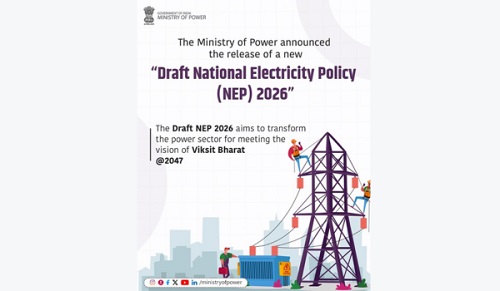
In a significant move aimed at overhauling India’s energy landscape, the Ministry of Power today released the Draft National Electricity Policy (NEP) 2026. The policy is envisioned as a transformative blueprint to modernise the power sector, aligning it with the national vision of ‘Viksit Bharat’ (Developed India) by 2047.
The draft policy sets ambitious targets for per capita electricity consumption, a key indicator of economic development and quality of life. It aims to elevate India’s per capita consumption to 2,000 kilowatt-hours (kWh) by 2030, and more than double it to over 4,000 kWh by 2047. This marks a substantial leap from the 1,460 kWh recorded in 2024-25. Achieving this target will necessitate not only a massive expansion of reliable power supply but also a surge in demand driven by industrial growth, urbanisation, and increased electrification of transport and households.
Crucially, the NEP 2026 is designed to be in harmony with India’s international climate commitments. It explicitly supports the national goal of reducing the emissions intensity of its economy by 45% by 2030 from 2005 levels. This underscores a dual focus: fueling growth through greater electrification while ensuring the transition is environmentally sustainable. The policy is expected to aggressively promote the integration of renewable energy sources, alongside strengthening grid stability and exploring cleaner fossil fuel technologies.
In its official statement, the Power Ministry described the draft as a “comprehensive blueprint for a future‑ready, financially viable and environmentally sustainable power sector.” The core objective is to ensure that all consumers receive reliable, quality power at an affordable price. This involves addressing longstanding challenges such as distribution company (discom) financial health, transmission bottlenecks, and ensuring 24x7 power for all.
Once finalised after stakeholder consultations, the NEP 2026 will replace the existing National Electricity Policy, which was notified in 2005. The 2005 policy laid the groundwork for a competitive market and accelerated generation capacity addition. The new draft reflects the evolved realities of the 21st century: the centrality of renewables, climate imperatives, digitalisation, and the need for consumer-centric services.
Key Focus Areas & Challenges:
Analysts suggest the policy’s success will hinge on several factors:
Massive Investment & Financing: Mobilising capital for generation, transmission, and distribution infrastructure, especially for green energy and grid modernization.
Distribution Sector Reforms: Achieving lasting operational and financial turnaround of state discoms is critical for viability and quality supply.
Grid Integration: Seamlessly managing a grid with an ever-higher share of variable renewable energy (VRE) like solar and wind.
Technology Adoption: Leveraging smart grids, energy storage, demand response, and digital platforms.
Policy Consistency & Implementation: Ensuring coordinated action between the centre, states, and regulatory bodies.
The release of the draft opens the floor for comments from state governments, industry players, experts, and the public. This policy represents India’s strategic roadmap to power its ambitions of becoming a developed nation by 2047, while steadfastly navigating the global imperative of climate action. It sets the stage for the next two decades of transformation in one of the economy’s most vital sectors.



















Leave Your Comment