


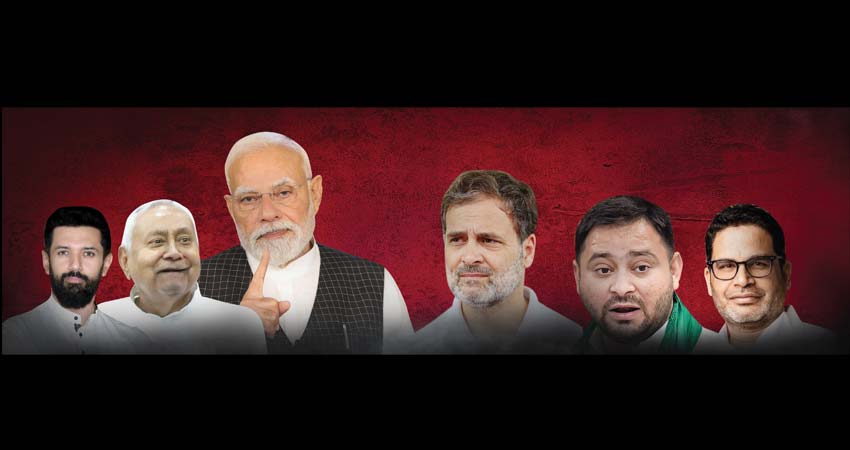
As Bihar prepares for the 2025 Assembly Elections, the political battlefield has become an intense three-way contest among the Bharatiya Janata Party (BJP), the Mahagathbandhan (Grand Alliance) led by the Rashtriya Janata Dal (RJD), and Prashant Kishor’s Jan Suraj Party (JSP)—a relatively new entrant seeking to reshape Bihar’s political culture. Amidst all this, one narrative dominating public discourse is Tejashwi Yadav’s promise of giving government jobs to every family in Bihar—a claim that, while emotionally appealing, is dangerously misleading and economically impractical.
This election is not just about choosing between parties but between populism and performance, rhetoric and reform, and ultimately, truth and illusion.
The Political Landscape: Realignment in Bihar’s Power Equation
The 2025 Bihar election marks a major realignment of state politics. The BJP, after parting ways with Nitish Kumar’s JD(U), is contesting independently, banking on its governance record at the Centre, strong organizational machinery, and the charisma of Prime Minister Narendra Modi. The Mahagathbandhan, consisting primarily of the RJD, Congress, and Left parties, is trying to revive the pre-2014 caste arithmetic that once worked in its favour. Meanwhile, Prashant Kishor’s Jan Suraj Party is attempting to position itself as a “third alternative,” emphasizing clean politics and governance reforms.
However, the real contest seems to be between BJP’s model of development and governance versus RJD’s emotional populism. Tejashwi Yadav, the face of the Mahagathbandhan, has built his campaign on lofty promises—particularly the claim of providing “one government job to every family in Bihar.” While the statement has gained traction among the unemployed youth, a closer examination exposes the hollowness of this claim.
The Reality Check: Bihar’s Employment and Fiscal Condition
Bihar, with a population of over 13 crore, has roughly 2 crore families. The idea of providing one government job per family would translate to around 2 crore government jobs, an astronomical figure by any measure. Currently, Bihar has around 5.5 lakh government employees. Even if we consider vacancies and possible expansions, it is practically impossible for any state government to expand its workforce by 40 times.
Economically, Bihar’s annual budget stands at approximately ₹2.6 lakh crore, of which nearly ₹80,000 crore already goes toward paying salaries and pensions. To accommodate Tejashwi Yadav’s promise, Bihar would require an additional ₹7–8 lakh crore annually, far exceeding its total revenue capacity.
In essence, Tejashwi’s promise is not a vision—it’s a deception, designed to exploit the hopes of unemployed youth for electoral gain.
The Populist Trap: RJD’s Politics of Unrealistic Expectations
Tejashwi Yadav’s campaign style mirrors a populist pattern seen across several states: promise impossible benefits, stir emotional appeal, and then blame others when reality catches up. His narrative that “every family will have a government job” may sound attractive in a state struggling with unemployment, but it lacks both policy coherence and fiscal logic.
Let’s recall his tenure as Deputy Chief Minister from August 2022 to January 2024. During this period, the RJD had full control over key departments, including Road Construction and Health, and partially over the Education Department. Yet, not even 10% of the promised jobs were filled. The RJD-led government announced over 10 lakh government jobs, but the majority remained stuck in administrative limbo or litigation. The result: more press conferences than appointments.
Instead of improving the industrial climate, skill development infrastructure, or private sector investment, RJD reverted to its comfort zone—making populist claims and blaming the Centre for everything. The irony is that the very state which once witnessed the “Jungle Raj” under Lalu Prasad Yadav’s regime now faces the risk of slipping back into the same cycle of emotional politics and economic stagnation.
BJP’s Counter:
Governance Over Gimmicks
In contrast, the BJP has approached the Bihar election with a focus on realistic development metrics. Its campaign, led by senior leaders like Amit Shah and JP Nadda, emphasizes infrastructure, connectivity, law and order, and social welfare delivery—areas where the Modi government’s impact is clearly visible.
Under Modi 2.0, Bihar received unprecedented investment in highways, railways, digital infrastructure, and rural electrification. The PM Awas Yojana, Har Ghar Jal, and Ayushman Bharat have tangibly improved the lives of the poor. Moreover, AIIMS Darbhanga, defence corridor extensions, and the industrial clusters along the Ganga Expressway are expected to boost employment opportunities in the private sector—something far more sustainable than artificial government employment.
The BJP’s core argument is simple: real jobs come from a growing economy, not from election-time promises. Instead of distributing jobs from the state treasury, the focus should be on creating an environment where industries, startups, and MSMEs can flourish—generating employment organically.
The Economic Logic: Why Tejashwi’s Job Promise Collapses
Tejashwi’s claim ignores the fundamental structure of Bihar’s economy. The state’s Gross State Domestic Product (GSDP) is around ₹8.5 lakh crore, contributing only about 3% to India’s GDP. The per capita income in Bihar (₹58,000) is less than one-third of the national average.
Providing government jobs on such a scale would require:
1. Massive increase in administrative expenditure, leading to a collapse in development spending.
2. Sharp rise in fiscal deficit, triggering borrowing from the Centre or financial institutions.
3. Eventual salary delays and economic mismanagement, as seen in states like Punjab or Himachal Pradesh.
Tejashwi’s approach is thus not a welfare model but a recipe for fiscal disaster. It risks transforming Bihar into a state of unfunded liabilities and bureaucratic inflation, rather than economic expansion.
Jan Suraj Party: The X-Factor or a Spoiler?
Prashant Kishor’s Jan Suraj Party has entered the Bihar political theatre as an aspirational alternative. Kishor’s message focuses on systemic change, administrative reform, and grassroots empowerment. While his ground-level “Jan Samvad” campaigns have gained traction among youth and first-time voters, the party still lacks a robust organization or a credible chief ministerial face beyond Kishor himself.
The JSP’s impact, however, could be decisive in fragmenting the anti-BJP vote, particularly among the youth and educated middle class, who might otherwise have tilted towards the RJD. Kishor’s critique of both BJP and RJD as status-quoist forces appeals to an emerging class of Biharis tired of dynastic politics and empty rhetoric.
Yet, whether Kishor can translate this sentiment into votes remains uncertain. As of now, his campaign seems more likely to hurt Tejashwi Yadav’s base than BJP’s.
The Law and Order Question: A Legacy of the Past
Bihar’s progress in the last decade has largely been due to restoration of law and order, an area where RJD’s track record remains its biggest liability. During the Lalu-Rabri years, Bihar was synonymous with kidnapping, extortion, and caste-based violence. While Tejashwi Yadav claims to represent a “new RJD,” his candidate list and political messaging suggest otherwise. The return of old faces linked to criminal cases, caste mobilization, and street-level muscle politics indicates that RJD’s DNA remains unchanged. For voters who remember the “Jungle Raj” era, Tejashwi’s populism might evoke nostalgia among some but fear among many more.
The BJP, in contrast, has successfully built a narrative around security and stability. The argument is simple: only a law-abiding state can attract investment. Without industrial confidence, all talk of employment becomes meaningless.
Caste vs. Development: The Battle of Narratives
Caste politics continues to influence Bihar’s elections, but the Modi era has subtly redefined political loyalties. The non-Yadav OBCs, EBCs, and Dalits, who were once RJD’s core, have increasingly moved towards the BJP due to targeted welfare delivery and direct-benefit transfers.
Tejashwi’s campaign relies heavily on consolidating the Yadav-Muslim (MY) base, but this combination alone is insufficient for a majority. Meanwhile, the BJP’s effort to expand its footprint among Paswans, Kurmis, Kushwahas, and Mahadalits gives it a structural edge.
The Jan Suraj Party, appealing to upper-caste urban youth, might carve out a limited segment, but the larger bipolar contest will revolve around developmental governance vs caste revivalism.
The Verdict: Bihar’s Choice Between Dream and Deception
As the 2025 election unfolds, Bihar’s electorate faces a defining choice. The Mahagathbandhan, led by Tejashwi Yadav, offers dreams unmoored from fiscal reality—a fantasy of overnight transformation through government jobs. In contrast, the BJP’s vision is grounded in gradual, institutional growth, with an emphasis on infrastructure, industry, and inclusive welfare.
While Tejashwi’s promises resonate emotionally, they are economically unsound and politically manipulative. Bihar’s youth need skills, industries, and entrepreneurship, not another generation of dependence on government recruitment drives that never materialize.
In a state that has long suffered from migration, unemployment, and underdevelopment, the road to progress lies not through hollow populism but through honest governance and pragmatic economics.
Tejashwi’s rhetoric may draw crowds, but it fails the test of logic. His claim of a government job for every family is not a policy—it’s a political illusion. Bihar cannot afford another experiment in deception.

By Nilabh Krishna
(The content of this article reflects the views of writer and contributor, not necessarily those of the publisher and editor. All disputes are subject to the exclusive jurisdiction of competent courts and forums in Delhi/New Delhi only)














Leave Your Comment