


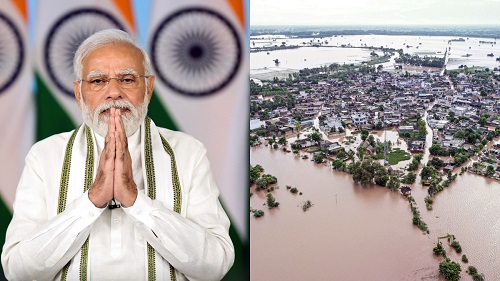
Prime Minister Narendra Modi will visit Punjab on September 9 to take stock of the devastating floods that have wreaked havoc across the state, leaving thousands displaced and vast stretches of farmland submerged. The visit underscores the Centre’s commitment to supporting Punjab in one of its worst natural disasters in recent memory.
n a post on X (formerly Twitter), the BJP’s Punjab unit announced that the Prime Minister will travel to Gurdaspur, one of the worst-affected districts, to meet with flood-hit residents, including farmers, and to directly review relief and rescue efforts.
“Prime Minister Narendra Modi is coming to Gurdaspur, Punjab, on 9th September. He will meet directly with the flood-affected brothers-sisters and farmers to share their sorrow and take every possible step to help the victims,” the BJP post read.
Highlighting the Centre’s solidarity with Punjab, it further stated, “This visit of the Prime Minister proves that the central BJP government always stands with the people of Punjab and will provide full support in this difficult time.”
The visit comes amid a broader assessment of flood-affected regions in northern India. Government sources confirmed that Modi will also visit Jammu and Kashmir, Gujarat, Rajasthan, Himachal Pradesh, and Uttarakhand in the coming days to review the flood situation.
Since June, relentless monsoon rains have triggered flash floods and landslides across the region, claiming more than 500 lives nationwide. Punjab has emerged as one of the worst-affected states, with nearly 1,650 villages across all 23 districts inundated.
Over 1.75 lakh acres of farmland have been submerged, destroying standing paddy crops and leaving thousands of farmers in distress. Key rivers, including the Beas, Satluj, Raavi, and Ghaggar, continue to flow above danger levels, while controlled water releases from Bhakhra, Pong, and Ranjit Sagar dams have added to the crisis.
According to official figures, Gurdaspur alone has witnessed the displacement of around 1.45 lakh people, making it the hardest-hit district, followed by Amritsar, Ferozepur, and Fazilka. Punjab has reported 37 deaths so far, with three people still missing. Since the onset of the monsoon, floods have claimed at least 46 lives in the state.
The Punjab government has ordered the closure of all schools, colleges, and universities until September 7 as relief and rescue operations continue. The Army, Air Force, Border Security Force (BSF), and National Disaster Response Force (NDRF) are engaged in round-the-clock rescue missions.
Thousands remain stranded in inundated homes, while transport networks have been crippled and agriculture—the backbone of Punjab’s economy—has suffered massive losses.
The Indian Meteorological Department has forecast light to moderate rainfall at isolated places in Punjab on Sunday and at a few locations over the next two days. While the rains are not expected to be severe, officials caution that even moderate showers may worsen conditions in waterlogged areas.
Political observers say Modi’s visit to Punjab sends a strong message of solidarity with the state at a time of humanitarian crisis. Punjab, with its vast agrarian base, faces long-term challenges in rehabilitating affected families, restoring damaged infrastructure, and compensating farmers for crop losses.
The Centre is expected to announce additional relief measures following the Prime Minister’s visit, ensuring that both immediate rescue operations and long-term rehabilitation receive full support.



















Leave Your Comment