


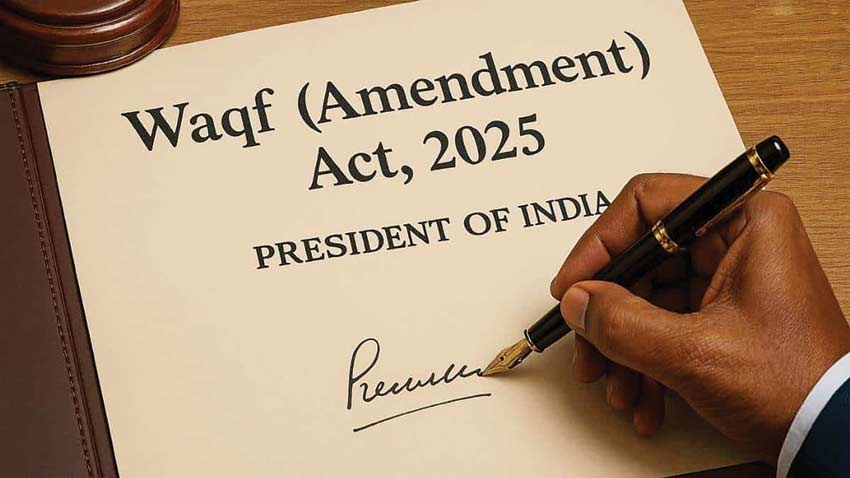
In a significant legislative move that underscores India’s constitutional vision of equality before law, President Draupadi Murmu has given her assent to the Waqf (Amendment) Bill, 2025, marking a landmark reform in the country’s religious endowment governance system. The bill, which was passed by both Houses of Parliament last week, seeks to bring greater transparency, accountability, and uniformity in the administration of Waqf properties. With this assent, the amendment becomes law, signaling a bold stride towards realizing the principle of "One Constitution, One Law for All" — a long-standing aspiration of those advocating for uniformity and legal parity across religious communities in India.
The passage of the Waqf (Amendment) Bill, 2025, witnessed a charged yet historic debate in Parliament. The bill was introduced in the Lok Sabha by the Minister of Minority Affairs, who underscored the need to eliminate arbitrariness and opacity in the functioning of Waqf Boards across the country. After considerable deliberation, it was passed with a decisive majority in the Lower House, with members largely from the ruling coalition supporting the bill. The Rajya Sabha followed suit after a passionate debate on the implications of the reform, eventually passing the bill with minor opposition. The democratic process that led to the bill's enactment is a testament to the legislative resolve to reform outdated laws in line with constitutional values of equality, justice, and non-discrimination.
The Waqf system in India, which governs religious endowments for Islamic purposes, has long operated under a set of laws that were increasingly seen as opaque, outdated, and riddled with inefficiencies. The principal act governing this domain was the Waqf Act of 1995, a legislation meant to regulate the administration of Waqf properties by State Waqf Boards. Over time, however, numerous loopholes emerged. Many Waqf properties were illegally encroached upon or misused. There were instances of poor record-keeping, lack of audits, and absence of public accountability. The autonomous powers granted to Waqf Boards often allowed them to make decisions without adequate oversight, leading to allegations of corruption, favoritism, and misuse of religious trusts. Critics of the system argued that it operated like a parallel legal structure, largely immune from public scrutiny and beyond the reach of common property and administrative laws applicable to other religious or charitable trusts in India.
It was against this backdrop that the need for a comprehensive amendment arose. The Waqf (Amendment) Bill, 2025, thus aims to introduce critical changes to the governance and regulatory framework of Waqf institutions. One of the key reforms introduced in the bill is the abolition of the Waqf Board’s unilateral power to declare any property as Waqf land without notifying or hearing the affected parties. This provision alone addresses decades of grievances from individuals and institutions who claimed their properties were arbitrarily labeled as Waqf land, often without due process or legal recourse. Under the amended law, no property can now be declared as Waqf without prior notification, investigation, and a fair hearing by an independent judicial authority. This change brings Waqf laws in alignment with Article 14 of the Indian Constitution, which guarantees equality before law and equal protection of the laws.
Another crucial amendment is the mandatory digitization and geo-tagging of all Waqf properties. This reform is aimed at plugging the widespread misuse of properties under Waqf and ensuring that they serve the purpose for which they were originally endowed — namely, charitable, religious, and educational activities within the Muslim community. With geo-tagging and mandatory audits, Waqf assets can be better protected from encroachment and embezzlement. Furthermore, these digital records will now be made available in the public domain, thus allowing for greater transparency and citizen oversight.
Critics who feared that the amendment would harm the interests of Muslims have been reassured by various provisions in the bill that actually enhance community participation and benefit. In fact, the reform is expected to empower ordinary Muslims by ensuring that Waqf properties — which run into lakhs of crores in market value — are efficiently used for public good rather than being monopolized by a few individuals with vested interests. Educational institutions, madrasas, orphanages, and health centers run on Waqf funding will now receive more organized and reliable support. The amended law also calls for the inclusion of civil society members, women, and legal experts in the Waqf Board to ensure more representative and professional governance.
This democratization of the Waqf system offers a profound benefit to the Muslim community. For far too long, the Waqf Boards were seen as unaccountable entities serving elite interests. With new provisions aimed at curbing corruption, involving community stakeholders, and ensuring lawful governance, the reforms restore faith in the system. Muslims — especially those from lower socio-economic backgrounds — stand to gain from better education, healthcare, and welfare services if Waqf assets are managed transparently and judiciously.
Most importantly, the Waqf (Amendment) Bill, 2025, reaffirms the idea that no community or religious institution can function outside the framework of the Constitution. India’s constitutional framework guarantees freedom of religion, but it does not allow parallel legal regimes that bypass due process, public accountability, or judicial review. The principle of "One Constitution, One Law" does not mean a dilution of religious rights; rather, it seeks to ensure that all religious institutions — be they temples, churches, gurdwaras, or mosques — function under a unified legal and ethical framework.
This move also opens up the possibility of broader legal reforms in the future. While the Waqf amendment is not about a Uniform Civil Code (UCC) per se, it reflects the same underlying intent — that laws must not be selectively applied based on religion. By ensuring that even Waqf Boards are accountable to the law of the land, the government has taken a critical step toward legal parity. It also sets a precedent for reviewing other religious laws and endowments to ensure that they meet constitutional standards and serve the actual needs of the community.
In conclusion, the Waqf (Amendment) Bill, 2025 is not just about reforming an administrative structure — it is about reaffirming India’s commitment to equality, transparency, and justice for all, regardless of religious identity. It strikes a careful balance between preserving the religious character of Waqf institutions and ensuring that they operate within the constitutional limits. With the President's assent, this amendment has become a powerful symbol of India's progress towards a more unified, accountable, and secular legal system. Muslims, along with other communities, will benefit from a governance structure that is more inclusive, transparent, and just. As India marches forward in its constitutional journey, such reforms lay the foundation for a more equal and integrated society — one law, one Constitution, one nation.
The Legislative Path of the Waqf (Amendment) Bill and the Scope for Political Flexibility
The Waqf (Amendment) Bill, 2025, now signed into law by President Droupadi Murmu, marks a transformative chapter in the administration of religious endowments in India. While the legal text is now binding across the country, the process of actual implementation involves multiple layers of administrative coordination, rule-making, and potential accommodation of concerns raised by political stakeholders — particularly within the ruling National Democratic Alliance (NDA).
How the Waqf (Amendment)
Bill Will Come into Effect
Now that the bill has received presidential assent, it becomes an Act of Parliament, but its enforcement across the country is not instantaneous or automatic in practical terms. Here’s how the process unfolds:
1. Publication in the Gazette: The Ministry of Law and Justice will notify the Act in the official Gazette. This formal publication is essential for it to be considered law in the public domain.
2. Notification of Commencement Date: Although the Act is legally binding upon gazette notification, certain provisions (particularly administrative and procedural ones) often require a separate notification specifying the date on which they will come into force. This gives the government time to prepare the required infrastructure and issue rules under the Act.
3. Framing of Rules: Most Acts require a detailed set of Rules and Guidelines, to be issued by the concerned ministry—in this case, the Ministry of Minority Affairs. These rules will define how the new provisions will operate at the ground level, such as:
Demands for Flexibility from NDA Allies
During the debate in Parliament, some NDA allies and even state-level BJP leaders expressed a desire for greater federal flexibility, particularly with regard to the composition and powers of State Waqf Boards. These demands were rooted in:
A few key allies — such as the JD(U) in Bihar and AIADMK in Tamil Nadu — urged the government to allow state legislatures some discretion in nominating members to the Waqf Boards, particularly to ensure regional and community representation as per local demographics.
Can the Modi Government Still Accommodate These Suggestions?
Yes — but with limits. Here's how:
1. Through Rule-Making Powers: The Modi government can accommodate suggestions without amending the Act itself, by incorporating flexibility in the Rules. For instance, the central rules may specify a range of options or criteria for board composition, allowing states to choose members from civil society, religious scholars, legal experts, or government officials, as long as they meet minimum national standards.
2. Consultative Framework: The Ministry of Minority Affairs can initiate consultative meetings with state Waqf Boards, much like what is done in inter-state council forums. These meetings can inform rule-making, and offer states a say in implementation details without affecting the core of the Act.
3. Model Guidelines vs. Mandated Norms: The central government may issue “model rules” or guidelines, instead of strict mandates, on certain administrative matters. This approach allows states to adopt, adapt, or supplement those rules within a defined constitutional framework.
4. Judicial Deference to States in Implementation: The Act allows the Centre to set the overarching framework, but its execution will depend on state bureaucracies and boards. Hence, the central government may choose not to micro-manage operational aspects, allowing states to interpret and implement provisions in line with local needs, subject to audit and compliance checks.
What the Government Is Unlikely to Compromise On
Despite the possibility of operational flexibility, the Modi government is expected to remain firm on certain non-negotiables, particularly those tied to the constitutional vision of equality and transparency:
These core provisions reflect the Modi government’s broader narrative of "One Nation, One Constitution", and are central to the goal of aligning religious governance structures with the constitutional principles of due process, rule of law, and equal rights.
The Power Trio: How Modi, Shah, and Doval Are Dismantling the Congress-Era Status Quo
In the annals of Indian political history, few combinations have proven as decisive, fearless, and transformative as the trio of Prime Minister Narendra Modi, Home Minister Amit Shah, and National Security Advisor Ajit Doval. Together, they have become the architects of a new political order — one that is fundamentally reshaping the power structures, ideological assumptions, and governance frameworks long held sacrosanct under the Congress-dominated post-independence ecosystem. From the abrogation of Article 370, to the drive for a nationwide National Register of Citizens (NRC), and now the passage of the Waqf (Amendment) Bill, 2025, this power trio is systematically delivering blows to what was once considered untouchable in Indian politics.
The abrogation of Article 370 in August 2019 was perhaps the most audacious political move in decades. For over 70 years, successive Congress governments and their intellectual backers held Article 370 as an untouchable provision, despite its originally “temporary” nature. Modi and Shah shattered this narrative with surgical precision — stripping Jammu and Kashmir of its special status and integrating it constitutionally and administratively with the Indian Union. This move did not just neutralize a legacy of separatism and appeasement, but also delivered a psychological blow to the Congress ecosystem that had long used Kashmir as a political bargaining chip. With NSA Doval playing a critical role in ensuring peace and intelligence-led stability on the ground, the move demonstrated the trio’s ability to pair bold decisions with strategic execution.
The idea of a nationwide NRC — though yet to be fully implemented — represents another shift in the political axis. It challenges decades of vote-bank politics and unchecked illegal immigration, especially in border states like Assam and West Bengal, where Congress and its allies often relied on demographic changes for electoral gains. The Modi-Shah-Doval axis has reframed the conversation around national identity, citizenship, and sovereignty, bringing to the fore issues deliberately kept at bay to avoid “communal” or “divisive” labels. They’ve shown political will where previous governments feared political fallout.
Most recently, the Waqf (Amendment) Bill, 2025, marks another direct strike at the parallel legal and institutional structures nurtured under Congress rule. For decades, the Waqf Boards operated as quasi-sovereign entities — insulated from public scrutiny, legal uniformity, or democratic accountability. By bringing transparency, curbing unilateral powers, and integrating these bodies within the constitutional fold, the Modi government has taken another step toward dismantling religious exceptionalism long protected by the Congress-era secularism model. Again, the role of Doval in pre-legislative consultations and security assessments was key in neutralizing potential backlash.
In essence, the Modi-Shah-Doval trio is doing what was once unthinkable — not just ideologically but administratively. They are challenging entrenched power centers and rewriting the rules of Indian politics. Their actions underscore a bold, unapologetic nationalism that refuses to be bound by legacy appeasement politics, reshaping India’s constitutional and national identity from within. For the Congress ecosystem, this is more than political opposition — it’s a systematic dismantling of its long-standing ideological foundations.

By NILABH KRISHNA
(The content of this article reflects the views of writers and contributors, not necessarily those of the publisher and editor. All disputes are subject to the exclusive jurisdiction of competent courts and forums in Delhi/New Delhi only)















Leave Your Comment