


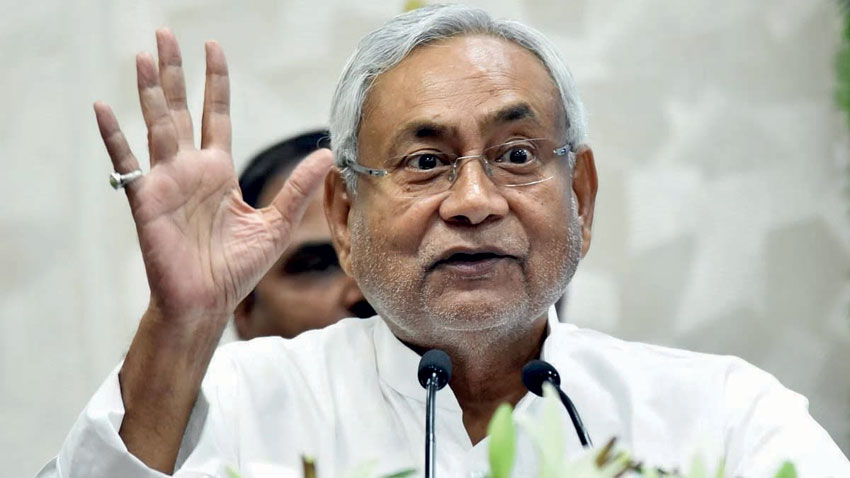
Call him whatever you want, paltu ram or turncoat, Janata Dal (United) chief Nitish Kumar’s latest U-turn of returning to the BJP-led National Democratic Alliance (NDA) in Bihar has completely demolished the opposition's case before the electorate.
His becoming chief minister for the ninth time on January 28 has exposed shenanigans of the anti-Narendra Modi camp in a bid to project an alternative in the run-up to the 2024 Lok Sabha elections. They have nothing in common for the people, except for their antipathy towards the Prime Minister.
Nitish-led JD(U) came to power along with the BJP after the 2020 Assembly election. Nitish left the NDA in August 2022 because he thought the BJP was out to marginalise his party. He blamed the BJP for its poor showing in the 2020 assembly polls. He formed the mahagathbandhan government, along with the RJD, Congress, and Left parties.
Ironically, those who hailed his exit from the NDA and for opposing Prime Minister Narendra Modi are the ones who are most upset with his politics of switching sides to stay on as the CM.
They did not see his act of August 2022 as a violation of the mandate given to the BJP-JD(U) alliance. So long as he was opposed to the BJP, he was a saint!
That's why the opposition's act of crying hoarse won't cut ice-- because everytime he has come to the group he once belonged to, Nitish has been received with open arms.
The fact is Nitish’s about-turn in 2017 betrayed the mandate of 2015. In 2022, he betrayed the mandate of 2020. He has now made yet another turn, this time returning to the BJP-led NDA. Only a few weeks ago, Nitish was considered by the anti-BJP Opposition alliance as a leader who had the potential to be its prime ministerial face. That is why there was the talk of Nitish being made the convenor of the alliance.
Until the moment of his return to its fold, the BJP too had vowed it would never again align with him and the JD(U).
For the BJP, Nitish’s re-entry into the NDA fold is best timed. With Nitish, an electoral victory in Bihar is now easier for BJP.
As an architect of the Bihar caste survey, Nitish is the one who showed that the Opposition’s caste census call and social justice pitch are a serious challenge for the BJP.
Undoubtedly, the BJP is the biggest beneficiary of the realignment in Bihar, while the biggest loser is the Congress. Nitish has shown that, under Rahul Gandhi, it is incapable of leading an alliance, let alone a coalition government at the centre.
After all, Nitish was the one who chaired the first meeting of the Opposition (INDIA) bloc in Patna in June 2023.
His act of joining hands with Modi puts a question mark on the Opposition’s bid to counter Hindutva with social justice and caste consolidation.
Nitish has said his latest switch was “in the interest of Bihar” and in respect to the mandate of 2020 assembly polls. On the other hand, the BJP said that its renewed “alliance with the JD(U) happened for the development of Bihar.”
A miffed Lalu Prasad Yadav's Rashtriya Janata Dal has said, “the game is not over yet” and predicted the JD(U)‘s demise as a party after the parliamentary elections.
However, we need answers for some key questions: Why did Nitish Kumar get so upset with Congress to leave the India alliance and join hands with BJP again?
Why did Nitish suspect Lalu Prasad Yadav is trying to break his Janata Dal(U) to make his son Tejashwi Yadavi as Chief Minister? Why did Nitish choose BJP to go back?
Why was BJP willing to re-embrace Nitish?
Can Lalu Prasad Yadav's RJD split JD(U) on the floor of Bihar assembly?
Will Congress MLAs switch support to Nitish eventually?
Nitish Kumar became the CM for the first time in 2000. At that time, he was against RJD and his campaign was based on opposing Lalu. In 2013, Nitish broke away from the NDA and came with RJD in the 2015 election--because he opposed Narendra Modi as Prime Minister. In 2017, Nitish Kumar severed his ties with the RJD and went back to the NDA. In 2022, Nitish Kumar again deserted the NDA and came back to RJD.
Why do all parties want him? Despite his unreliable track record, there’s a reason Nitish is welcomed back into any alliance he chooses to join.
Nitish is seen as the most influential leader among the most backward castes within the OBCs like Kurmis, Koeris and Kushwahas.
The RJD has support of dominant Yadavs and Muslims whereas the BJP is seen as having support among other castes.
An alliance between Nitish and BJP is seen as a "natural alliance." It brings together support of all castes, except a majority of Yadavs.
The RJD, despite its larger social base of loyal voters and the enduring popularity of Lalu Yadav, lacks Nitish’s credentials of good governance.
It is also true that, even with its massive appeal of Modi, the BJP lacks a leader of stature in Bihar. So, BJP understands the value of Nitish’s vote-bank of extremely backwards castes and beneficiaries of government welfare schemes.
Nitish is a product of the Mandal movement. As CM, he created sub-quotas among OBCs and Dalits who were called “Ati Pichhda” (EBC) and Mahadalits. This was not liked by the dominant Yadavs and Dusadhs (supporters of Paswan).
Recently, Nitish hiked the quotas for all the deprived classes. This, he had hoped would give a boost to his party’s sagging fortunes and also inspire parties in other states, which had joined him to form the opposition bloc INDIA. Nitish has also given importance to “Pasmanda” Muslims, who are being wooed by the BJP too.
Though Nitish was widely regarded as the architect of the opposition front, the Congress and Lalu were not keen on naming him as its convenor. Also, suggestions made by Mamata Banerjee and Arvind Kejriwal for projecting Congress president Mallikarjun Kharge as PM candidate upset him. Moreover, Nitish suspected Lalu was working to divide his party JD(U) so that his son Tejashwi Yadav becomes CM sooner or later.
The buzz was that Nitish was supposed to hand over CM's post to Tejashwi before Holi festival and shift to national politics, ahead of the Lok Sabha polls. Nitish also feared that RJD ministers were out to spoil his reputation as a "clean" CM as they were on to collect funds for the Lok Sabha polls.
Tejashwi, who also lost his deputy chief ministership after Nitish joined hands with the BJP, is under the scanner of the central agencies for acts committed during his father's tenure as Union railway minister in the UPA government. He has been questioned by the Enforcement Directorate in the "land for job" scam for railway jobs.
As a long term plan, the RJD is set to position Tejashwi as the “development man” and show he is different from his father’s regime, which was infamous for being a “jungle raj.” The RJD is still the single-largest party in Bihar Assembly, with 79 MLAs in the 243-member House.
Back to the question: what prompted Nitish' u-turn this time? Apart from being upset by the behaviour of Congress, Nitish could see BJP is now the front-runner in the Lok Sabha elections.
He felt that there is no point in staying with the Opposition alliance. There was more support for going with the BJP within JD (U).
There was also a sense that the inauguration of the Ram temple in Ayodhya could have an impact on JD(U)-RJD voters.
Lastly, as the results from 2019 and 2009 confirms, the JD(U), too, has benefitted in Lok Sabha elections by aligning with the BJP. It did very poorly in 2014, when the party contested alone. Even women voters are now more likely to vote for the BJP than ever before because of Modi. Like Modi, Nitish has been nurturing women voters through various policies including introduction of prohibition since 2005. Also, Nitish knows he carries the women's vote with him only when he contests with the BJP, and not with the RJD. Women voted more for the BJP-JD(U) combine in 2019 and 2020, but not in 2015, when JD (U) contested with the RJD.
Also, the Modi government’s decision to confer Bharat Ratna to backward class icon Karpoori Thakur has impressed Nitish. He wants to be the sole claimant of Karpoori’s legacy. It suits the BJP that all non-Yadav OBCs who rally behind Nitish will also pitch for Modi. Above all, the opening of the Ram temple in Ayodhya has marked a new phase of the BJP. By welcoming Nitish back, the BJP has defanged the entire opposition in the Hindi belt.

By Shekhar Iyer
(The content of this article reflects the views of writers and contributors, not necessarily those of the publisher and editor. All disputes are subject to the exclusive jurisdiction of competent courts and forums in Delhi/New Delhi only)














Leave Your Comment