


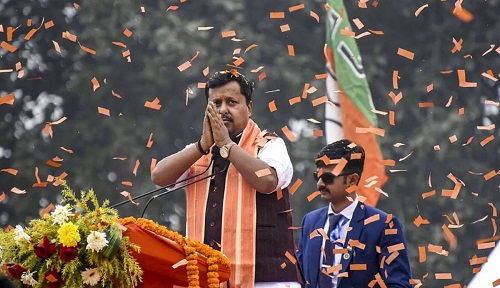
The Bharatiya Janata Party (BJP) is set to get a new national president today, with Nitin Nabin elected unopposed, marking a generational shift at the helm of India’s largest political party. At just over four decades of age, Nabin becomes the youngest-ever BJP national president at a time when the party is gearing up for crucial state elections and seeking to further consolidate and expand its political footprint across the country.
The formal announcement of Nabin’s elevation is expected between 11:30 am and 1:30 pm at an event in New Delhi, which Prime Minister Narendra Modi is scheduled to attend. The ceremony is likely to underscore the party’s emphasis on organisational continuity, disciplined leadership, and a renewed push for grassroots mobilisation ahead of upcoming electoral battles.
Nitin Nabin’s candidature enjoyed overwhelming backing within the party. Of the 37 sets of nomination papers filed, 36 came from BJP state units, while one set was submitted by the BJP Parliamentary Party, reflecting broad-based consensus across organisational and parliamentary wings. His nomination was proposed by several senior leaders, including Prime Minister Narendra Modi, Union Home Minister Amit Shah, and Defence Minister Rajnath Singh—an endorsement that highlights the central leadership’s confidence in his leadership abilities.
Nabin’s unopposed election also signals the BJP’s continued preference for internal unity and smooth leadership transitions, especially at a time when the party is focused on electoral preparedness rather than internal contestation. His rise is seen as part of a larger strategy to blend organisational experience with youthful energy, particularly to strengthen the party’s connect with younger voters and cadres.
With his appointment, Nabin joins a distinguished line of BJP presidents who have played pivotal roles in shaping the party’s ideological and organisational trajectory. The BJP was founded in 1980 under the leadership of Atal Behari Vajpayee, its first national president. He was succeeded in 1986 by Lal Krishna Advani, who held the post for three terms and oversaw the party’s transformation into a major national force. Other notable leaders who have served as BJP presidents include Murli Manohar Joshi, Kushabhau Thakre, Bangaru Laxman, Jana Krishnamurthi, Venkaiah Naidu, Rajnath Singh—who held the position twice—Nitin Gadkari, and Amit Shah.
Each of these leaders contributed to strengthening the party’s organisational structure and expanding its electoral reach. As the latest link in this chain, Nitin Nabin takes charge at a moment when the BJP is already dominant at the national level but faces the challenge of sustaining momentum, countering regional rivals, and maintaining organisational discipline across states.
As BJP president, Nabin will be tasked with steering the party through a demanding electoral calendar, sharpening its campaign strategies, and reinforcing coordination between the central leadership and state units. His elevation is widely seen as a statement of intent—signalling continuity in leadership vision while ushering in a new generation to lead the party into its next political phase.
















Leave Your Comment