


Political Success, as Dr. Orison Swett Marden, an American inspirational author, once remarked, is not solely determined by the achievements one attains, but rather by the obstacles faced and the resilience displayed in overcoming significant challenges. This sentiment underscores the essence of perseverance and courage in the face of adversity, highlighting the true measure of success.
In the realm of Indian politics, the Narendra Modi 3.0 government has navigated a challenging landscape where the ruling Bharatiya Janata Party (BJP) lacks an absolute majority to form the government independently and relies on coalition partners with distinct agendas. This dynamic necessitates astute leadership to engage in robust parliamentary debates not only as a means to assert authority but also as an opportunity to demonstrate conviction and resolve, both to themselves and to the nation at large.
The ongoing parliamentary session has been marred by intense deliberations on a spectrum of critical issues, including the contentious NEET paper leak scandal, opposition’s sharp response to the President’s speech, the fallout from provocative statements such as "you are not Hindus”, and the implications of new criminal laws, made Indian parliament an interesting space to watch. These debates have underscored the ideological divides and political tensions prevalent in the current political landscape.
Modi, Rahul face- off in Parliament
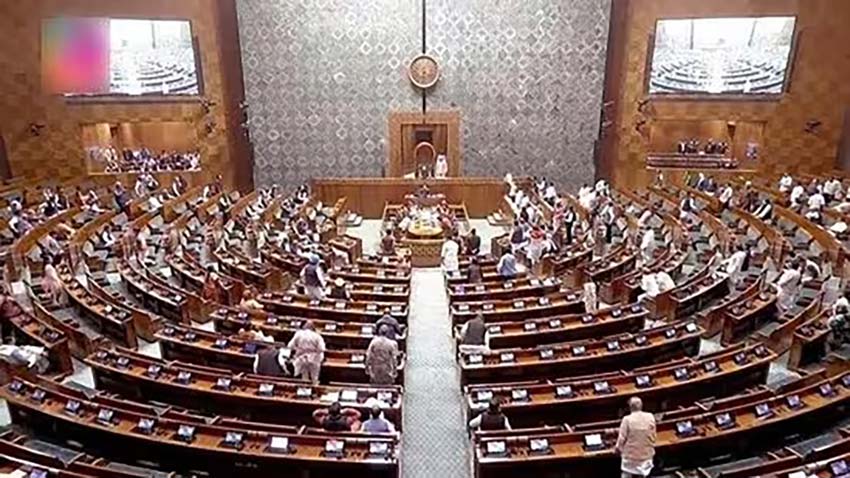
This was perhaps the first incident when the leader of the opposition was challenged by none other than the Prime Minister. This was a first of its kind debate between the leader of the opposition and the Prime Minister. Never before has it happened that the leader of the opposition had to stop his speech when interjected by the senior most member of the government.
This particular flashpoint emerged during a face-off between Prime Minister Narendra Modi and Leader of the Opposition Rahul Gandhi, where divergent views on the Hindu community sparked heated exchanges. Prime Minister Modi vehemently repudiated Rahul Gandhi's insinuations that Hindus are inherently prone to violence, decrying what he perceived as a deliberate attempt to malign the community. Asserting that such baseless accusations would resonate through generations, Modi underscored the need to safeguard the sanctity of religious beliefs and cultural symbols.
PM Modi also emphasised that insulting gods and goddesses by the opposition is hurting 1.4 billion people in the country.
Standing to refute and question the “careless remark” about the community which has a long history of being the most calm societies which has embraced all those who came to the country either to learn or to loot. There are a sizable number of examples where people belonging to the community targeted have gladly sacrificed their dear ones to support even the adversaries.
The Union Home Minister minced no words and said, “He has categorically said that those who call themselves Hindus engage in violence. Crores of people in the country proudly call themselves Hindus. Are they all speaking about violence? Linking violence to any religion, that too by somebody holding a constitutional position... I believe he should apologise.”
In response, Rahul Gandhi accused the BJP-led government of orchestrating a systematic erosion of India's foundational principles and constitutional ethos. By symbolically associating the Congress party with the Hindu 'Abhayamudra' gesture, Gandhi sought to reclaim the narrative of fearlessness and inclusivity in the face of perceived threats to pluralism and democratic values.
The discourse further intensified as the opposition staged a dramatic walkout from the Rajya Sabha during Prime Minister Modi's address on the Motion of Thanks to the President's address. The contentious moment unfolded when the Leader of the Opposition, Mallikarjun Kharge, was denied an opportunity to interject, prompting accusations of stifling dissent and restricting democratic participation. The ensuing exchange underscored deep-seated tensions regarding parliamentary decorum, constitutional propriety, and the right to dissent within the political spectrum.
Amidst the acrimony, voices from different regions of the country raised concerns over the omission of critical issues in the President's address, particularly regarding the escalating violence in Manipur and the plight of displaced populations.
Congress MP Angomcha Bimol Akoijam highlighted the humanitarian crisis in Manipur, decrying the government's inaction and attributing the dire situation to systemic neglect and apathy. These impassioned pleas underscored the urgency of addressing regional disparities and upholding the principles of social justice and inclusivity.
Furthermore, Congress MP Manickam Tagore expressed disappointment over the perceived lack of substantive welfare measures in the President's address and critiqued the government's priorities, alleging a focus on elite interests over the welfare of marginalized communities. He underscored the shifting dynamics in the political landscape, emphasising the need for inclusive governance and equitable representation to address the multifaceted challenges facing the nation.
The opposition walked out of the Rajya Sabha during Prime Minister Narendra Modi’s reply to the Motion of Thanks to the President’s address, after leader of opposition and Congress MP Mallikarjun Kharge was not allowed to intervene. Following their walkout, Modi said that the opposition had “insulted” the Upper House and that they were “running away from the truth”, while Rajya Sabha chairman and vice president Jagdeep Dhankhar said that the opposition had “shown their back to the Constitution” by walking out. The opposition walked out about 45 minutes into Modi’s speech after raising slogans and demanding that Kharge be allowed to intervene on Modi’s remarks on the Constitution.
During his speech, Modi said that it was possible for him to become the Prime Minister because of the Constitution and B.R. Ambedkar.“I am here because of the Constitution given by Babasaheb Ambedkar. There are many like me who have been able to come here because of the Constitution. The people have also given their mandate for the third time. For us, the Constitution is not a compilation of articles. For us its spirits and words are also valuable,” he said. Modi said that his government had decided to celebrate Constitution Day on November 26, while some in the opposition had opposed it.
“Now, in every school and college, it is being taught how the Constitution was drafted, what was included and what was left out. We have tried to ensure that the Constitution remains our inspiration. Now, in the 75th year [of the Constitution] we have made it a national event. In every corner of the country, awareness about the values of the Constitution are being spread. The people of the country have given us a mandate for the third time to make a Viksit Bharat,” he said.
The opposition then started raising slogans, after Kharge sought to make a point of order and intervene in the speech. With Rajya Sabha chairman and vice president Jagdeep Dhankhar ignoring their demands, the opposition started chanting, “LoP ko bolne do (Let the LoP speak)” and “LoP, LoP”.About 45 minutes into Modi’s speech, with Kharge not being allowed to speak, the opposition – including former BJP ally Biju Janata Dal (BJD) – staged a walkout.
“We walked out because the PM was addressing the House on the President’s address and said some wrong things to the House. It’s his habit to lie and mislead people and speak against the truth. When he was speaking about the Constitution, all we said was that you didn’t make the Constitution, you people were against the Constitution. I was just clarifying [which people] were for and against the Constitution. That is what I wanted to place before him,” said Kharge.
“I wanted to place before him that the RSS mouthpiece Organiser on November 30, 1949 wrote that the worst part of the Indian Constitution is that it does not have anything Indian and does not include anything about ancient India. The laws in Manusmriti have been praised across the world. Who said this? Organiser, RSS and the people of the Jan Sangh said this. They opposed the Constitution and now they are calling us Constitution-virodhi.
“They burnt the effigy of BR Ambedkar and Nehruji. We are saying ‘Save the Constitution’ because what was the intent of the Jan Sangh, BJP and the RSS? They say time and again that we disrespected BR Ambedkar. I wanted to say that drafting committee chairman Babasaheb Ambedkar said that he was shocked when he was chosen as the chairman. It is the discipline of the Congress that every section of the Constitution was implemented. I wanted to say this. I was raising my hand. All INDIA parties wanted the Chairman’s attention. I then requested the prime minister several times. I wanted to expose his lies. I wanted to show what Ambedkar said in his Constituent Assembly speech and what RSS Organiser said,” he added.
NEET Issue row in the Parliament

Rahul Gandhi also raised the issue of alleged irregularities in conducting the NEET-UG exam 2024 during a discussion on the Motion of Thanks on the President's address to a joint sitting of Parliament. Referring to the medical UG entrance exam as a “commercial exam” rather than a “professional one,” the Raebareli MP said, “NEET is not a professional exam; it's a commercial exam; it is designed to suit rich students.” Demanding a separate one-day discussion in Parliament on the NEET-UG 2024 controversy, the former Congress chief said the government is not allowing discussion on NEET as it is not interested in the future of students.
The LoP Rahul Gandhi said he had met several NEET aspirants, and every single student told him that the NEET-UG exam was designed to create a quota for rich people and to create a passage for them into the system and is not designed to help poor students.
“NEET students spend years and years preparing for their exams. Their family supports them financially and emotionally, and the truth is that NEET students today do not believe in the exam because they are convinced that the exam is designed for rich people, not meritorious people. I have met several NEET students. Every single one of them tells me that the exam is designed to create a quota for rich people and to create a passage for them into the system and is designed not to help poor students,” LoP Rahul Gandhi said.
Rahul Gandhi said that the opposition wanted a one-day discussion on NEET. It is an important issue. More than two crore students have been affected. Paper leaks have happened on 70 occasions. We would be happy if you allow a separate discussion on the issue.
“A message is disseminated to the country from Parliament. We want to send a message to students that the NEET issue is important for the Parliament. So, to send this message, we want the Parliament to discuss this,” said Rahul Gandhi.
Responding to this, Lok Sabha Speaker Om Birla said, “You can give your suggestions, but I decide.” Responding to Rahul Gandhi's demand, Union Defence Minister Rajnath Singh said that a separate discussion cannot occur until the House concludes its Motion of Thanks on the President’s speech.
“Parliament proceedings are carried out based on some rules and traditions. I request the Opposition that any discussion be done only after the Motion of thanks on the President's address,” Singh said.
Earlier on June 29, the Union Minister of Education Dharmendra Pradhan stated that the Congress does not want a debate on the NEET-UG 2024 issue, instead, they want disruption and barriers to Parliament’s functioning.Meanwhile, students protesting at the Jantar Mantar against irregularities in NTA-held examinations—NEET UG, PG, and UGC NET—ended their protest on the sixth day today without mentioning any reason. They were demanding a ban on NTA and the resignation of the Education Minister.
New criminal laws to prioritise justice instead of punishment: Amit Shah
Union Home Minister Amit Shah discusses the implementation of new criminal laws prioritising justice over punishment. "Instead of punishment, it is now justice. Instead of delay, there will be immediate trials and speedy justice. Earlier, only the rights of the police were protected, but now, victims' and complainants' rights will be protected too," Shah said during a press conference.
“Now, instead of the Indian Penal Code (IPC), there will be Bharatiya Nyaya Sanhita (BNS), instead of the Criminal Procedure Code (CrPC), there will be Bharatiya Nagarik Suraksha Sanhita (BNSS), instead of the Indian Evidence Act, there will be Bharatiya Sakshya Adhiniyam (BSA),” he said. “We have prioritised sections and chapters in accordance with the spirit of our Constitution, with the first priority given to crimes against women and children. I believe this should have been done much earlier," Shah remarked.
The opposition accused the government of passing these laws from the parliament forcibly by suspending MPs, the ruling party countered these allegations by citing Justice Chandrachud where he described the new criminal justice system as a 'watershed moment for our society.’
In a strongly worded post on social media platform, X, Congress president Mallikarjun Kharge said, "After the political and moral shock in the elections, Modi ji and the BJP are pretending to respect the Constitution, but the truth is that the three laws of the criminal justice system that are being implemented from today were forcibly passed by suspending 146 MPs.""INDIA will no longer allow this “Bulldozer Justice” to run on the Parliamentary system," he added.
Nothing can be more apt than one said by the author of the Indian constitution, when he said, “Democracy is not just about voting, it’s about ensuring that people’s votes are heard.”
In conclusion, the evolving political landscape in India reflects a complex tapestry of competing ideologies, power dynamics, and socio-economic disparities. The ongoing debates and controversies surrounding issues like the NEET paper leak, religious identity, and parliamentary decorum underscore the imperative of fostering constructive dialogue, upholding democratic values, and addressing the diverse needs of the populace. As the nation grapples with these challenges, the resilience, integrity, and commitment displayed by its leaders will ultimately shape the trajectory of its democratic journey and define the contours of its collective future.
By Alok Sharma
(The content of this article reflects the views of writers and contributors, not necessarily those of the publisher and editor. All disputes are subject to the exclusive jurisdiction of competent courts and forums in Delhi/New Delhi only)














Leave Your Comment