


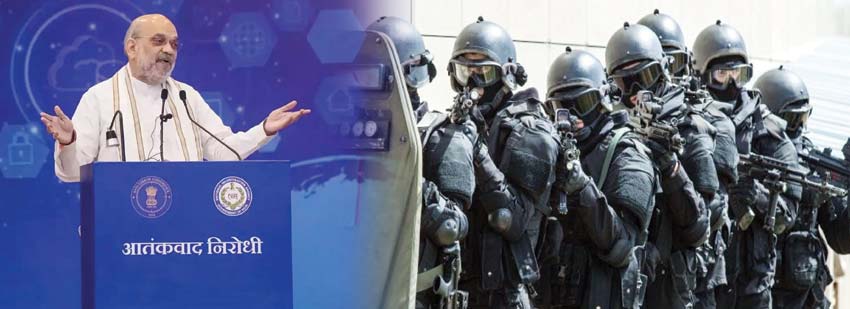
In a world where threats to national security are constantly evolving, India finds itself at a pivotal moment in its fight against terrorism. Today, at a high-profile conference, Union Home Minister Amit Shah announced a landmark step: the government is set to unveil a comprehensive National Counter-Terrorism Policy and Strategy within the next few months. This policy is part of a broader vision under Prime Minister Narendra Modi’s government to proactively combat terrorism, dismantle the terror ecosystem, and address emerging threats that could undermine India’s security.
The announcement signifies a strategic shift in India’s approach to national security. Under Modi’s leadership, the government has emphasized building robust infrastructure to not only respond to threats but to prevent them. Through initiatives like the Multi Agency Centre (MAC) and its expanding reach, India has already made significant strides. MAC’s focus has extended beyond traditional terror activities to include cyber threats, narco-terrorism, and the surveillance of radical hotspots. This proactive approach has paid off by enabling law enforcement agencies to detect and prevent crimes before they occur.
At the heart of this national security apparatus is the Multi Agency Centre, or MAC. Established under the Intelligence Bureau, MAC acts as a nodal hub for intelligence sharing and inter-agency coordination. Initially focused on conventional terrorist activities, MAC has transformed under Modi’s leadership into a dynamic and expansive entity with a broadened mandate. Today, it is responsible not only for detecting terrorist threats but also for monitoring cyber security, narco-terrorism, and tracking radicalization across various regions.
The government’s approach has moved from reactive to preemptive, recognizing that terrorists are adapting rapidly, using digital platforms and social media to spread ideologies and plan attacks. By expanding MAC’s mandate to include these digital domains, India has strengthened its ability to monitor and respond to a wider range of threats, often before they materialize into actual violence.
A significant component of this revamped security strategy has been the development of Standard Operating Procedures (SOPs) that define and streamline the roles of various agencies. These SOPs ensure that information sharing and coordination are seamless, avoiding delays and maximizing efficiency in threat neutralization. The Modi government has recognized that in a vast and diverse country like India, with its 1.3 billion population, an isolated approach to national security simply won’t work. Instead, MAC operates as an inclusive platform where state and central agencies collaborate, ensuring that intelligence flows smoothly across jurisdictions and responsibilities.
This coordinated, intelligence-led approach has yielded significant results. The ability to act on intelligence in real time, involving multiple agencies simultaneously, has thwarted several high-profile threats. One example is the interception of cross-border smuggling networks linked to narco-terrorism. Drugs and illicit funds from these networks have long been used to finance terrorist activities, particularly in states like Punjab and Jammu & Kashmir. By focusing on the financing and supply chains, rather than just the end criminal activities, MAC’s multi-agency approach has disrupted several key players in the narcotics pipeline, striking at the root of terror financing.
Another critical area is cyber security. India’s digital landscape has expanded rapidly, making it a potential vulnerability in terms of cyber-attacks and online radicalization. The Modi government’s expanded focus on cyber intelligence within MAC’s mandate has enabled early detection of threats in cyberspace, including hacking attempts and online recruitment efforts by extremist groups. Recently, thanks to MAC’s expanded cyber-monitoring capabilities, intelligence agencies were able to identify and neutralize a series of coordinated cyber-attacks targeting critical infrastructure in financial and public health sectors.
Home Minister Amit Shah emphasized today that the forthcoming National Counter-Terrorism Policy and Strategy will solidify these advancements into a structured national framework. The policy will outline clear directives for agencies to follow, defining roles, communication protocols, and strategic objectives. One of the key features of this policy will be its adaptability; as Shah indicated, the policy will be reviewed and updated periodically to address new and emerging threats.
The importance of this adaptability cannot be overstated. With global terror networks constantly evolving and technology enabling new methods of radicalization, India’s counter-terrorism efforts must remain agile and forward-looking. This is particularly true in the realm of cyber-radicalization. Terror groups are increasingly leveraging social media platforms to spread propaganda and recruit youth, taking advantage of the anonymity and accessibility offered by the digital world. By incorporating robust cyber-monitoring and social media analysis into the counter-terrorism policy, India can make it harder for these groups to gain traction and exploit vulnerable individuals.
Furthermore, MAC’s efforts in identifying radical hotspots within the country have been instrumental in preventing localized acts of violence. By closely monitoring regions with a high risk of radicalization, MAC has successfully intervened in multiple cases, alerting state police and local authorities to suspicious activities that could signal the early stages of terrorist plots. This early intervention approach is particularly crucial for safeguarding regions that have historically been targeted by terror groups, ensuring that any emerging threat is identified before it can escalate.
At a local level, the Modi government has also focused on community engagement and awareness, partnering with local authorities to strengthen bonds within communities and deter radicalization. Local engagement has proven to be an effective tool, as trusted community leaders can play a pivotal role in discouraging youths from falling prey to extremist ideologies. The policy’s emphasis on community-centric approaches underscores the government’s recognition that national security isn’t solely the responsibility of intelligence agencies but requires a collective effort.
As India gears up to implement a national counter-terrorism policy, it is essential to recognize how this approach will strengthen not just the nation’s security but also its international standing. India’s proactive measures in the fight against terrorism serve as a model for other countries battling similar threats. By prioritizing preemptive intelligence sharing, community involvement, and a comprehensive cyber-security framework, India is setting a new standard in the global fight against terrorism.
A national counter-terrorism policy under Modi’s administration represents a monumental step in ensuring that every Indian can live free from the threat of violence. The message is clear: India is committed to dismantling terror networks wherever they emerge, safeguarding its citizens, and securing a future of peace and resilience for the generations to come.
By Uday India Bureau




















Leave Your Comment