


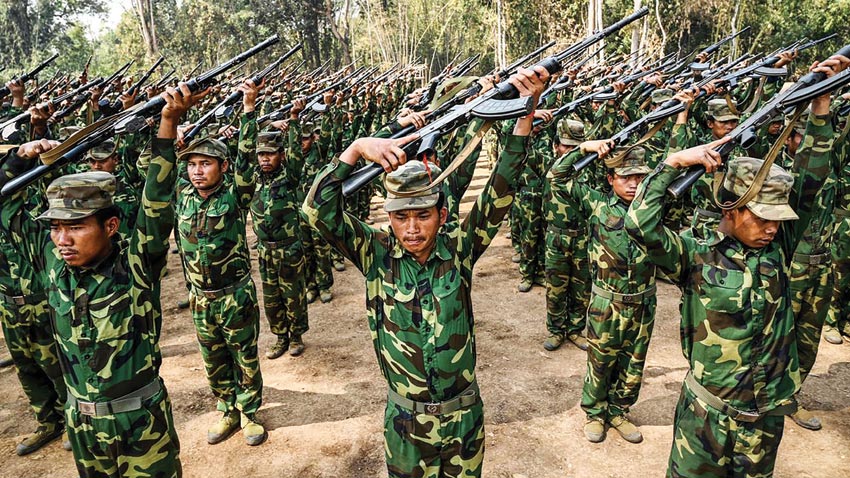
Myanmar, a nation fraught with political turmoil and civil unrest since the military coup in February 2021, is witnessing a significant shift in its internal power dynamics. Rebel forces in Rakhine and Chin states, notably the Arakan Army (AA) and the Chin National Army (CNA), have achieved notable successes against the military junta. These developments, while largely viewed as a regional concern, hold profound strategic implications for India. India shares a 1,643-kilometer-long border with Myanmar, making stability in the neighboring country essential for its northeastern region’s security and development. Recent victories of the rebel groups could provide India with opportunities to secure its interests, both geopolitical and economic, in the region.
Rakhine State, located along the western coast of Myanmar, holds significant geopolitical importance due to its proximity to the Indian Ocean and its role in China’s Belt and Road Initiative (BRI). Chin State, bordering India’s Mizoram, serves as a key region for cross-border connectivity and trade. Stability in these regions is crucial for India’s Act East Policy, which aims to enhance connectivity and economic integration with Southeast Asia.
The weakening of Myanmar’s military junta could enable better coordination between India and the rebel groups in Rakhine and Chin states. These groups, particularly the CNA, have expressed an interest in maintaining peaceful relations with India. This can help India in securing its northeastern borders, reducing the spillover of insurgency and illegal activities such as arms smuggling and drug trafficking. The junta’s failure to consolidate power has created a vacuum that can be strategically leveraged. India can engage with the rebel forces to counterbalance China’s growing influence in Myanmar. The Arakan Army, for instance, has opposed China’s exploitation of Rakhine’s resources, presenting an opportunity for India to establish goodwill and explore economic partnerships.
India’s Kaladan Multi-Modal Transit Transport Project, aimed at enhancing connectivity between India’s northeastern states and Southeast Asia, runs through Rakhine State. The success of the Arakan Army in consolidating control over Rakhine’s key territories could ensure smoother implementation of such projects, provided India builds a rapport with the rebel leadership. The ongoing conflict has resulted in a humanitarian crisis, with thousands of refugees fleeing to India. By providing humanitarian aid and engaging diplomatically with the rebel forces, India can position itself as a responsible regional power. This approach could also strengthen India’s influence in international forums addressing the Myanmar crisis.
Despite the potential advantages, India must tread cautiously. Supporting rebel forces could strain India’s official ties with Myanmar, especially if the military junta remains in power. Furthermore, aligning with insurgent groups might embolden similar movements within India’s northeastern states, posing a threat to national security. The involvement of China complicates matters further. Beijing has historically supported both the junta and certain rebel groups to safeguard its strategic interests, including the China-Myanmar Economic Corridor (CMEC). India’s overt engagement with the Arakan Army or Chin National Army could provoke countermeasures from China, escalating regional tensions.
India’s response to the evolving situation in Myanmar should be carefully calibrated to maximize benefits while mitigating risks. Backchannel diplomacy can be employed to engage with rebel leaders through discreet diplomatic channels to explore avenues for cooperation without alienating the Myanmar government. Improving surveillance and infrastructure along the Indo-Myanmar border is essential to prevent cross-border insurgency while facilitating legitimate trade and connectivity. Collaborating with ASEAN nations to build a consensus on addressing Myanmar’s political crisis can dilute China’s influence and ensure a more stable region. Additionally, investing in developmental projects in Rakhine and Chin states can help build trust with local populations and rebel leaders. This could include healthcare, education, and skill development initiatives. Supporting refugee rehabilitation and providing aid to conflict-affected areas will project India’s image as a benevolent neighbor.
The recent successes of rebel forces in Myanmar’s Rakhine and Chin states present a unique set of opportunities and challenges for India. By adopting a nuanced and proactive strategy, India can secure its northeastern borders, counter Chinese influence, and bolster its Act East Policy. However, this requires a delicate balancing act that prioritizes long-term stability and regional cooperation over short-term gains. As Myanmar’s internal conflict continues to evolve, India’s ability to navigate this complex landscape will be crucial for its geopolitical aspirations and regional standing.
Uday India Bureau















Leave Your Comment