


RSN SINGH
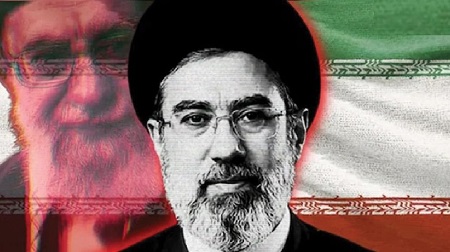
No one has seen or heard Mojtaba Khamenei ever since the mantle of Supreme Leader of Iran was seemingly thrust upon him following the killing of his father, Ali Khamenei, in US-Israel bombing on 28 February 2026. He was intriguingly absent during the entire funeral proceedings of his father. The succession of Mojtaba itself is shrouded in mystery.
Nevertheless, ambiguous messages attributed to him are being bandied about by the current IRGC (Islamic Revolutionary Guard Corps)-dominated dispensation, giving rise to several contradictory interpretations. It is, however, the interpretation by the IRGC that seems to prevail. What has made matters worse is the attempt by the current dispensation to negate growing apprehension worldwide about Mojtaba's very existence or functionality as a leader. In the process, the Iranian media, fiercely loyal to the IRGC, has released videos of Mojtaba, only to be betrayed by their antiquity.
INTERNECINE POWER STRUGGLE
Mojtaba Khamenei is physically absent but politically ubiquitous. The physical absence of the leader has engendered factionalism and internecine rivalry for power. Each faction is paranoid about the consequences of losing power. They fear their own fellow Iranians. In its bid to transform the country from a civilizational entity into a pan-Islamic identity, the regime has ruled with an iron hand over the last four-and-a-half decades. The IRGC has a monopoly over violence. It has been able to suppress the counter-revolution, but not crush it. The clamour for reclaiming the civilizational legacy is clearly discernible amongst the Iranian people.
IRGC SUBORDINATES ALL INSTITUTIONS
In war, security forces are directionless without political direction. In the Iranian political setup, the Supreme Leader is the leader of the country and the Supreme Commander of the armed forces. But in the prevailing discourse, both the leader component as well as the commander component is missing. Sun Tzu, in his book The Art of War, says, "In war, the General receives his command from the sovereign." Sadly, the sovereign in Iran, Mojtaba Khamenei, has been reduced to a ghost character by the IRGC. Sun Tzu further says, "Without harmony in the state, no military expedition can be undertaken." By "expedition", what is implied is offensive operations. Iran has so far survived this war amidst extreme disharmony amongst institutions because it has remained purely on the defensive, with overwhelming dependence on proxies and terrorism, which includes maritime terrorism in the Strait of Hormuz and the Red Sea. In Iran today, the Legislature and the Executive are at loggerheads.
IRGC HAS KILLED THE REGIME
The original character of the regime is nowhere in evidence. It was a hybrid regime combining theocracy with modern organs of a Republic. In fact, a clerical system enveloped the Republic. The head of state was the Supreme Leader, assisted by the Guardian Council and the Assembly of Experts. The President was No. 2 and wielded considerable power, as he was directly elected by the people. The Guardian Council and the Assembly of Experts seem to be defunct. President Masoud Pezeshkian and the Speaker of the Majlis (Parliament), i.e., head of the legislature, Mohammad Bagher Ghalibaf, have been sidelined by the IRGC, which, from being the sword arm of the theocratic regime, has become the regime itself. The theocratic component of the regime is just not visible.
IRGC CONTROLS THE MEDIA
Recently, IRGC chief Ahmad Vahidi showered praise on the chief of the state broadcaster, IRIB (Islamic Republic of Iran Broadcasting), Peyman Jebelli, for the "effective role" and "valuable effort" of IRIB. On the other hand, President Pezeshkian has accused IRIB of censoring his interview wherein he said that the late Ali Khamenei was in favour of negotiations. The Speaker, Ghalibaf, has also been bitter with IRIB for cutting footage of a parliamentary recording in which he had spoken about IAEA inspections, the release of foreign assets, and a $300 billion reconstruction loan. It should, therefore, not be very difficult to conclude that the IRGC, which is at the helm, is against peace and negotiations. Probably, it has decided that if it sinks, it will take the country along with it.
WHO DECIDES WAR OR PEACE?
Mojtaba Khamenei is the Supreme Commander of the armed forces. He should be the final authority on matters relating to war and peace. It is he who has to balance between the theocratic, political and diplomatic imperatives.
During the Iran-Iraq War (1980-88), Ayatollah Khomeini was the one giving the higher direction of the war. Even in the recent 12-day war (June 2025) with Israel and the US, Mojtaba's father and predecessor, Ali Khamenei, was the ultimate deciding authority. In the ultimate analysis, it is the Supreme Leader who decides on the military posture of the country. It is he who is finally responsible for public mobilisation, both in times of war and peace.This war has split the Iranian establishment between hawks and moderates. Since the IRGC has a monopoly over the coercive tools of the state, it has appropriated the decisive role. To perpetuate its dominance, it generates and interprets the messages attributed to Mojtaba in a way that favours war over peace. On the other hand, the moderates interpret these messages as meaning both retribution and negotiation. The moderates cannot afford to categorically denounce war for fear of a backlash by the hawks. Hence, the compulsion to perpetuate the fiction of a healthy and strong Mojtaba is more acute for the hawks (IRGC) in comparison to the moderates.
AUTHORITY WITHOUT PUBLIC APPEARANCE
Can a Supreme Leader function without public appearance? If the Supreme Leader cannot attend his father's and wife's funerals, it gives rise to genuine and legitimate apprehensions that either he is dead or incapacitated. Why no audio message? Probably because the audio may betray his psychological and physical condition, in case he is alive. Why is the present dispensation of Iran so paranoid about revealing the actual status of Mojtaba? The IRGC says that his absence is deliberate for security reasons. Well, his sworn enemies, Trump and Netanyahu, have not gone into hiding. They are making regular public appearances on national and international forums. It implies that Iran has clearly lost the war. Mojtaba Khamenei is also the spiritual leader of the Shias of the world. Spiritual leaders are expected to fear only God. Guru Tegh Bahadur, in full public view, willingly sacrificed his life for the sake of the nation. The Islamic Revolutionary regime of Iran panders to political Islam, while Guru Tegh Bahadur was motivated by spiritual nationalism.
Theocratic regimes are marred by cowardice and paranoia; hence, their ultimate weapon is terror. They cannot survive without their key political and religious figures. Once legitimacy is gone, so will the religious and theocratic pretensions. It is for this reason that the present Iranian dispensation has to keep the fiction of Mojtaba alive. This compulsion is not a new phenomenon. For many years, the Damdami Taksal kept the canard of Bhindranwale being alive after Operation Blue Star. Without the resurrection theory of Jesus, Christianity would never have gained ground. The most telling example of this phenomenon is the Taliban, which had kept the news of Mullah Omar's death concealed for more than two years.
THE TALIBAN PARALLEL
Iran today, to a great extent, mirrors Afghanistan of 13 years ago. Mullah Omar had died in April 2013. Mullah Mansour, the successor of Mullah Omar, later revealed in his biography that Mullah Omar's death was intentionally kept secret, primarily for tactical reasons. He says in his biography: "Several key members of the Supreme Council, and authentic religious scholars together, decided on concealing the tragic news ... and keep this secret limited to very few colleagues."
He goes on to say: "One of the main reasons behind the decision was that 2013 was considered the final year of power testing between Mujahideen and foreign invaders, who had announced that by the end of 2014 all military operations would be concluded."
It did not stop just at concealment. It was further attributed to Mullah Omar that he believed negotiation was the only legitimate means to put an end to occupation by foreign forces.
The Taliban top leadership expelled five senior figures, as also the spokesperson, Shahidullah Shahid, for doubting the existence of Mullah Omar.
CONCLUSION
The messages attributed to Supreme Leader Mojtaba Khamenei have been deliberately kept ambiguous so that the IRGC can exploit the latitude. Ambiguous messaging, however, diffuses responsibility, promotes factionalism and engenders institutional clashes.
No country can endure a war without unity, unanimity and cohesion. When these are absent, it is the intervention of the Supreme Leader that saves the day. But this intervention is missing in Iran.
Is it because the Supreme Leader is dead or in a vegetative state?
(The content of this article reflects the views of writer and contributor, not necessarily those of the publisher and editor. All disputes are subject to the exclusive jurisdiction of competent courts and forums in Delhi/New Delhi only)




















Leave Your Comment