


Since Narendra Modi's entry into the national stage, India's attitude and response to the Israeli-Palestinian issue have altered over time, becoming more pronounced and noticeable. Though many of the modifications occurred while the New Delhi governments were run by the Congress, Modi's appointment as prime minister in 2014 gave the procedure a distinctive flair and grandeur. In the United Nations after World War II, India put out a federal plan while the majority of other members advocated dividing Palestine. India thus joined Arab and Islamic nations in opposing the partition plan in November 1947, and a year later, it even vetoed Israel's membership to the UN.
However, Jawaharlal Nehru's decision to recognise Israel in September 1950 was driven by his dissatisfaction with the Arab world's pro-Pakistani stance as well as the imperatives of realpolitik. However, the establishing of diplomatic ties between India and Israel did not happen right away.
The readiness of the Palestinians to pursue a negotiated settlement with Israel through the Middle East peace process came after the conclusion of the Cold War and the establishment of a world order controlled by the United States. As a result, Prime Minister P V NarasimhaRao of the other Congress decided to normalise India's relations with Israel in January 1992. In September 2003, Prime Minister AtalBehari Vajpayee welcomed his Israeli colleague Ariel Sharon and put on a very public display of friendliness. Also around this time was the first visit at the level of the foreign minister.
But Modi gave the relationship between India and Israel a personal touch. He visited Israel in 2007 while serving as Gujarat's chief minister and freely voiced his respect for Israel's accomplishments. Since Modi became prime minister in 2014, there have been a number of political encounters. Pranab Mukherjee made history by becoming the first Indian president to visit Israel in October 2015. Modi also met with Israeli officials abroad, something that earlier Indian administrations had hitherto avoided.
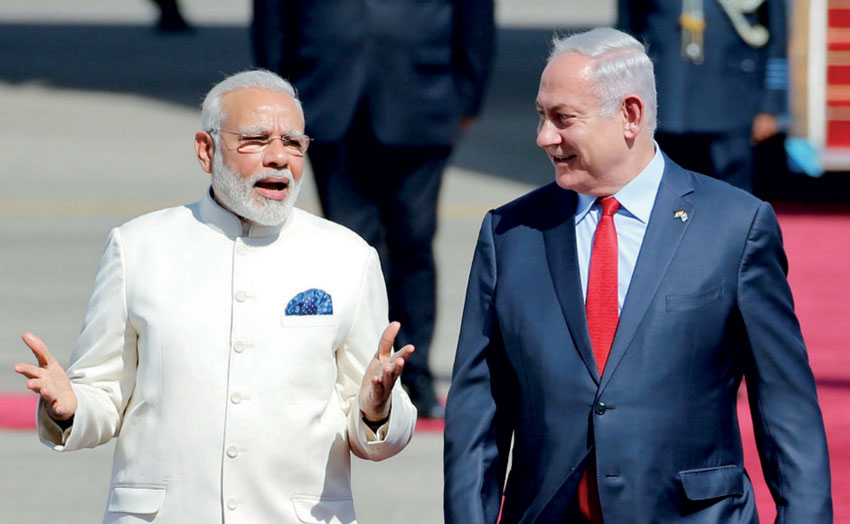
The turning point occurred in July 2017, when Modi travelled to Israel for the first time as prime minister of India. He did not go to Ramallah, the seat of the globally acclaimed Palestine National National Authority, as is customary in India. As a result, many believed that his trip to Israel marked the end of India's dual relations with Israel and Palestine. With Israeli Prime Minister Benjamin Netanyahu, he has developed a tight personal relationship and they communicate frequently. In addition to these political interactions, Modi subtly changed India's stance towards the eventual Palestinian State. Just weeks before his visit to Israel, Mahmoud Abbas, the president of the Palestinian Authority, was hosted by Modi, who proclaimed India's support for a "sovereign, independent, united, and viable Palestine, coexisting peacefully with Israel."
The ten-year-old mention of the capital of the future Palestinian State being in East Jerusalem was absent. Similarly, the Modi administration started refusing to vote on measures in UN bodies that were lopsided or very critical of Israel.
The present fighting between Israel and Gaza has highlighted these less subtle changes. Modi was one of the first foreign leaders to respond when the horrors of the Hamas attacks on Israel came to light. He declared that "the news of terrorist attacks in Israel" had shocked him. "The innocent victims and their families are in our thoughts and prayers. We support Israel during this trying time," he wrote in a post on X. A few days later, with violence escalating, the Ministry of External Affairs reaffirmed its long-standing position on the Israeli-Palestinian conflict: support for a two-state solution. It was a subtle distinction between Hamas, which opposes coexistence with Israel, and the Palestinian National Authority, which is run by Fatah. India was clear in referring to what occurred in Israel as "a terrorist act" without designating Hamas as a terrorist group, as numerous Western nations do. This is how PM Modi is leaving his legacy on Indian Foreign policy.
Uday india Bureau














Leave Your Comment