


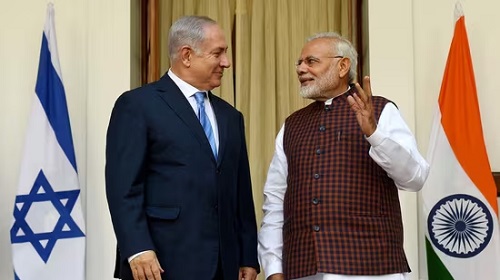
Prime Minister Narendra Modi's two-day visit to Israel on February 25–26 is being watched closely — not just for the deals it will seal, but for the diplomatic signals it will send.
Nine years after becoming the first Indian prime minister to set foot on Israeli soil, Modi returns to a region — and a relationship — that has grown considerably more complicated. The visit comes on the heels of India backing a global condemnation of Israeli settlements in the West Bank, making the trip a delicate exercise in the kind of strategic balancing act that has defined India's foreign policy in recent years. The warmth between Modi and Israeli Prime Minister Benjamin Netanyahu has never been in question. Netanyahu described Modi's upcoming visit as "historic.
India's Strategic Tightrope
India has long maintained a careful balancing act in the Middle East — nurturing its ties with Israel while sustaining relationships with Arab nations and championing the Palestinian cause on international platforms. Under Modi, this balance has tilted somewhat more visibly toward Israel. Analysts note that Indian diplomats and officials have justified this pivot as a "pragmatic approach" — Israel's tech and military expertise is seen as too valuable to ignore — while New Delhi has simultaneously tried to strengthen its Arab alliances.
But this realist turn has come at a cost, according to some experts — to India's relationship with Palestine and, in the view of critics, to India's broader moral credibility in the Global South.
Importantly, while multiple Western leaders have visited Netanyahu since the October 7, 2023 Hamas attacks, very few Global South leaders have done so, making Modi's visit particularly significant in geopolitical terms.
Defence at the Centre of the Agenda
Defence cooperation is expected to be the centrepiece of Modi's conversations with Netanyahu. Israel is a global leader in defence innovation, having developed and deployed advanced missile defence systems such as Iron Dome, David's Sling, and Arrow. India is looking to procure long-range missiles and loitering ammunition — weapons that can be launched by air, ground, and sea — to bolster its military edge.
The visit is also tied to Mission Sudershan Chakra, announced by PM Modi on Independence Day last year, which is widely seen as India's bid to build a robust anti-ballistic missile defence system and develop long-range conventional ballistic missiles. Joint development with Israel could accelerate this ambition considerably.
The two countries had already signed a landmark agreement in November 2025 to enhance defence, industrial, and technological cooperation, enabling the sharing of advanced technology to promote co-development and co-production. Business Standard
Beyond Defence: Technology, Trade, and AI
India and Israel signed terms of reference in November 2025 to formally launch negotiations on a free trade agreement, though officials caution that reaching a final deal will take considerable time. Bilateral trade, which more than doubled since 2013 to a record $5 billion in 2024, dipped to $3.6 billion in 2025, making a trade agreement all the more relevant.
The two sides are also expected to discuss agriculture, clean drinking water technology, and science — areas where Israel has long been a world leader and where India has much to gain.
The Gaza Question
Perhaps the most closely watched element of Modi's visit will be how — or whether — he raises the Gaza conflict with Netanyahu. Modi and Netanyahu have remained in close contact since the Pahalgam terror attack in April 2025, speaking multiple times over the course of the year to discuss the regional situation. But a private conversation is very different from a public statement of concern.
With India having just backed the condemnation of West Bank settlements, the international community — and India's own opposition — will be looking for signs that New Delhi is willing to translate its stated support for Palestinian rights into concrete diplomatic pressure. Whether Modi chooses to make that move publicly or privately will itself be a statement about where India's foreign policy priorities truly lie.
A Visit That Carries Weight
Modi's 2026 Israel trip is more than a routine state visit. It is a moment that crystallises the tensions and opportunities at the heart of India's foreign policy — between principle and pragmatism, between old solidarities and new partnerships, between the Global South's expectations and the strategic imperatives of a rising power. How Modi navigates those tensions in Jerusalem over the next two days will be closely studied far beyond the halls of the Knesset.














Leave Your Comment