


How is Narendra Bhai Modi viewed by the Indian diaspora? The views range from complete admiration to anger and vitriolic responses. Yet as a Prime Minister, Mr. Modi’s reputation is partly a reflection of a modern technological age which has made it possible to study him and his achievements in a way that was not possible a generation ago. This can also be done both nationally and internationally in real time and by anyone with access to a computer and a social media site. To understand how the diaspora thinks of the Indian Prime Minister one has to first pin point what is the composition of the diaspora, what are its expectations of India, and that explains how they rate Mr. Modi.
Diasporas: A Background
A diaspora is described as a group of people who are spread across the globe but tied by common cultural ties to a homeland. The homeland, in fact, defines their identity regardless of which country they are located in and how well they have done economically, socially, or politically. Thus, people as successful as Satya Nadella, Sundar Pichai, and Vinod Khosla will, despite their achievements in the tech world, be referred to in the press as Indian-Americans which is something that does not happen to anyone who fits into the mold of white and Christian.
The other fact that is important to remember is that till recently diasporas had a hard time maintaining cultural ties to the home country because the technology was not there to allow these groups to remain in contact with friends and family. Nor were they able to actually follow the day to day events taking place in the country of their birth in real time. Instead, they got their information from radio broadcasts which were monopolized by western media outlets like the BBC or by accessing books and old newspapers.
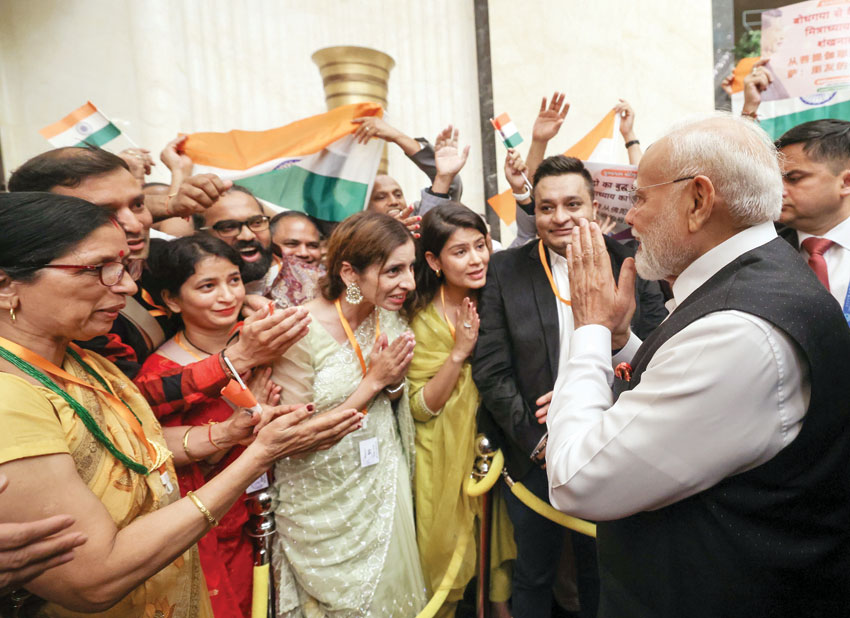
In the Indian context, diaspora groups that went to countries like Trinidad and Tobago and Fiji as indentured workers over a century ago were particularly impressive they managed to maintain their religious identity and even their language. This was without any forms of contact like phones, the internet, satellites, or even air flights to facilitate easy visits by these groups to the homeland (It should be pointed out the language evolved somewhat differently from the way it was spoken in India because of the lack of contact with the home country).
Even as late as the 1990s, when the internet was in its infancy, connecting with India was difficult. Flights were few, phone calls were expensive, while email and the world wide web were yet to reach their high level of cultural dissemination to the global population. Early websites were amateurish affairs and newspapers and media outlets took time to understand the potential of the web.
Modern technology changed the way a diaspora was able to connect and interact with the home country. As satellites and the internet became common, and later with the advent of cellphones and social media, diaspora groups were able to follow in real time the events in the home country and see for themselves the changes in culture and society. More importantly, they could maintain contact with a culture which they saw as both authentic and defining their personal identities. The Dutch writer, Ian Buruma, has pointed out how the advent of satellite television allowed working class Moroccans in the Netherlands to be connected with their home country and to have their conservative views reaffirmed by what was beamed out of Morocco. The Indian case is somewhat different and more nuanced.
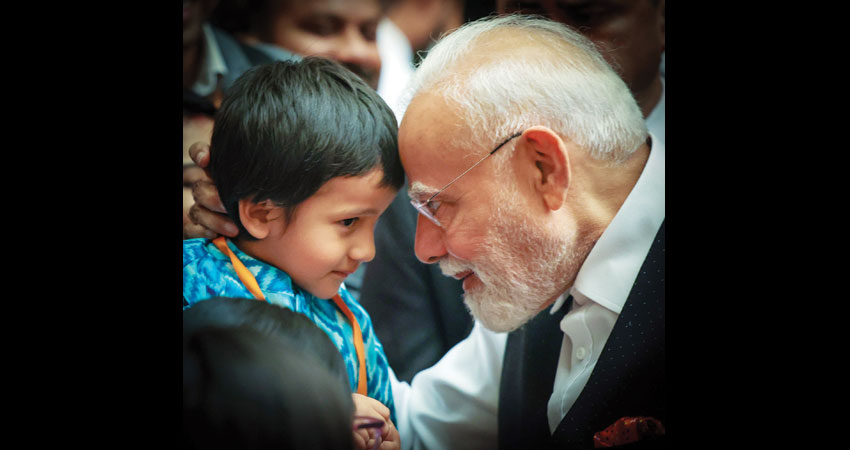
Indians have become a digital diaspora in that modern technology allows them interact with their friends and family and to understand events in real time. It also allowed them to comment on events in India and to try and influence them according to the value system of the diaspora. Recognizing this trend, Indian political parties started to solicit funding from the diaspora and to even work to push certain political agendas for them (one being the establishment of Overseas Citizens of India cards).
The efforts of Indian-American groups were, in fact, successful enough to deny Prime Minister Modi an American visa when he was the Chief Minister of Gujarat because of the Godhra riots. Such was the influence of the diaspora that the ban could only be lifted when Mr. Modi became the Prime Minister and the US State Department could not deny a visa to the leader of a large democratic nation like India. One has also seen how Khalistani groups in Britain, Canada, and the United States have worked to try and change the policies of these host countries towards India. So what shapes the attitudes of the Indian diasporic community towards the current prime minister? Their attitudes are shaped by the countries they are located in, their economic status, and their religious identities.
There is a big difference between Indians in the Persian Gulf countries who are there for purely economic reasons and have relatively modest incomes when compared to the Indian diaspora in the United States where the median household income of Indian-Americans is $150,000 making them the richest minority in America (they are also the best educated because eighty percent of the men and fifty percent of the women have college degrees).
Those working in countries which give lower wages actually send the largest amounts of money home to their families. They also tend to very patriotic and deeply connected to the homeland. Cricket lovers know that the revolution in the game that led to higher wages did not happen in India but rather in the emirate of Sharjah where Sheikh Abdul Rahman Bukhatir organized one-day games between the national teams of the world. He was shrewd enough to know that the large Indian and Pakistani populations in the Gulf would flock to the games to see their national teams and thereby feel connected to their homeland. It is countries like the Gulf states, Fiji, and Trinidad and Tobago where the pro-Indian sentiment is high and the Prime Minister has a favorable image since these Indians either have plans to return home or they, like those in Fiji and Trinidad, face an oppressive political environment which makes them seek the support of the home nation.

In the west, particularly the United States, the attitudes towards the Prime Minister are based on education, ethnicity, and religion. They are also based on the fact that every Indian prime minister generates polarizing opinions in the diaspora. Mrs. Indira Gandhi was an example of this for while most members of the diaspora saw her as a strong and decisive leader, the university based intellectuals in the United States were of the opinion that she was authoritarian in her style of governance. As a consequence, they strongly opposed her regime and sought to move the American political system to put pressure on Mrs. Gandhi particularly while the Emergency was ongoing in India.
Now things have changed for there is a division within the educated groups in the United States on how to view the Indian Prime Minister. In the tech world, Mr. Modi is popular since he is seen as embracing technological development and pushing to make India an advanced economy. His diplomatic efforts to persuade successive American Presidents to not reduce the number of Indian H1-B visas was also deeply appreciated by the tech community because such labor used to help Silicon Valley maintain high levels of profitability. He is also viewed by the techies as both a strong leader who has competently represented India on the global stage and for building up the country’s military capabilities.
Yet even there this support has not gone beyond compliments, photo opportunities, and following him on social media. When Operation Sindoor took place, none of the tech millionaires and billionaires were actively pushing India’s position in the American corridors of power. In contrast, sections of the Jewish community effectively mobilized after the Hamas attack of October 7, 2022 to strengthen the resolve of both Biden and Trump to support Israel by both defending the country and providing it with American weaponry in the form of grants( which meant Israel would not have to repay the United States). Such was the support that the United States pulled missiles from its own stockpiles to defend Israel. Nor with the current tariff war have we seen the Satya Nadella’s or Sundar Pichai’s come out to criticize the Trump economic policy towards India. The admiration and support for Mr. Modi, therefore, is constrained by the economic realities in which the tech world operates. It depends on being in the political good graces of the Trump Administration and, consequently, we have not witnessed any attempt to mobilize on behalf of the Indian government or its positions.
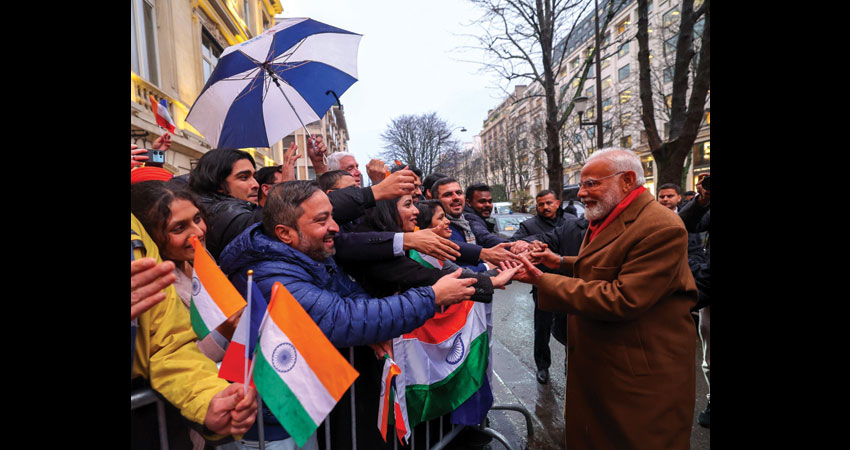
On the other hand, on college campuses there is opposition to the Prime Minister based on the perception that he has been responsible for shifting the nation away from its democratic traditions. It is there that graduate students and college professors of Indian origin tend to take a harsher view of Mr. Modi and protest against him and his policies. It was also mainly this grouping which was instrumental in denying him a visa to America.
Not all university faculty and graduate students fall within this category because a significant number identify as practicing Hindus and they are huge fans of the Prime Minister and the BJP which they see as having boosted the country’s image and its national pride.
In the business community, on the other hand, there is considerable support for Mr. Modi because his policies are seen as favoring business as well as investment in India. To business groups, he is viewed as creating opportunities in the Indian market and again the opinion is that he has made India into a militarily stronger nation-state. If there is an educational divide on Mr. Modi there is also one based on ethnicity.
Indians in America and the West have not abandoned their ethnic identities and continue maintain them through cultural groupings. This leads to Indians organizing as Telugus, Marathis, Bengalis, Punjabi, and Gujaratis to the extent that now some people do not describe themselves as Indian-Americans but rather as Gujarati-Americans. This splintering of identity has had its impact on Mr. Modi’s reputation since the Gujarati community has overwhelmingly gone out of its way to mobilize support for him in the United States. The Gujarati community is unlikely to strongly support a prime minister from another state thus making it improbable that there would be a “Howdy Modi” style mega event for a leader from Bengal or Orissa.

Religious identity also plays a role in how the Prime Minister is perceived by the diaspora. Some Indian Christian and Indian Muslim groups have sought to mobilize and publicly criticize Mr. Modi on the treatment of both these groups in India. Now some members of these groups do not even identify with India preferring to call themselves Muslim Americans or South Asian Americans. Neither identity makes sense since there are huge ethnic divisions within Muslims in America (starting with the African-American Muslim movement) and South Asian Americans is like saying European Americans. It is a geographic identity and not an ethnic one.
So how does one best describe the diaspora’s perception of the image of the Indian prime minister? The most fundamental thing to remember is that like every other Indian prime minister Mr. Modi has fans of his policies as well as strident critics of these policies and by extension of him for being their public face. Mrs. Gandhi had her critics in the diaspora, as did Rajiv Gandhi and Atal Behari Vajpayee, but that is a reflection of the fact that India remains a democracy and that means different views and approaches are to be expected in the diaspora’s perception of Mr. Modi and his track record.
What is also clear is that Mr. Modi is the first digital prime minister of the country and, consequently, this means that everything he does or says is beamed around the world through both the government’s social media as well as by the common man in the country. This means he has faced far greater scrutiny than his predecessors who did not see an instantaneous reaction to what they did or said to the general public. Every politician faces this challenge now and the mainstream media is no longer able to control the narrative and present a favorable picture as it did during the times of Nehru or Mrs. Gandhi. Citizen journalists now are a far more effective through WhatsApp and Tik Tok than the traditional print media in either India or in the rest of world. This being the case one has to say that Mr. Modi has managed to deal fairly well with this complex media environment and project a positive image to most of India’s diaspora.

By Amit Gupta
(Amit Gupta is a Senior Fellow in the National Institute for Deterrence Studies and has written extensively on Diaspora politics. )
(The content of this article reflects the views of writer/contributor, not necessarily those of the publisher and editor. All disputes are subject to the exclusive jurisdiction of competent courts and forums in Delhi / New Delhi only.)














Leave Your Comment