


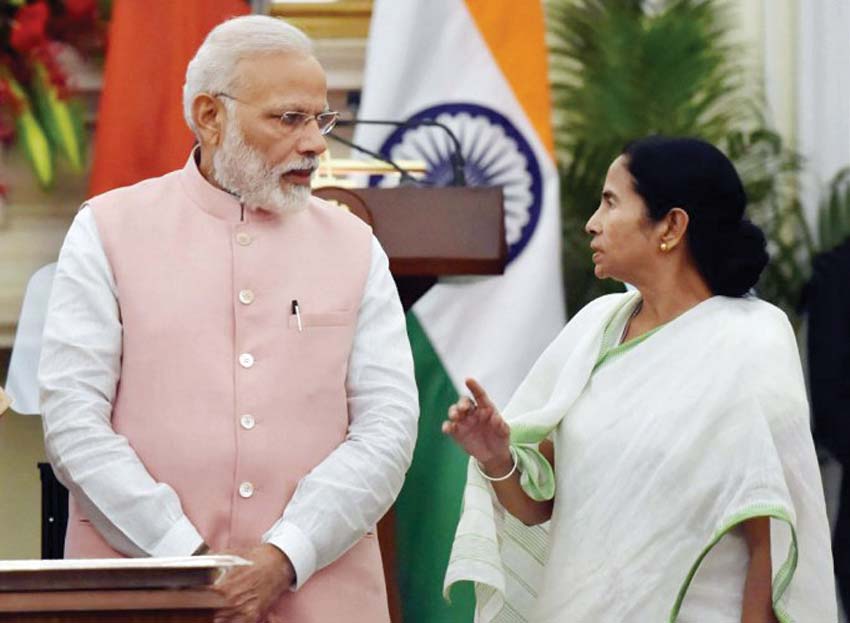
The first challenge that has been thrown up at Indian Prime Minister Narendra Modi as he pursues his foreign policy - vision during his third consecutive term at the office has come from Chief Minister of West Bengal, Mamata Banerjee.
This challenge seems to reflect two major trends in India’s external behaviours, of late - “water nationalism” and the growing “federalisation” of Indian foreign policy. These trends may well limit Modi’s power, or for that matter the power of any central or federal government at Delhi, to conclude international treaties or agreements with foreign countries.
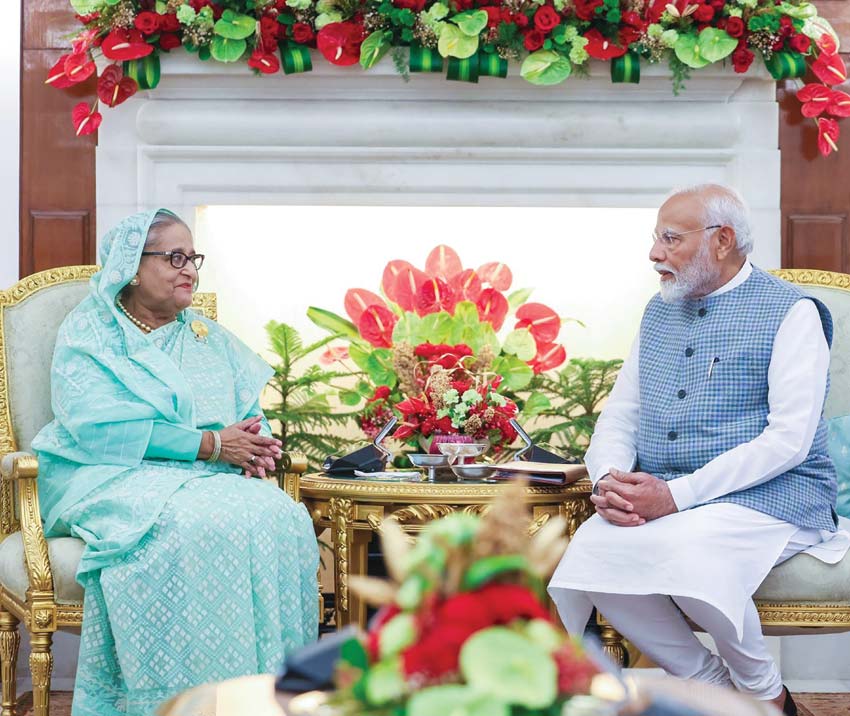
Following a highly successful visit last week of the Bangladesh Prime Minister Sheikh Hasina, the first on the part of the head of a foreign country after Modi began his third innings, Banerjee, a powerful leader of the opposition in the country, has written a letter to the India Prime Minister, indicating that New Delhi should not reach any water-sharing agreement without Bangladesh without taking into confidence the state government led by her.
“I am writing this letter in the context of the recent visit of the Prime Minister of Bangladesh. It seems that water-sharing issues relating to the Ganges and Test rivers may have been discussed during the meeting. Such unilateral deliberations and discussions without consultation and the opinion of the state government is neither acceptable nor desirable,” Mamata Banerjee wrote.
"I came to understand that the Government of India is in the process of renewing the India-Bangladesh Farakka Treaty (1996) which is to expire in 2026. It is a treaty which delineates the sharing of water between Bangladesh and India and as you are aware, has huge implications for the people of West Bengal”, she added, emphasizing that the people of Bengal are"worst sufferers" of such treaties.
In her letter, Banerjee, of course, noted how West Bengal shares a very close relationship with Bangladesh – geographically, culturally, and economically and how the state has cooperated with Dhaka on several issues in the past. “Agreement on the exchange of India-Bangladesh enclaves, also known as the Chitmahals, Indo-Bangladesh Railway Line and Bus Services are some of the milestones of jointly working together with Bangladesh for the betterment of the economy in this region. However, water is very precious and is the lifeline of the people,” she wrote, adding “We cannot compromise on such a sensitive issue”.
Incidentally, all the cooperative agreements between India and Bangladesh, including the sensitive exchange of enclaves in 2015, have taken place under the Modi government only. And Banerjee did support all these measures. But, water sharing is proving to be a difficult issue.
It may be noted that the centuries-old water systems of the Indian subcontinent got fractured when the country was partitioned in 1947. As a result, many rivers became “shared rivers", leading to differences among the countries in the region over the quantum of the shares.
The ‘shared rivers’ are increasingly becoming sovereign issues and are being manifested as the phenomena of “water nationalism”, with water becoming scarce with each passing year for nearly two billion people of the subcontinent.
It is to be noted that Modi is not the first Prime Minister that Mamata Banerjee as the Chief Minister of West Bengal is fighting over sharing water with Bangladesh. Despite her party, Trinamul Congress, being a component of the then ruling UPA led by Prime Minister Manmohan Singh, she scuttled efforts at sharing water. Manmohan Singh, before his visit to Bangladesh in September 2011, had prepared, in consultation with his Bangladeshi counterpart Sheikh Hasina, a package of agreements to resolve many of their bilateral irritants. However, a week before Singh’s visit, Banerjee denounced the proposed water sharing agreement. Her opposition made the whole trip effectively irrelevant, to both sides’ great embarrassment.
There have been other instances of Delhi’s power to deal with foreign countries being diluted because of the resistance of state or provincial governments, leading to what experts call the growing “federalization” of Indian foreign policy. Constitutionally speaking, foreign-policy is a subject that is the exclusive domain of the central government in India’s quasi-federal arrangement. The primary institutions for framing and implementing foreign policy are the external affairs minister, the bureaucracy attached to the ministry of external affairs, the prime minister and his office.
It is the Centre that can declare war; conduct relations with foreign nations and international organisations; appoint and receive diplomatic and consular officials; conclude, ratify, and implement treaties; and acquire or cede territory.
No wonder why soon after independence, all major treaties that India had entered into with other countries – the Indo-Bhutanese Treaty of 1949, the Nehru-Liaquat Agreement of 1950, the Indo-Nepalese Treaty of 1951, the India-China Agreement of 1954, the Tashkent Agreement of 1965, the Indo-Soviet Treaty of 1972, the Simla Agreement of 1972 and the Indo-Lanka Accord of 1987 – were never discussed or debated in Parliament in advance, let alone state governments being briefed about them.

Even after the treaties were concluded, the parliamentarians, in the absence of any mandatory requirement of the Parliament’s approval for their ratification, have been helpless in modifying the texts.
However, things are now changing, particularly in the “border states”. Leaders here have forced the central government to include the concerns of the states’ people in dealings with the neighbouring country. Foreign policy is thus being conditioned accordingly and getting “federalized”.
India borders Pakistan, China, Bangladesh, Myanmar, Sri Lanka and Maldives. In effect, what this means is that any development in each of these countries has its fallout on the contiguous Indian states. India-Pakistan relations thus affect Gujarat, Rajasthan, Punjab and Jammu and Kashmir; India-China relations affect Kashmir, Uttarakhand, Himachal Pradesh, Sikkim and Arunachal Pradesh; India-Nepal relations spill over to Bihar, Uttarakhand, Uttar Pradesh, Sikkim and West Bengal; India-Bhutan relations impinge upon West Bengal, Sikkim, Arunachal Pradesh and Assam; India-Myanmar relations will have an impact on Arunachal Pradesh, Nagaland, Manipur and Mizoram; India-Bangladesh relations have implications for West Bengal, Tripura, Meghalaya, Mizoram and Assam; India-Sri Lanka relations are closely intertwined with the politics of Tamil Nadu; and India-Maldives relations will have its impact on Minicoy Islands.
It so happens that most of the important regional parties that happen to govern the border states have important concerns with the neighbouring countries that are different from the concerns seen from New Delhi. See the way Jammu and Kashmir looks at Pakistan, West Bengal looks at Bangladesh, and Tamil Nadu looks at Sri Lanka.
Incidentally, then an opposition parliamentarian, George Fernandes, on March 5, 1993, had given notice of intention to introduce the Constitution (Amendment) Bill, 1993 in the Lok Sabha (Lower House) for amending article 253 to provide that treaties and conventions be ratified by each House of Parliament by not less than one half of the membership of each House and by a majority of the legislatures of not less than half the States. But the Bill was not listed for consideration during the life of that Lok Sabha.
Prior to that, in February 1992, M A Baby, a Rajya Sabha (Upper House) member, had also given a similar notice. His Bill came up for discussion in the Rajya Sabha only in March 1997. But it did not go beyond the discussion-stage.
It is important to note that during the discussions, former Congress leader Pranab Mukherjee (subsequently he became India’s President), whose Congress party was supporting the then minority United Front government, had strongly argued as a Congress law-maker in favour of “the Executive” (the Central government) retaining its primacy in treaty making.
He had pointed out that if parliamentary approval would be mandatory for the conclusion of all treaties, then given the divisive nature of the polity, no important and sensitive treaties such as the water-sharing treaties with Nepal and Bangladesh and World Trade Organisation (WTO) agreements could ever have received India’s accession. He had only conceded that Parliament could have informed debate and discussion on the relevant provisions of the treaty, but without any power to veto it.
Be that as it may, over the last few years, there have been enough instances that underscore the fact that states or provinces are clamouring for bigger roles in external relations, which were hitherto the exclusive preserve of the Central government. After all, when one talks of globalisation and the consequent interconnectedness between the peoples of various regions of the world, the state governments do get concerned if the people of the states are adversely affected by the impact of globalisation, particularly in the areas of agriculture, setting up foreign industries, allowing multi-band retail, nuclear projects and resource-sharing.
There is that burning example of the ignominious end of the South Korean giant POSCO’s plan to build a $12 billion steel plant in the eastern State of Odisha – India’s largest foreign direct investment project – following the State government’s suspension of the land acquisition for this project in the face of opposition from the people of this iron-ore rich region who would have been displaced because of the industrial project.
Whether growing federalisation of foreign policy is good or not depends on many variables. By its very nature, the term “federalisation” presupposes a balance of political forces between the inherent tendencies of parliamentary centralization and federal decentralization. But, what is happening is that there is more “regionalization” than proper “federalization”, affecting thus the normal foreign policy process and making decisions unpredictable. And that is not good for the country as India’s economy grows and its integration with the global economy becomes more important.
Therefore, many foreign policy experts agree that the need of the hour is “A Balancing Act”. Whether Modi succeeds in meeting this challenge remains to be seen.

By Prakash Nanda
(prakash.nanda@hotmail.com)














Leave Your Comment