



Deepak Kumar Rath
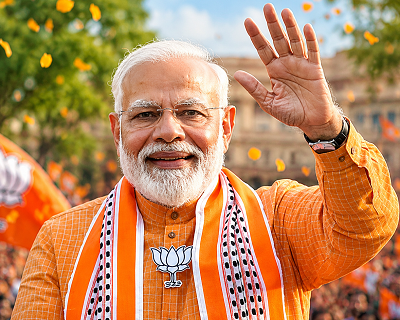
Twelve years ago, India stood at a complex crossroads, grappling with structural inertia and a collective crisis of confidence. Today, the national narrative has shifted entirely. Under the stewardship of Prime Minister Narendra Modi, the country has undergone a profound psychological and cultural renaissance, transitioning from a state of geopolitical hesitation to one of self-assured global leadership. At the heart of this transformation lies a unique philosophy of governance—one that mirrors the ancient ideal of the Nishkam Yogi, an individual who performs their duty with absolute dedication, detached from personal ambition, solely driven by the welfare of the collective.
For a nation that spent decades viewing its heritage through a lens of colonial self-doubt, the last twelve years have served as a powerful period of cultural reclamation. PM Modi has systematically dismantled the notion that modernization requires the abandonment of indigenous identity. Instead, he has woven India's civilizational ethos into the very fabric of statecraft. From the grand resurgence of sacred spaces like Kashi and Ayodhya to the global celebration of International Yoga Day, the administration has successfully awakened India’s latent spirituality. This is not merely a revival of ritual; it is the reactivation of a foundational philosophy that anchors the modern Indian identity, offering a distinct alternative to Western materialism. By anchoring progress in cultural roots, the current leadership has restored a long-lost sense of civilizational pride to the populace.
This spiritual awakening has directly translated into a newfound confidence on the global stage. Where Indian foreign policy once prioritized non-aligned caution, it now operates with bold strategic autonomy. Today, the world witnesses an India that speaks as an equal, whether navigating complex multipolar conflicts, championing the interests of the Global South, or securing its own economic and energy interests against external pressures. This is the confidence of a populace that no longer seeks validation from foreign capitals. The modern Indian citizen faces the world with the assurance that their country is not just an emerging market, but a civilizational power shaping the future of global technology, climate action, and digital infrastructure.
Crucially, PM Modi’s leadership style resonates deeply with a changing demographic landscape. As the first Prime Minister born in post-independence India, he is entirely free from the historical anxieties of the immediate post-colonial era. He speaks directly to the language of an aspirational, young nation that demands efficiency, dignity, and rapid development. His governance model operates on the principles of Nishkam Karma—relentless public service driven by a vision of systemic equity. The scale of the welfare initiatives implemented over the past twelve years demonstrates this ethos. By leveraging technology to provide millions of citizens with digital banking, clean energy, affordable housing, and universal healthcare, the government has treated welfare not as a political favor, but as a fundamental duty to the underprivileged.
Through this synthesis of welfare, infrastructure, and cultural dignity, the current leadership is attempting to build Ram Rajya on its own modern terms. In this contemporary vision, Ram Rajya does not represent a retreat into the past, but the realization of a just, equitable, and prosperous society. It manifests as a state where governance is transparent, where corruption is aggressively minimized, and where the poorest citizen is empowered to participate in national growth. It is a blueprint that combines high-speed rail networks and semiconductor hubs with ancient moral values, demonstrating that absolute material progress can coexist harmoniously with spiritual consciousness.
Ultimately, the defining achievement of the last twelve years is the psychological liberation of the Indian mind. The nation has moved past the era of survival and entered the era of assertion. By acting as a bridge between India's timeless spiritual heritage and its futuris-tic global ambitions, Modi has fundamentally redefined what it means to be a modern Indian. The country is no longer merely reacting to global trends; it is actively setting them, guided by a leadership that views political power strictly as a vehicle for national transfor-mation.




















Leave Your Comment