


Manoj Dubey
Nehru emerged as the most widely accepted national leader after Gandhi, supported by the Congress leadership and enjoying broad public popularity. As Prime Minister (1947-1964), he laid the foundations of parliamentary democracy, scientific development, economic planning, and a non-aligned foreign policy, shaping the direction of modern India for nearly seventeen years. During his tenure, major investments were made in heavy industries, steel plants, dams, power generation, scientific research, and public-sector enterprises.
Historians and political analysts continue to debate Jawaharlal Nehru’s legacy. Major criticisms include slow economic growth, persistent poverty, neglect of primary education, food insecurity, and sluggish gains in literacy. India’s defeat in the 1962 Sino-Indian War is widely regarded as his greatest foreign policy setback. The decision to refer the Kashmir dispute to the United Nations remains controversial.
Many of these criticisms must be understood against the backdrop of the enormous challenges India faced in 1947: Partition, refugee rehabilitation, poverty, illiteracy, communal violence, and the integration of princely states. Supporters argue that Nehru's emphasis on democracy, secularism, scientific temper, and institution-building helped stabilise a newly independent nation, while critics contend that several policy choices slowed India's economic and strategic development.
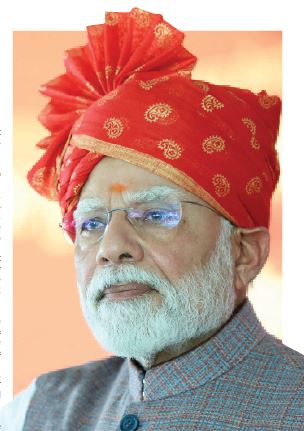
Narendra Modi
Narendra Modi, the 14th and current Prime Minister of India, is among the most influential and dynamic leaders of our time. His journey from a modest childhood in a small town to leading the world’s largest democracy is a remarkable story of determination, discipline, and leadership. Modi’s life embodies the values of hard work, perseverance, and commitment to the nation, making him a source of inspiration for millions across India and beyond.
Early Life and Childhood
He grew up in a humble OBC family. His father ran a small tea stall at a local railway station, where young Narendra often helped by serving tea to passengers. This early life experience instilled in him the values of hard work, discipline, and empathy for ordinary people. Growing up in modest circumstances, he developed a deep connection with common people and their aspirations. In 1971, during the Indo-Pak war, Modi volunteered at relief camps to help soldiers and families, displaying his sense of duty.
Rise in the BJP
He joined the BJP in 1987 and began as a grassroots organiser, working tirelessly to strengthen the party’s base in Gujarat. He was entrusted with major responsibilities, including Advani’s Ram Rath Yatra (1990) and Murli Manohar Joshi’s Ekta Yatra (1991). Both events expanded the BJP’s base across India. By the mid-1990s, Modi had risen to the position of National General Secretary (Organisation) of the BJP.
Chief Minister of Gujarat (2001-2014)
Narendra Modi’s tenure as Chief Minister of Gujarat transformed the state into one of India’s fastest-growing economies. Taking office in 2001, amid political instability and post-earthquake challenges in Bhuj, Modi introduced policies focused on infrastructure, industrialisation, and investment promotion. He initiated the construction of the world’s tallest statue (182m) dedicated to Sardar Patel near the Sardar Sarovar Dam. The Vibrant Gujarat Global Summits attracted domestic and foreign investors, positioning Gujarat as an industrial hub. Supported by business-friendly policies, Gujarat’s GDP growth consistently outpaced the national average.
I lived in Gujarat for 14 years and witnessed the state's progress. Modi was more popular than the BJP in Gujarat. He won three consecutive Assembly elections in 2002, 2007, and 2012, making him Gujarat’s longest-serving Chief Minister. His governance model, often called the ‘Gujarat Model’, is praised for driving economic growth and has firmly established him as a development-oriented leader.
Godhra Incident and Legal Battle
In February 2002, a train carrying Hindu pilgrims was set on fire at Godhra station, killing 59 people. The incident triggered communal riots in Gujarat that claimed over a thousand lives, mostly Muslims. Allegations of administrative lapses and complicity were levelled against Modi, drawing strong criticism at home and abroad.
Modi’s legal battle to clear his name was protracted and intense. Over years of investigation, the Supreme Court-appointed Special Investigation Team (SIT) found no evidence to prosecute him. In 2012, he was given a clean chit, a verdict later upheld by higher courts and reaffirmed by the Supreme Court in 2022. Legally exonerated, Modi turned the controversy into a political resurgence.
Prime Minister of India – First Term (2014 – 2019)
Narendra Modi’s success in Gujarat propelled him onto the national stage. In 2013, the BJP declared him its Prime Ministerial candidate. He campaigned across the country, promising development, good governance, and a corruption-free government. In the 2014 general elections, the BJP won 282 Lok Sabha seats, securing a full majority for the first time in three decades. Modi was sworn in as the 14th Prime Minister of India on 26th May 2014. His first term focused on development-driven governance, with flagship schemes including-
1. Swachh Bharat Abhiyan, Make in India, Digital India, Jan Dhan Yojana, Ujjwala Yojana, PM-Kisan Scheme and infrastructure improvement.
2. The Surgical and Balakot airstrikes showcased a strong stance against terrorism.
3. Goods and Services Tax (GST) is the most significant tax reform in independent India.
4. The Doklam standoff lasted 73 days and ended through diplomatic negotiations, sending a firm message to China that this is not India of 1962.
Prime Minister of India – Second Term (2019 – 2024)
In 2019, the BJP returned with an even larger mandate, securing 303 seats. Modi began his second term on 30th May 2019, with greater political authority.
Landmark Decisions
Prime Minister of India – Third Term (2024 – 2029)
In 2024, the BJP won 240 seats, and with its allies, the NDA formed the government led by Narendra Modi. He was sworn in for a rare third consecutive term as India’s Prime Minister on 9th June 2024, marking the first such instance since Jawaharlal Nehru. Unlike his previous outright majorities, the BJP fell short of a solo mandate and relied on coalition partners, indicating a shift towards more consensus-driven governance.
Key Moves so far
1. Waqf (Amendment) Act, 2025 – Passed and enacted in April 2025, the amendment introduced sweeping changes to Waqf property governance, aiming for secular, transparent, and accountable administration.
2. Operation Sindoor – Launched on 7th May 2025 in response to the brutal Pahalgam terror attack. Indian forces conducted precision strikes on 9 terrorist camps across Pakistan and PoK, targeting centres linked to LeT, JeM, and HM. In this brief 25-minute operation, over 100 terrorists were killed, and many more were injured.
3. India was formally declared free from Naxalism.
India’s infrastructure has expanded significantly. National highways have grown from 91,000 km in 2014 to over 147,000 km in 2025, with construction at 34 km per day. Railways have added over 27,000 km of new tracks, averaging 7.4 km per day. Semi-high-speed Vande Bharat trains have been launched, and rail electrification is nearly complete. The metro network has grown from 248 km in 2014 to 1013 km. The number of operational airports has increased from 74 to 160. More than four crore pucca houses have been built under the PM Awas Yojana. Over 400 new medical colleges have been established, and defence exports have surged. Chenab Bridge (the world’s highest railway bridge) and the new Pamban Bridge (India’s first vertical-lift rail-sea bridge) have been constructed.
Conclusion
Narendra Modi’s journey from a tea seller in Vadnagar to the Prime Minister of India is a story of resilience, determination, and vision. His life reflects the power of hard work and dedication, showing how someone from modest beginnings can rise to the highest office through commitment and leadership. In 2014, India’s GDP stood at $2 trillion, ranking 11th globally. Eleven years later, it has grown to $4.3 trillion, making India the fourth-largest economy. Recently, due to the depreciation of the rupee against the US dollar, India slipped to 6th place, with a value of $4.15 trillion. India has also risen to 4th place in global income inequality rankings, with a Gini Index of 25.5. The World Bank reported that over 27 crore people have moved above the poverty line in the last 10 years. Healthcare has become more affordable through the Ayushman Bharat and Jan Aushadhi (generic medicines) schemes. Notably, Modi has never faced corruption allegations as either Chief Minister or Prime Minister. While admired for his bold decisions and governance style, Modi remains a figure of debate in Indian politics. Supporters see him as a visionary leader who transformed India’s global stature, while critics question his handling of social and political challenges.
Regardless of perspective, Narendra Modi has left an indelible mark on India’s political landscape and continues to shape its future. Internationally, Modi has enhanced India’s diplomatic presence, balancing relations with major powers and positioning India as a leader of the Global South. If India’s political landscape in 2026 is vastly different from that of 2014, a large share of the credit goes to Narendra Modi. He has used a mix of welfarism, Hindutva, development, nationalism, and personal popularity to corner the Opposition.
10th June 2026 marks a special occasion in India’s history, as Narendra Modi completed 4399 days in office and became the longest-serving elected Prime Minister in a consecutive tenure, surpassing Pt Nehru’s 4398-day tenure. All the Prime Ministers of India have contributed to the country’s growth story. Pt Nehru laid the foundation of modern India; Indira Gandhi brought in the ‘Green Revolution’; Rajiv Gandhi emphasised ‘computer technology’; Narsimha Rao liberalised the economy; and Vajpayee improved the road network. Pt Nehru was an undisputed leader, supported by Mahatma Gandhi, and was not challenged electorally.
Narendra Modi is a self-made leader who has sought to transform India through reforms and delivery. He is credited with reshaping India’s polity and building new voter bases for the BJP. Before 2014, there was a kernel of truth in describing the BJP as a Hindi-belt party of upper castes; over the last 12 years, it has emerged as a pan-India party. Today, the BJP, with its allies, is in power in 22 states and union territories. Congratulations to Prime Minister Modi on completing 12 successful years as the elected leader of the world’s largest democracy.




















Leave Your Comment