


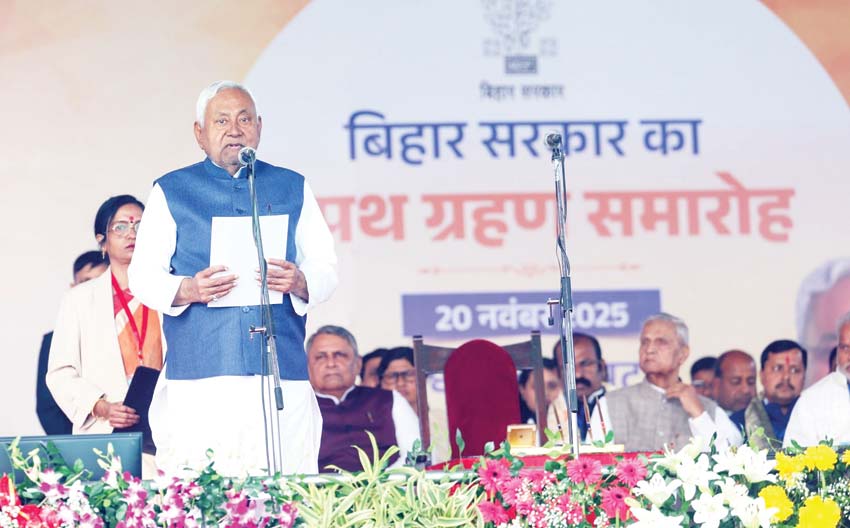
Nitish Kumar became the Chief Minister in 2005, when Bihar was struggling with poor infrastructure, weak law and order, and a low literacy rate. Large-scale migration was taking place due to rising crime under the previous RJD government. Nitish Kumar prioritised development, governance reforms, and social welfare. His major achievement was restoring law and order, marked by a sharp decline in crime and more effective policing. Roads, bridges, and rural connectivity improved substantially through Mukhyamantri Gram Sampark Yojana and other infrastructure projects. Educational reforms such as free bicycles and uniforms for girls increased school attendance and boosted female literacy.
Health facilities expanded through new primary health centres. The Jal-Jeevan-Haryali Abhiyan and Saat Nishchay schemes focused on water conservation, sanitation, and employment. Bihar’s power supply saw a major turnaround, achieving near-universal electrification. Socially, Nitish Kumar emphasized women’s empowerment by reserving 50% of seats for women in local bodies and 35% in government jobs. Despite economic challenges, Bihar’s growth rate often exceeded the national average during his tenure. Overall, his government transformed Bihar’s image from a ‘backward’ state to one striving for inclusive development and good governance. There have been no corruption allegations against him, and he consistently avoided dynastic politics. He remains the most popular leader in Bihar. However, despite many achievements, the state still faces serious challenges, including poverty, unemployment, and migration.
Election Strategy and Campaign
Political parties raised a mix of development, social justice, and governance-related issues to attract voters. The ruling NDA highlighted two decades of achievements, including better roads, electricity, women’s empowerment, law and order, and welfare schemes. They projected Nitish Kumar as a symbol of honesty, stability, and good governance. The direct transfer of Rs 10,000 to over one crore women proved to be a master stroke of the NDA government. Amicable seat-sharing and cohesion within the alliance were the strengths of the NDA. The BJP’s strong organizational network and Prime Minister Modi’s popularity further energized the alliance. Amit Shah, recognized for his strategic acumen, effectively shaped the NDA's approach. Prime Minister Modi, Amit Shah, J. P. Nadda, and Nitish Kumar, along with the Chief Ministers of the BJP-ruled states, campaigned vigorously. All five alliance partners worked as a seamless team and convinced the voters of their manifesto promises.
The opposition MGB, led by RJD and Congress, focused on unemployment, rising prices, corruption, migration, youth dissatisfaction, and anti-incumbency. Tejaswi Yadav promised a government job for one person in every family and criticized the government for failing to create employment despite years in power. Although the MGB’s grassroots outreach and social media campaign were energetic, the alliance suffered from a lack of unity and lingering doubts about RJD’s past governance and law and order record.
Both alliances made big promises in their manifestos to woo the voters. Overall, the Bihar election debate revolved around the contrast between ‘development and stability’ promised by the NDA and ‘employment and change’ demanded by the opposition.
Bihar’s Condition
The state continues to battle several long-standing problems that hinder its development. Poverty and unemployment remain widespread, especially among the youth, due to limited industrialization and inadequate job opportunities. Agriculture, the main livelihood, suffers from inadequate irrigation, outdated techniques, and frequent floods or droughts. Education and healthcare systems face a shortage of quality teachers, doctors, and quality infrastructure, leading to poor human development indicators. Caste-based politics and corruption often disrupt governance and hinder fair resource distribution.
Bihar needs a multi-pronged approach. Promoting industries and small enterprises will generate jobs and reduce migration. This can be done by improving infrastructure and better law and order. Modernizing agriculture through improved irrigation, training, and market access will boost rural incomes. Investing in quality education, skill development, and digital literacy will empower youth. Strengthening healthcare infrastructure, especially in rural areas, is crucial for a healthier population. Investment is vital for overall progress. Finally, promoting good governance, transparency, and social harmony will ensure inclusive and sustainable development. Bihar will have to transform its challenges into opportunities for long-term growth.
Record Voting
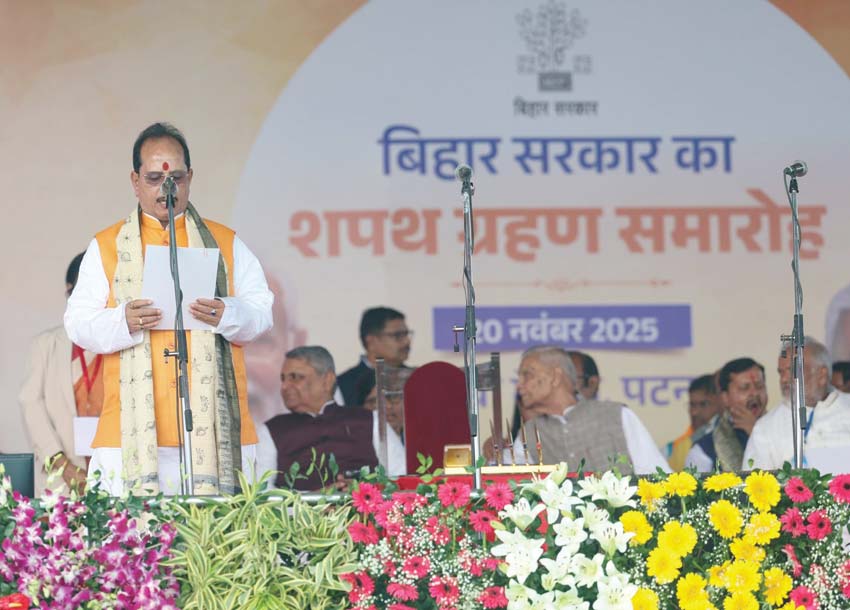
Elections were held in two phases on November 6 and 11, 2025, across 243 assembly constituencies. A record 67.13% of 74.5 million eligible voters participated, determining the outcome for 2616 candidates. Women voters, with 71.6%, outnumbered men voters at 62.8%. This indicated strong voter engagement and applied pressure on all major parties.
Results
Counting of votes was done on the 14th, and the results were announced by late evening. The National Democratic Alliance secured a landslide victory with 46.6% of the vote share and won 202 of 243 assembly constituencies (ACs) in the state. The BJP, JDU, LJP(R), HAM, and RLM won 89, 85, 19, 5, and 4 seats, respectively. The Mahagathbandhan (MGB) secured only 35 seats with 37.9% of the votes. The RJD, Congress, CPI(ML), CPI(M), and IIP secured 25, 6, 2, 1, and 1 seats, respectively.
NDA’s Triumph
= After two Lok Sabha majorities in 2014 and 2019, the BJP slipped below the halfway mark in the 2024 elections. This was dubbed as the beginning of the BJP’s and, more importantly, Narendra Modi’s decline. But the party has buried the ghost of the 2024 defeat and bounced back successfully.
= The seat distribution among the alliance partners was frictionless.
= The campaign was perfect, at the macro level, it focused on the empowerment of women, infrastructure and development, and the creation of employment.
= Pre-poll welfare measures, including Rs 10,000 to over one crore women, an increase in old-age pension, allowance to 12th pass students for two years, etc.
= Elections were contested under Nitish Kumar’s leadership, who is the most popular leader in Bihar with no corruption allegations and a clean image.
= Reminding the people of ‘Jungle Raj’ under the RJD rule from 1990 to 2005, the majority of voters have seen it and would not want its repetition.
= MY (Muslim-Yadav) was reframed as Mahila-Yuva, and policies were drafted accordingly.
= Strong direct outreach by Modi and Nitish Kumar helped them connect with voters.
MGB’s Decimation
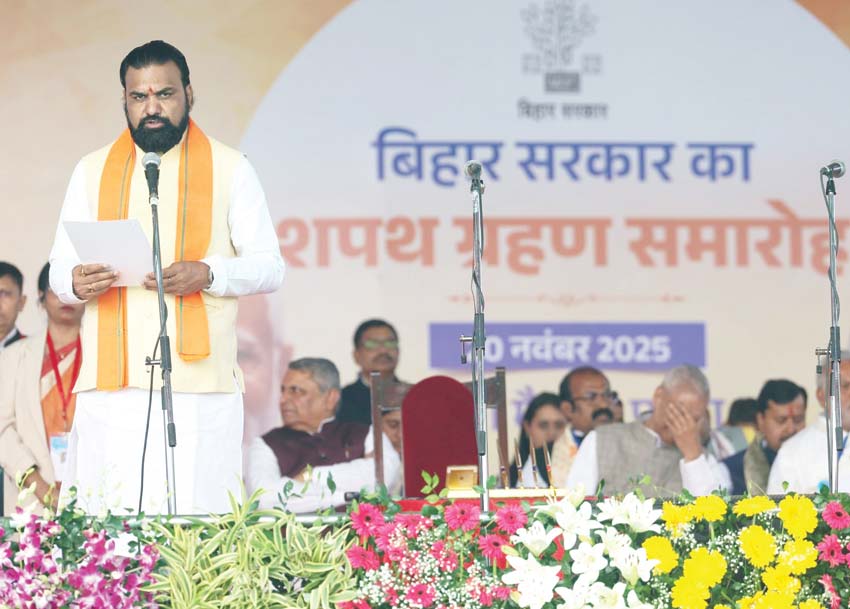
The alliance, led by the RJD, contested the election in an unplanned and inconsistent manner from the beginning.
= The RJD and Congress faced a friendly fight in several constituencies due to disagreements over seat-sharing. This internal rivalry weakened the alliance’s electoral coordination.
= Tejaswi Yadav led the campaign alone, appearing overconfident and taking Yadav voters for granted. Even his family members were not of any help to him. The alliance focused heavily on unemployment and corruption allegations but failed to counter the NDA’s welfare schemes. The campaign lacked message, discipline and consistency. Personal remarks on Nitish Kumar’s health were not appreciated.
= Despite Tejaswi’s energetic campaign, a section of voters viewed MGB as inexperienced, especially compared to NDA’s established image of ‘stability and welfare delivery’.
= NDA successfully revived concerns about law and order during Lalu Yadav’s era. This message of fear of the return of ‘Jungle Raj’ resonated strongly with the voters.
= There was no cohesion in the alliance partner. VIP of Mukesh Sahni was promised the post of Deputy CM, annoying the Congress, but the party did not win any seats.
= The promise of one government job per family, announced in desperation, to counter Rs 10,000 to women by the NDA, was totally impossible.
= Unlike the NDA’s disciplined booth-level machinery, the MGB suffered from poor coordination, weak candidate selection, and a lack of grassroots mobilization.
= Women voters form a decisive block in Bihar, leaned strongly towards NDA due to welfare schemes and perceived safety. MGB lacked a women-centric pitch.
= Congress performed very poorly, hampered by organizational weaknesses and a lack of leadership. Rahul Gandhi’s attack on SIR, his allegations of ‘Vote Chori’, and comments on PM Modi and the Chhath festival were unpopular. There was no coordination between Rahul Gandhi and Tejaswi Yadav. The campaign of Congress was ineffective, and the party became a liability to the alliance. Rahul Gandhi has done more harm than good to Congress and the alliance.
Election Commission of India (ECI)
The ECI conducted the SIR and made a fair electoral roll. No violence was reported during the polling, and no re-polls were conducted. We should commend the ECI for organizing these elections smoothly. Unfortunately, some losing parties accuse the ECI of irregularities to help the ruling party. This is a disrespect to the mandate of the people. If the parties have the evidence, they can always approach the court. We remember the 2010 Bihar assembly election results, the NDA won 206 seats, 4 more than this time. The Election Commissioner was then appointed by the Congress-led UPA government.
Prashant Kishore
His Jan Suraj Party secured only 3.3% vote share but no seats. A good consultant or strategist may not be a successful politician. He worked very hard and focused on the important issues of jobs, migration, and industry. His party earned a lot of limelight but not enough votes. He selected good candidates to contest, but voters were not convinced. Unfortunately, Bihar and Biharis may not have been ready for the message yet, although his campaign did strike a chord with young people. If he has to be relevant in Bihar, he needs to continue his political work for the next five years.
Muslim Politics
The traditional MY (Muslim-Yadav) social equation has not worked for the RJD. Muslims were upset when MGB promised Mukesh Sahni’s VIP the Deputy CM’s post. The Mallah community only has about 3% population, against 18% Muslims in the state. AIMIM has emerged with the highest number of Muslim MLAs in Bihar, all 5 from the Seemanchal region. This makes Bihar the first state after Telangana where the AIMIM has the highest number of Muslim MLAs. This has happened when the overall number of Muslim MLAs in Bihar has dropped to a historic low of just 11, with an all-time high share from Seemanchal. This information shows that the representation of Muslims is increasingly becoming ghettoised as they are failing to get elected from areas where they do not have a sizable presence. And in a region where they have the numbers to get their peers elected, they prefer a Muslim party.
Conclusion
The historic landslide victory of the NDA reflects the will of the people of Bihar and will significantly influence national politics. It is strengthening Prime Minister Modi’s leadership and the coalition. Nitish Kumar’s JDU has re-emerged strongly, reaffirming his role within the NDA. Welfare-driven politics remains highly effective, and the BJP/NDA may increasingly adopt such schemes nationally, especially targeting women, backward classes, and other demographic groups. This win will shape upcoming state elections and potentially the next general election. For investors and policymakers, a strong NDA government lowers political risk in the short term. The magnitude of the NDA win may encourage other regional parties to align more closely with the NDA, viewing it as a winning alliance. It also diminishes the opposition, especially Congress, reducing their ability to offer a credible alternative at the national level unless they reconsider their strategy. This victory will enable the ruling coalition to secure all 10 Rajya Sabha seats in the upcoming biennial elections in the state, throughout the remaining term of the Modi government. The new state government under Nitish Kumar needs to fulfil the promises made to the people of Bihar. The rapid development of the state will contribute to a developed India by 2047.

By Manoj Dubey
(The content of this article reflects the views of writer and contributor, not necessarily those of the publisher and editor. All disputes are subject to the exclusive jurisdiction of competent courts and forums in Delhi/New Delhi only)














Comments (10)
A
Wonderful article. A bridge for central and state governments.
N
Wonderful article by the author. It's a step by step analysis of the recently concluded election in Bihar. It's now time for delivery. Let's hope for the best.
S
The analysis given is easy to understand to the readers,simple,logical ,sequential and on the basis of real situation in Bihar.Requested to publish such articles regularly.
S
बिहार में NDA के प्रचंड जीत के मुख्य कारण थे - . मोदी और नितीश के विकास नीति में जनता का विश्वास . ' मेरा बूथ सबसे मजबूत ' अभियान द्वारा महिलाओं और युवाओं से सीधा जुड़ाव. मतदान में रुचि नहीं रखने बाले अनेक जातियों को मतदान के प्रति उत्साह जगाना. जंगल राज के प्रति नफ़रत जगाना. SIR का विरोध तथा घुसपैठियों का मुद्दा प्रवल होना. राहुल द्वारा मोदी पर व्यक्तिगत प्रहार और उसके बामपंथी अराजकता और Gen z का आवाहन. २०२४ में मोदी का २४० सीटों पर रुकने पर जनता का अफसोस इत्यादि। लेखक ने विशिष्टता से बिहार चुनाव परिणाम का विश्लेषण किया है। नये गृहमंत्री से बिहार का कायाकल्प होगा ऐसी अभिलाषा है। लेखक को ऐसी ही सामयिक लेख प्रकाशित करते रहने के लिए बहुत बहुत धन्यवाद।
H
Wonderful analysis in respect of Bihar political scenario right from very begining. In fact it was Nitish led Government that brought out Bihar from very bad image. JDU coalition government with BJP has done a highly appreciable job for all round development of the State. Previous Lalu government did nothing but only focused on the development of his own family. Now there is very bright future waiting ahead for people of Bihar.
S
Wonderful article, it depicts power of BJP and poor conditions of congress, keep it up
D
Excellant article, Bihar was in very savvy condition before 2005 until Nitish Kumar taken over as Chief Minister. The road, law and order, electricity, employment etc were not in order and state was under the rule of jungle raj. After Nitish roads, electricity, education and employment opportunities improved. Women empowerment with 35 percent reservation in government services and rs 10000 to every woman played an important role in favour of Nitish. The help of Modi and NDA leaders leads to the thumping win under Nitish leadership for development of Bihar. Very good article, kudos to author.
A
Writer of artcle describe prevalent confused conditions in Bihar before Nitish kumar and after taking cm post took majors to work in the field of Law and Order took majors to control crime ,upliftment of medical facilities in Bihar. He joined with NDA and BJP organised cadre , women empower ment by giving Rs 10000/ to over one crore women resulted 202 seats in Bihar vidhansabha elections I again congrats him to again write such Artcles
S
Great, Awesome insight with absolutely brilliant magnanimity of inspiration…!! WOW!!
S
Great, Awesome insight with absolutely brilliant magnanimity of inspiration…!! WOW!!