


The BharatiyaJanata Party (BJP), under Prime Minister NarendraModi, has consistently been labeled as a party championing Hindutva. However, with its latest "Saugat-e-Modi" campaign, the BJP is making a significant attempt to reach out to India's minority communities. This outreach, initiated during Ramzan and set to extend to the festivals of Sikhs, Christians, Buddhists, Jains, and Parsis, is a noteworthy political maneuver. Given the entrenched opposition of a large section of minority voters to the BJP, many wonder why the Modi government is making such an effort. More importantly, some fear that such overtures could alienate BJP’s traditional Hindu support base.
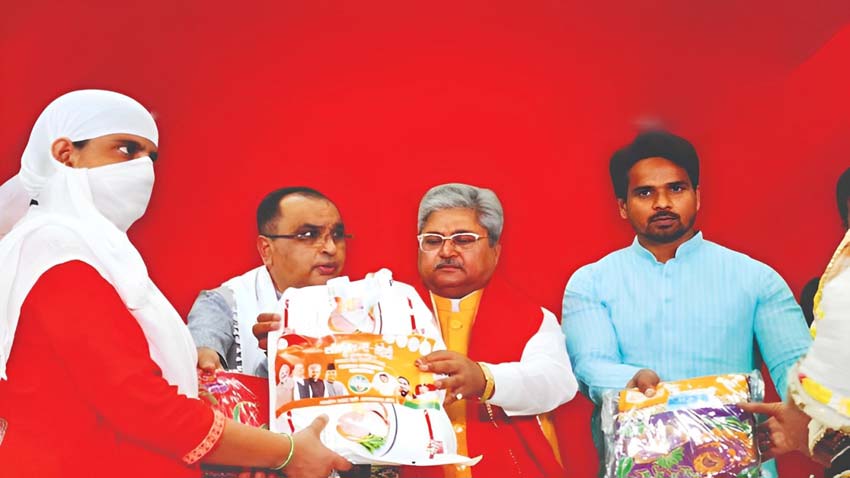
To understand this outreach, one must first acknowledge the BJP’s broader political strategy. The party has steadily expanded its base beyond its core Hindu nationalist supporters, making inroads into Dalit, OBC, and tribal communities. A similar strategy is now being applied to minorities, particularly targeting the economically weaker sections among them. The "Saugat-e-Modi" campaign, which focuses on distributing food and essential supplies to the needy, is designed to appeal to those within minority communities who may not be ideologically opposed to the BJP but have historically voted for opposition parties due to socio-political conditioning.
Moreover, this initiative is not merely about winning votes immediately but about altering long-term perceptions. The BJP understands that it is unlikely to secure a large share of the Muslim vote anytime soon. However, by consistently engaging with minorities, the party seeks to weaken the narrative that it is exclusively anti-minority. This could, over time, lead to a segment of minority voters reconsidering their political alignment, especially if they feel their socio-economic concerns are better addressed by the BJP than by other parties that have traditionally courted them but failed to deliver.
Some critics argue that this outreach is a direct attempt to counter the opposition’s allegations that the BJP is divisive. By publicly celebrating minority festivals and offering welfare assistance, the party is presenting an image of inclusivity, thereby blunting accusations of majoritarianism. This could prove especially useful in international diplomacy, where Modi’s government has often faced criticism over its handling of religious minorities.
The biggest concern, however, is how the BJP’s core Hindu support base perceives such moves. Many hardline Hindu voters, who have backed Modi for his strong leadership and pro-Hindutva stance, might view such outreach as unnecessary appeasement. There is a genuine risk that a section of the BJP’s Hindu base could feel betrayed, especially those who believe that the party should focus solely on consolidating Hindu unity rather than attempting to court communities that have been largely hostile to its ideology. The perception of a "softening" BJP might lead some supporters to explore alternatives like the Shiv Sena (Shinde faction) or other regional outfits that project a more hardlineHindutva image.
However, the BJP appears confident that it has consolidated its Hindu vote bank to an extent where it can afford to make limited outreach efforts without suffering electoral damage. Modi’s personal brand is so strong among Hindus that a calculated minority outreach is unlikely to result in large-scale defection of core voters. Furthermore, Hindu voters may not necessarily see this initiative as appeasement if it is framed as an act of generosity rather than political maneuvering. The BJP has historically opposed policies of religious appeasement such as subsidies and special privileges; "Saugat-e-Modi" does not promise electoral doles but instead provides humanitarian assistance, which can be justified as a universal good rather than religious favoritism.
Ultimately, the BJP’s minority outreach is a high-risk, high-reward strategy. While it may not yield immediate electoral dividends, it is a long-term investment in reshaping the party’s image and weakening the opposition’s monopoly over minority votes. The risk of alienating Hindu voters exists, but the Modi government seems to be betting on the belief that its larger governance and Hindutva credentials will keep its core support base intact. Whether this gamble pays off will become clearer in upcoming elections, but for now, the BJP appears determined to broaden its appeal—even if it means venturing into politically uncertain territory.
Uday India Bureau














Leave Your Comment