


Based on the popularity of Prime Minister Narendra Modi and his guarantees combining development and welfare politics with Hindutva, the BJP won key state elections in the Hindi heartland, sweeping back to power in Madhya Pradesh at the head of a landslide and unseating the Congress government in Rajasthan and Chhattisgarh. Additionally, it declared its arrival in Telangana, where the Congress overthrew the BRS government. The Bharatiya Janata Party's (BJP) strategy of leveraging collective leadership, spearheaded by Prime Minister Narendra Modi, to direct its campaign clearly paid off in these assembly elections, as seen by its historic triumph. As did the party's tactics of concentrating on its welfare outreach, nurturing important vote blocs like women and tribals, and continuously hammering the Congress on charges of anomalies and corruption. This strategy was particularly evident in Madhya Pradesh, where the party faced significant hurdles from anti-incumbency and the old guard was not the party's face in the polls, and in Chhattisgarh, where the party was clearly weaker than expected before the elections and lacked a strong state leadership. The party employed a similar strategy in Rajasthan, but it also benefited from a robust infrastructure spearheaded by former chief minister Vasundhara Raje.
The party secured clear mandates in all three states: 164 out of 230 seats in Madhya Pradesh, 115 out of 199 seats in Rajasthan, and 54 out of 90 seats in Chhattisgarh. The party had suffered crushing losses in all three in 2018.
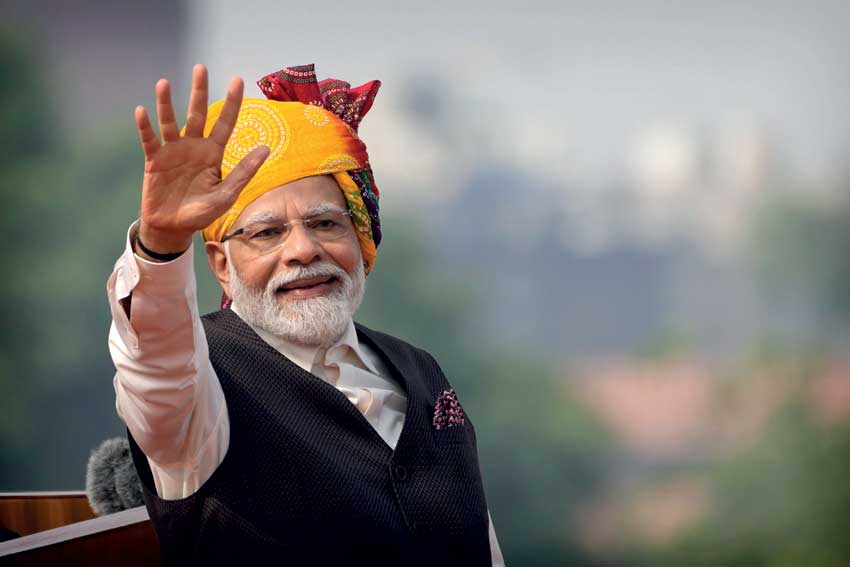
At the BJP headquarters in New Delhi, Modi praised the Assembly victories as "historic" and "unprecedented" and informed party workers that "this hattrick of victories has given the guarantee for the 2024 hattrick"—a reference to the upcoming Lok Sabha elections, in which he will lead the party campaign for a third consecutive term in office in a few months.
Questions concerning Rahul Gandhi's leadership and the role the Congress seeks in the Opposition INDIA bloc to oppose the BJP and Modi are also raised by the decisive victories in Madhya Pradesh, Chhattisgarh, and Rajasthan, where leader after leader credited Modi for the party's impressive showing. The fact that the Congress decided to stand alone in the state elections is already causing discord within the coalition, and the results will further exacerbate the complaints of other members of the group. The BJP is now establishing itself as a major force in the southern state. The BJP's Katipally Venkata Ramana Reddy defeated state Congress chief A Revanth Reddy, who was a strong contender for the position of the next chief minister, and BRS chief and chief minister K Chandrasekhar Rao in the Kamareddy constituency, despite the fact that the Congress has taken control of Telangana.
The percentage of the BJP's votes has increased from seven per cent to fourteen per cent. Modi also specifically mentioned Telangana while standing in front of a party banner that thanked Madhya Pradesh, Chhattisgarh, Rajasthan, and Telangana. At one point, he even spoke in Telugu.

“Over the last few years, this support has only been increasing and this trend will continue in the times to come. Our bond with Telangana is unbreakable and we will keep working for the people. I also appreciate the industrious efforts of each and every BJP karyakarta,” he said.
“This is a historic, unprecedented victory. Today, the sentiment that the development of the states will lead to development of Bharat has won,” Modi said.
While Modi's popularity and acceptance as a strong leader continue to be the BJP's greatest asset, the party has also benefited from its organisational strength, the goodwill generated by welfare programmes Chief Minister Shivraj Singh Chouhan started in Madhya Pradesh, the promises the party made in Chhattisgarh and Rajasthan, and the Hindutva platform.
It should be noted that the BJP's electoral performance has been aided by the regaining of the trust of tribal people, which is important in the three heartland states, and women voters, a demographic that has grown to be a key component of the party's political plans.
In his victory speech, Modi said: “Every poor person, every deprived person, every farmer, every tribal is thinking he has won today. Every woman is seeing her own victory. Every young person, every citizen is seeing this as a personal success.”
In response to the Opposition's attempt to centre the 2024 conflict around a caste census, Modi restated his poll platform, saying that only four castes exist in his view—the poor, youth, women, and farmers being the largest—and that the country can only become developed if these four classes are elevated.
In the Assembly elections, the BJP used "Modi ki guarantee" to counter the Congress's string of pledged guarantees. And Modi repeated this message when he spoke on the dais at the BJP headquarters on Sunday following the results. The words on the banner behind him read, "Sapne nahni, haqeeqat bunte hain, tabhi toh sabh Modi ko chunte hein (He weaves realities not dreams, that's why everyone chooses Modi)".
BJP leaders claim that the party made a significant effort in the four weeks leading up to the November 17 election. According to a BJP leader involved in the Madhya Pradesh election strategy, it was almost like a surgical strike, but it was executed thanks to the party's organisational strength and mobilisation capacity.
Party insiders noted that Union Home Minister Amit Shah took charge of electioneering on the ground while Modi headed the campaign in Madhya Pradesh.
The party has spent the last few weeks outlining its micromanaging tactics and political methods in an attempt to rally party members to fight this election and steal the victory away from the Congress, which was already relishing its advantage.
The decision by the party's central leadership to field a number of well-known politicians and leaders, such as Union Ministers Prahlad Patel, Faggan Singh Kulaste, and Narendra Singh Tomar, as well as party general secretary Kailash Vijayvargiya, proved effective.
In Rajasthan, where over ninety per cent of the population is Hindu, the BJP's campaign against the Ashok Gehlot government's "appeasement politics" seems to have benefited the party, even if Modi and his popularity remained its most important weapon in its armoury. If there was any doubt about its own state leadership, it addressed it by focusing its campaign on the growing gulf between Sachin Pilot and Gehlot.
The party in Chhattisgarh seemed prepared for a "decent" performance, despite the state unit's dismal performance over the previous five years. The BJP's numerous pledges, made just days before the first round of voting on 7 November, which included providing poor families with cooking gas cylinders for Rs 500 and married women with financial help of Rs 12,000 annually, are probably what kept the party in the race.
There was "an instant positive reaction" to the promises, according to our editor Deepak Kumar Rath, who visited the area prior to the polls.
The BJP central leadership is anticipated to select Chief Ministers after consulting with the elected members of the corresponding states, now that the results are in. It is unlikely, though, that Chouhan or Vasundhara Raje in Rajasthan will be disregarded in the process of selecting a leader. Both Chouhan and Raje continue to be well-liked party leaders with substantial backing from the victorious candidates.
Madhya Pradesh Dilemma
The party relied on Modi's popularity and the social programmes of the Union government, emphasising the potency of the "Modi guarantees," rather than putting incumbents up or designating them as chief ministerial candidates. In the Madhya Pradesh campaign, which the party ruled for eighteen of the previous twenty years, the strategy came together the best. According to some reports, there was a belief within the party that the BJP's 2018 performance—which saw it win 109 seats, trailing only the Congress's 114—was the result of anti-incumbency feelings directed towards Chief Minister Shivraj Singh Chouhan.
When the high command—Modi and Union home minister Amit Shah—launched the Jan Ashirwad Yatra, signalling the first moves towards a shift in order, it became clear that Chouhan was not leading from the front.
The party leadership sent out a message that a fresh person may take the top spot in the state by fielding legislators along with prominent Union ministers. Chouhan, sometimes known as uncle or mama, served as the CM for four terms. Party leaders claimed that despite the popularity of his programs, particularly those aimed at women and underprivileged groups, there was a "fatigue factor" attached to him.
The party aimed to gain from the individual support base of prominent figures and Union ministers, such as Faggan Singh Kulaste, Narendra Singh Tomar, Prahlad Patel, and national party general secretary Kailash Vijayvargiya, as well as the caste groupings they represented. Voters who were leaning against the previous administration saw a chance for change.
Rajasthan Conundrum
The party in Rajasthan adhered to the same tactic even though there was no comparable incumbency weariness with previous Chief Minister Raje. The BJP and Congress have alternated in Rajasthan. As such, the electorate is not confined to the same leadership. Change was desired even if the administration has historically been popular or pro-people. Raje has a significant base and influence because of her control over a sizable portion of lawmakers, her appeal to female voters, and her acceptance by people of all castes. Although the Party had parliamentarians like Rajyavardhan Singh Rathore and Diya Kumari as contenders, who were also considered as potential successors to Raje, her political savvy and control over the state's cadre make her a formidable opponent. Since 2014, the BJP has been more vocal in embracing generational shifts than in the past. Thus, it was believed that collective leadership would make room for a new generation of leaders. One of the steps to ensure that 2023 isn't just another 2018 was to switch up the faces at the state level.
Breaking the Chattishgarh Fort
Senior leaders in Chhattisgarh, including state president Arun Sao, Union minister Renuka Singh, and former minister Ram Vichar Netam, were among the legislators fielded as fresh faces to make sure they garner votes through their own caste groupings and seats. There is a belief in the state that the only people qualified to run the government are OBC or ST politicians. Raman Singh, a Thakur, served as chief minister for three terms and enjoyed great popularity. However, in 2018, he became unreliable due to accusations made against the government he oversaw. Despite his involvement in this election campaign, he was by no means the face of the Chief Ministerial post.
The party's narrative focused on issues that the average person experienced, such as those faced by farmers and the corruption that the Mahadev app revealed. When the BJP discussed buying paddy and made a bonus guarantee, it was this that swung the election in their favour. On the directive of the Central High Command, this was carried out. The emphasis on issues was intended to compensate for the absence of influential figures who were seen to be serious candidates for Baghel.
Owing to the Congress's well-received promises and schemes in states like Karnataka and Himachal Pradesh, as well as their popularity, the BJP also provided welfare programmes like the Mahtaari bandhan Yojna, which would give married women ₹1,000 per month.
Additionally, the party did not downplay during the campaign any particular state-centric issues, such as jobs, farmer difficulties, or societal unrest over topics like caste and reservation.
As the Lok Sabha elections draw near, the momentum and morale boost these results give will serve as a launchpad for incursions into states targeted for growth.
The BJP has once again shown itself to be a regularly operating party in this election. The Congress is not present there, but the BJP is there and actively participating in the ground. In addition to weakening the Opposition INDIA group, the Congress fiasco has increased the BJP's influence. Rahul Gandhi's standing is deteriorating while the Modi brand has gained credibility.

By NILABH KRISHNA
(The content of this article reflects the views of writers and contributors, not necessarily those of the publisher and editor. All disputes are subject to the exclusive jurisdiction of competent courts and forums in Delhi/New Delhi only)














Leave Your Comment