


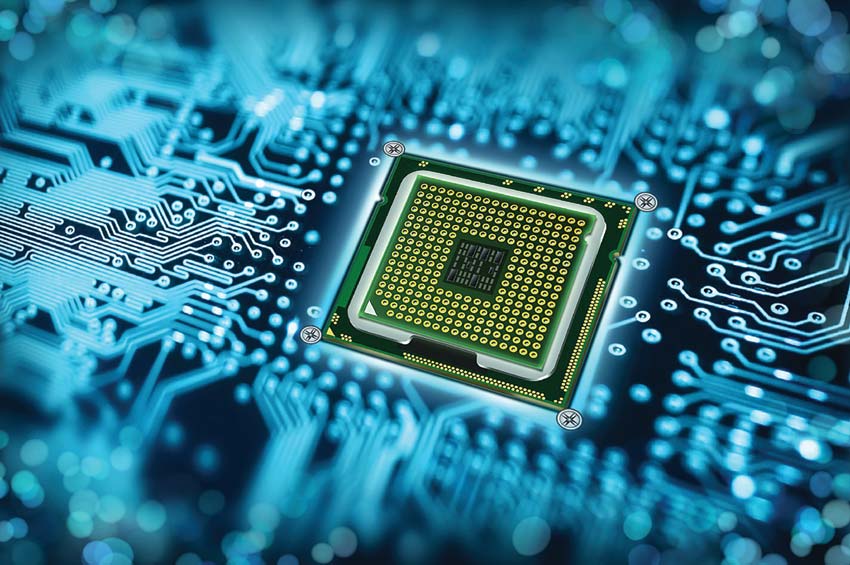
“Today's India inspires confidence in the world… When the chips are down, you can bet on India” Moving ahead now India is eager to manufacture its own chip as early as possible.
Mission Semiconductor with reference to India is a unique idea which can empower digitisation. The challenge is our background does not support the execution. The independent India never had the system and processes to encourage qualitative research. There was very little to celebrate!
Independent India was always considered as a mediocre and the development of new techniques was never an important issue.
Despite facing crisis after crisis, it kept on believing that peace can be managed without the power to protect. Kashmir invasion was taken to UN, Dalai Lama was given shelter without protecting his home land, lost huge parcel of land in a calamitous war with China in 1962. During war of 1965, spares were not provided by the arm selling countries. Lal Bahadur Shastri the then prime minister tried to shake the nation from its slumber. Jai Jawan Jai Kisan slogan led the nation to self-reliance in food grains. ISRO, ICAR did well but many other institutions lagged behind.
The threat from Pakistan drove a successful nuclear program and encouraged the government to spend plenty of money on foreign aircraft and weapons systems, but it took NDA government to initiate few serious incentives. The government tried unpack the piles of red tape throttling the Ministry of Defence and its domestic procurement programs. It is heartening to see aggression, accountability and commitment in our defence research and development organisations.
• If India is serious about making itself more self-sufficient and an exporter of repute it will require self-sufficiency in production of semiconductors. Today every product uses artificial intelligence, dependent on the power of computing, AI is taking over in one form or other. Even the art and literature are not aloof to this intervention. Chat Gpt has changed the way we do our research. More than a few policy tweaks here and there would have taken us nowhere. Entirely new mindset was needed. there would have to be a dramatic transformation in the way we think, discuss and contemplate.
• Another big issue was lack of risk taking capacity which depends on research and out of box thinking. China has been working since years and has been a successful to challenge the monopoly of the developed world as more and more new patents are being acquired by it.
• the problem was multiplied by corrupt license raj where processed coffee making needed intervention from the top. (Cafe Coffee Day story)
• India under present regime has opted for the ethical way for transfer of technology by providing incentives to promote ‘Made in India” campaign.
Moment of truth
The COVID 19 endemic challenged us, the country stood tall. India developed the vaccine much ahead of the developed countries and rescued the third world by providing the vaccine at affordable price. Digital intervention helped the nation to implement flawless vaccination campaign.
The world was crippling with the after effects of total Lockdown while digital payments kept the nation moving. The reduced growth rate was better than that exhibited by most of the countries. As a result, India launched New Education Policy, Mission Semiconductor and other initiatives during the peak of COVID endemic. The government proposed to provide incentives worth 76000 crore (10 billion US dollars). The aim was to build an ecosystem to manufacture semiconductors and invited applications for the same.
Challenges
Manufacturing the semiconductor is very different than any other manufacturing. The major challenges are:
• It requires constant research and deep pockets to fund it.
• Technically sound workforce.
• Difficulty in getting the know-how till we develop it indigenously.
• Well Integrated infrastructure where different vendor connects seamlessly to save on time and resources.
• Availability of rare metals.
• Ease of doing business.
Looking to these handicaps’ naysayers were sceptical in visualising great outcome. They have been proved wrong in a short span of three years!
”PM Modi laid the foundation stone of a chip fabrication unit at Dholera in Gujarat which is being set up by the Tata Group in partnership with Powerchip Semiconductor Manufacturing Corp of Taiwan. The first set of semiconductors will start rolling out from the Dholera plant in December 2026”. (ET, Mar 14, 2024)
Even though the problems envisaged did occur, few of these were:
• Less than expected applications,
• Failure in implementing,
• Strategic partner leaving midcourse
• Not able to mobilise enough resources.
The government has made genuine attempt to surmount these with following initiative.
• Massive subsidies
To woo the semiconductor players with massive subsidies were offered which can go to over 50%. This led to increase in interest from semiconductor companies and collaboration with these will help India achieve its target of capturing 10% of the world’s semiconductor market by 2030. India is already a hub for design facilities at Bengaluru.
Need for Industry-Academia Collaboration
There had been a significant lack of collaboration between academia and industry, hampering the innovation potential across sectors. The future lies in academia and industry working together. It will enable India to lead in markets like sensors and IoT. India currently ranks 66th in among 130 countries for Academia-industry collaborations.
NEP 2020 envisages to improve this. Universities are being encouraged to have faculty members having exceptional experience in the industry. IITs and other technical institutions are collaborating with the industry. As these experts will do the handholding students will try to become entrepreneurs. It will result in minimising the number of students specialising in Semiconductor Technology related areas ending up working abroad.
Establishing a Semiconductor Research Centre at the Indian Institute of Space Sciences
Speaking at SEMICON India 2024 the Prime Minister Shri Modi revealed plans to, establish a Semiconductor Research Centre at the Indian Institute of Space Sciences in collaboration with IITs, to produce not only high-tech chips for today but also next-generation chips.
Critical Mineral Mission
Critical Mineral Mission has been announced for securing critical minerals needed for the semiconductor industry. It will boost domestic production and overseas acquisition. India is working rapidly on customs duty exemptions and mining auctions for critical minerals. India has 6 percent of global reserves but production is insignificant at present.
Bringing all the stake holders on a single platform to discuss, explore and collaborate
Over and above the initiative mentioned above SEMICON India 2024 was organized from 11 to 13th September with the theme “Shaping the Semiconductor Future”. The three-day conference showcased India’s semiconductor strategy and policy which envisions making India a global hub for semiconductors. It witnessed the participation of top leadership of global semiconductor giants and will bring together global leaders, companies and experts from the semiconductor industry.
Talent Development
India has a growing pool of skilled engineers and technologists in the semiconductor field. Till recently internship with the industry used to be tool for getting unpaid labour, without enriching the knowledge. Even now one can see frustration of these young students who are posting their bad experiences on social media. The country's emphasis on STEM education and training will be a critical factor in supporting the semiconductor industry’s growth.
These initiatives have started showing green shoots. In all probability by 2026 in Indian semiconductors will be in market.
Challenges are many but Necessity is the mother of invention
The tiny East Asian country of Taiwan, is the world's undisputed leader in terms of raw semiconductor manufacturing which is largely due to the work of a single company, Taiwan Semiconductor Manufacturing Co. (TSMC). It alone manufactures roughly 50% of the world's semiconductors. As the diplomatic status of Taiwan is disputed by China the world may face a threat of losing its major source of semiconductors. India is importing 92 percent of its semiconductor requirement, which is a big drain on foreign exchange and it makes us dependent as well. Endemic COVID exposed us to this threat when we were depending on Chinese raw material to manufacture our medicines. World is also looking for other alternatives. We have missed the bus in 1990. Today the aspirations of Indian youths cannot be met by schemes like NAREGA. To move higher in value chain, we have to embrace innovation, entrepreneurship and prudent risk taking.
Opportunities and rewards
The global semiconductor market size was valued at USD 611.35 billion in 2023 and is projected to grow from USD 681.05 billion in 2024 to USD 2062.59 billion by 2032, exhibiting a CAGR of 14.9% during the forecast period. (Source: https://www.fortunebusinessinsights.com/semiconductor-market-102365). India can join the party if the present momentum is sustained.
Taiwan the biggest producer’s semiconductors industry benefits greatly from a robust end-to-end semiconductor supply chain. Taiwan is home to thousands of semiconductor-related companies. These companies handle every aspect of the semiconductor manufacturing process, from establishing the initial IP and designing the circuit to fabricating, manufacturing, and testing the final product. It is home to many state-of-the-art manufacturing facilities, can produce semiconductors that cannot be manufactured anywhere else in the world. Taiwan is always living under a threat therefore its leading company have joined hand with Tatas. Government of Gujrat is promoting Dholera as a semiconductor hub. Tamil Nadu, Assam and few other states have chalked out big plans. Many states are lagging behind on account of law and order and other issues.
In past when Indian automobile companies were seeking collaboration, the contempt shown by the leading companies was much more, three decades later Indian automobile companies are flourishing with brands like Land Rover and Jaguar in their pocket. India has taken a deep leap of faith and the luck rewards the brave.
A WORD OF CAUTION
The history has taught us that we suffered most when our GDP was contributing the maximum to the world GDP. More than 1000 years India has faced Invasions, loot and exploitation. The data available on internet indicates that present growth of our economy is not palatable to many forces in India and outside. The turnaround of railways led to better facilities and a smaller number of accidents. This sweet spot is not being tolerated by a few sections and now railway tracks are under attack. The high-speed national highways are being exposed to road blocks for months. Non issues are being flared up in brutal violence. Time has come to safeguard public and public properties. Unfortunately, politics has kept votes above the national interests. Its high time to initiate a national debate and formulate a national policy to deal with the miscreants, extremists and other divisive forces with an iron hand. Wealth needs protection and technological wealth needs protection in the form of Intellectual property rights (IPR).
Conclusion
India has joined the semiconductor revolution quite late yet the opportunities have smiled once again. The government has taken a bold initiative. Focus should not be in improving ease of doing business, infrastructure and talent management. Consistency in policy making is of importance for foreign companies investing big in India. Vodafone, POSCO and Sterlite are blot on Indian system. Care should be taken to ensure safety of environment, public and that of the investor companies. Cut and paste strategies which do not stand the test of law or market forces, do more harm than good. Growth should not overlook good governance. Mission semiconductor is our road map to manage the aspiration of our youth and provide the world uninterrupted supply of semiconductors.
(The content of this article reflects the views of writers and contributors, not necessarily those of the publisher and editor. All disputes are subject to the exclusive jurisdiction of competent courts and forums in Delhi/New Delhi only)

By Rakesh Kumar














Leave Your Comment