


The results of the Legislative Assembly elections in Maharashtra have come as a surprise, not just for the political parties and candidates, who were either defeated or who performed poorly, but also to the victorious ruling Mahayuti alliance comprising the Bharatiya Janata Party (BJP), the Shiv Sena (Eknath Shinde) and the Nationalist Congress Party (Ajit Pawar), given its unpredicted success.
Exit polls often go wrong, but over the years, one has seen that leaders with an ear to the ground and journalists falling in the same category, with an additional quality that they go to see what is happening on the ground, rather than what they wish to see or believe, are rarely off the mark when it comes to prediction of electoral results. From the start of the poll, it was expected to be a closely fought election, though there were claims by the Maha Vikas Aghadi (MVA) comprising Congress, Shiv Sena (Uddhav Thackeray) and Nationalist Congress Party (Sharad Pawar), that it would sweep the poll. This was in the light of the results of the Lok Sabha election, where the MVA had put up very good fight, with more than satisfying results.
In the light of the Lok Sabha election results, the verdict of the electorate in the Legislative Assembly has come as a surprise, rather as a shock for almost all who study, understand and closely follow electoral politics.
A superficial look at the results, is bound to lead to suspicion that there was something drastically wrong that led to a near one-sided result. In the light of that, doubts have been raised about the Electronic Voting Machines (EVM). There have been some cases of EVMs malfunctioning or showing suspicious data. For example, in one case a particular pooling booth EVM showed that Raj Thackeray’s Mahavikas Aghadi candidate got four votes, though he and his family members and supporting neighbours voted on the same EVM. Given the doubts raised and the numerous complaints about the functioning of the EVM a proper scientific investigation is required, instead of a standard answer by the Chief Election Commissioner’s (CED) repeated reply that there is nothing wrong with the EVMs.
Even if there is nothing wrong with the EVMs, it is the duty of the Election Commissioner to allow the scrutiny of the machines and to prove it to the members of the public that the EVMs cannot be tampered with. This the EC is not open to, thus raising doubts about the efficacy of the machines.
The public at large does not have faith in the CEC and questions his integrity, so it is all the more pertinent that a proper probe is conducted. The argument that if the EVMs are faulty, how come the result in Jharkhand went against the BJP does not hold water, as if manipulation is to be carried out, while showing neutrality, it is best to sacrifice a smaller state to win a bigger and richer state.
That the Election Commission has failed in its duty, is clear from numerous instances of bias while acting on complaints. During the Lok Sabha poll as well as at the just concluded Maharashtra Assembly election, on several occasions it was seen that the Election Commission was quick to act on the complaints against the opposition parties, while it turned a blind eye to complaints against the ruling alliances led by the Bharatiya Janata Party.
Use of money power is not new to politics in India and Maharashtra is no exception. Money has played a role during the past in the state, but this is the first time that money power has played such a major role in Maharashtra politics.
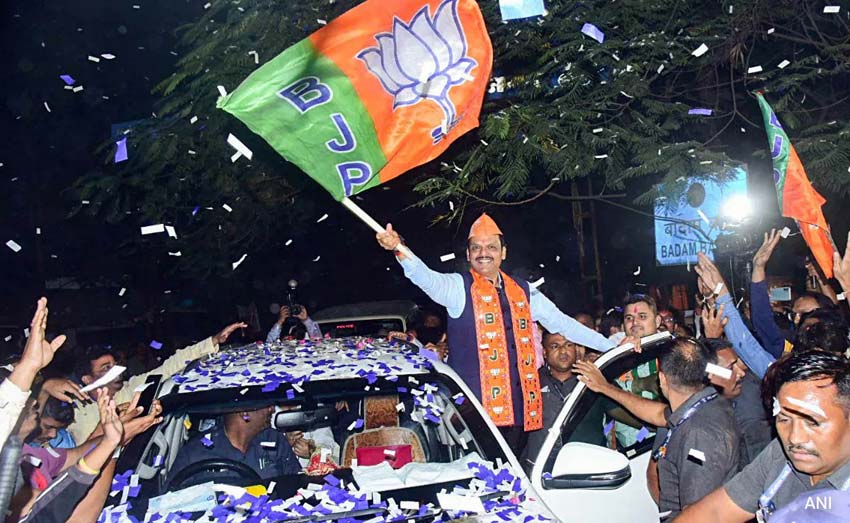
Money power is of two types during elections, the legal and the illegal. The legal money power is the expenditure by individual candidates and by the political parties. The candidates have a ceiling on expenditure and most importantly cannot use money to bribe votes, by way of gifts or cash. While this is so, there have been huge number of cases of money being distributed among voters in a big way. Of course, the honest and duty-bound officials of appointed by the election Commission to ensure that the Model Code of Conduct is followed, carried out their duties and apprehended those indulging in such malpractices.
Several individuals were caught distributing money, liquor, sarees and gifts. In one case, a person was apprehended distributing Rs 1,500 per voter, by taking charge of the election identity card and marking the left index finger with indelible ink, used by the commission. This was being done with those, who were known to vote for the MVA candidates, so as to deprive them of the right to vote.
The Election Commission has declared that it has seized over Rs 500 crore in cash from different parts of Maharashtra.
On the complains of two candidates of the Bahujan Vikas Aghadi, Hitendra Thakur and his son Kshitij, BJP National General Secretary Vinod Tawde was caught with a bag containing nearly Rs 10 lakh in cash. The father son duo also should diaries found in the bag, with numerous entries of names and figures against it, indicating payments made to those individuals. The Thakurs alleged that rupees five crore were distributed by Vinod Tawde in the constituency.
A case was registered against Tawde, but he was not arrested. In other cases, those caught with unaccounted money or found distributing cash among voters, were arrested, but no candidate was arrested, in whose constituency the money was distributed. Ironically, almost all the persons caught distributing money belonging to the BJP or the Shiv Sena (Shinde group).
Media reports from Western Maharashtra state that in a span of 20 days of the campaigning, over 25,000 kg of mutton was sold in Kolhapur and Satara alone, apart from huge amount of liquor, the combined value going to crores of rupees. Needless to say the ECI failed to keep an eye on this or to take action on those organising liquor and mutton parties in the region, to win over the voters.
The BJP used money power in a big way legally too. Being the biggest beneficiary of the funds from the electoral bonds, the party has huge funds at is disposal and it has used the money well in building the party all over the country, with Maharashtra being no exception. It has set up huge and modern offices even in smaller towns and cities, as well as suburbs of bigger cities in the state. This gives the party more visibility.
Apart from this the BJP had brought 90,000 party workers from other states, to work at the booth level in Maharashtra. This was stated by BJP leader Pankaja Munde, who is he daughter of the late Gopinath Munde. Going by her statement and presuming that these party workers stayed in Maharashtra for over a month, it is left to one’s imagination as to the amount of money that must have been spent by the party on the travel, lodging and boarding of these 90,000 party workers, not to speak of the remuneration most of them must have been given.
The Rashtriya Swayamsevak Sangh, the ideological guardian or mother of the BJP, has a dedicated army of volunteers, specialised in whisper campaigns and in brainwashing the public, sent out its army to carry out the task from door to door. Thousands of such volunteers went door to door and convinced Hindus that their existence is in danger. This campaign started even before Uttar Pradesh Chief Minister Yogi Adityanath came and spewed communal poison in a state, which as by and large respected different religions and maintain communal harmony over the years.
There are numerous dargah and temples in Maharashtra, which are a living example of communal harmony, with Hindus and Muslims worshiping jointly at these religious places. In fact, in some cases the first right to worship is given to members of the religion to which the sacred place is not dedicated.
Maharashtra is proud of being the birth place of a Hindu king, Chhatrapati Shivaji Maharaj, who was never against Muslims, but was against the Mughals, not because of their religion, but because they were invaders. Among his confidantes were Muslims and he had ensured communal harmony among the masses. That quality of the state was badly damaged during the just concluded election, with slogans of batenge to katange and ek hain to safe hain, given by Adityanath and Prime Minister Narendra Modi respectively. The BJP was quick to react to the criticism from sensible voices in the state and the nation, stating that the two statements were not directed against the Muslims. The people of the state are not so naïve to believe them and clearly read through the message that they need to unite against the Muslims, who they are made to believe, are a threat to their existence.
Thus, there was tremendous polarisation and consolidation of the Hindu votes, which went en bloc to the Mahayuti, which was looked upon as the saviour of Hindus from the percieved threat from the Muslims. Leaders like Pankaja Munde and Radhakrishna Vikhe Patil of the BJP and Ajit Pawar have been among the Mahayuti leaders to state publicly that they do not agree with the batenge to katange slogan.
To add to this BJP leader and state Deputy Chief Minister Devendra Fadnavis announced at an election rally that Indian tricolour will soon be flyng in Pakistan. The country is full of people blinded with support to the BJP on the basis of religion, where logic is dead, many in Maharashtra too forgot that defence is not a state subject, yet they decided to back Fadnavis and his party in the state, on that issue.
Another factor that was seen this time in Maharashtra election, was the use of violence. The state has been free from electoral violence, but for a few stray incidents over the years. However, this time there were numerous incidents of election related violence in the state. The violence was not confined to skirmishes between rival party workers, but also there have been several cases, where the candidates were attacked. The most noteworthy was the attack on former state Home Minister Anil Deshmukh, whose car was pelted with stones, in which he had a skull injury, requiring suturing.
Given all these factors, which helped the Mahayuti, the biggest turning point for the alliance was the success of the Ladki Bahin (beloved sister) scheme, in which women the state get Rs 1,500 per month from the government. The scheme was announced a few months before the election and an amount of Rs 7,500, which included arrears for previous months, was deposited in the bank accounts of the beneficiaries.
For most beneficiaries the amount was credited to their accounts before Diwali, which was a great relief to crores of women and their families. Shinde and his deputies publicised the scheme as a bhau beej (bhai duj) gift from a brother (Shinde) to his beloved sisters, seeking their support in return.
There were instances of some of the Mahayuti leaders making public statements that if the beneficiaries are found attending meeting and rallies of opposition parties or voting for them, not only would they be deprived of the scheme’s benefit, but also the amount paid to them would be recovered. This was the strongest move by the Mahayuti leaders, forcing women to come out in large numbers in its support.
The MVA had promised Rs 3,000 per month through a scheme for women if it comes to power, that did not go well with the women voters in the state, since they were made to realise that the MVA scheme was a dream, while the Ladki Bahin scheme is a reality.
Uddhav Thackeray and Sharad Pawar, seem to have felt that they would get the sympathy of the voters, given the split in their parties; the results show that blood may be thicker than water, but money is thicker and heavier than water.
Political parties in Maharashtra, which proudly speak of the teachings of Chhatrapati Shivaji Maharaj, Shahu Maharaj, Jyotiba and Savitribai Phule, and Babasaheb Ambedkar need to spread the messages of these great personalities, to maintain their legacy, which has been the foundation of modern Maharashtra.
By Abhay Mokashi
(The content of this article reflects the views of writers and contributors, not necessarily those of the publisher and editor. All disputes are subject to the exclusive jurisdiction of competent courts and forums in Delhi/New Delhi only)














Leave Your Comment