


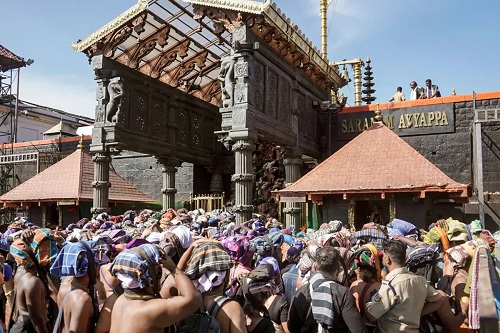
The government of Kerala, led by the Left Democratic Front (LDF), has decided to reverse its earlier position on the sensitive issue of entry of women into the historic Sabarimala Temple. The state administration will now inform the Supreme Court of India that women below the age of 50 should be barred from entering the shrine in order to preserve long-standing religious customs and traditions. The move marks a significant shift from the government’s stance in 2018, when it supported unrestricted entry for women of all age groups.
The decision was taken during a special cabinet meeting chaired by Chief Minister Pinarayi Vijayan on Friday, March 13. The cabinet approved the resolution passed by the Travancore Devaswom Board (TDB), the body responsible for administering the temple, which reaffirmed its commitment to protecting the traditional practices of the shrine dedicated to Lord Ayyappa.
Under the traditional practice followed at Sabarimala for centuries, women of menstruating age—generally considered to be between 10 and 50 years—are not permitted to enter the temple. The state government will submit an affidavit to the Supreme Court by the March 14 deadline responding to seven queries raised by the court on constitutional and legal aspects of the issue. Notably, these questions do not directly mandate the entry of women into the temple.
The matter is expected to gain renewed legal attention as review petitions challenging the landmark 2018 judgment are scheduled for hearing beginning April 7 before a three-judge bench led by Chief Justice Surya Kant.
Responding to criticism that the move represents a political flip-flop, Communist Party of India (Marxist) state secretary M. V. Govindan said the party’s ideological position remains unchanged. Addressing a press conference, he explained that the government has been instructed to prepare an “appropriate response” after consultations with legal experts, scholars, and religious authorities, while also taking into account the sentiments of devotees.
Govindan emphasised that the Supreme Court’s queries deal with larger constitutional questions involving the balance between religious practices and fundamental rights across different faiths. According to him, the issue should not be reduced to a simple binary choice of allowing or denying entry but should involve broader deliberation on the protection of religious traditions.
Earlier, on March 2, the Travancore Devaswom Board adopted a resolution clarifying that it had never officially supported the entry of women of menstruating age into the Sabarimala temple. The board stated that a view expressed by its lawyer in 2020 suggesting openness to the idea was merely a personal opinion and not the official stance of the institution.
The TDB reiterated that it has a constitutional and administrative responsibility to safeguard customs that devotees believe have been followed for centuries.
The government’s shift is widely seen as having political implications, particularly with the state assembly elections approaching. The decision, approved with the consent of the LDF leadership and the CPI(M) state secretariat, appears aimed at avoiding alienation of traditional devotees who regard the temple’s customs as sacred.
The Sabarimala controversy dates back to a petition filed in 2006 by the Indian Young Lawyers Association challenging the restrictions. In 2018, the Supreme Court struck down a 1991 ruling of the Kerala High Court that had upheld the ban, thereby allowing women of all ages to enter the temple. The judgment triggered widespread protests across Kerala, with many devotees arguing that the decision interfered with deeply rooted religious practices.
At the time, the LDF government had strongly defended the verdict as a victory for constitutional values and gender equality. The latest policy adjustment, however, reflects an attempt to reconcile constitutional considerations with the sentiments of believers as the legal and political debate surrounding Sabarimala continues.



















Leave Your Comment