


As someone who has been a keen observer of Kerala politics since the early 1980s, this writer has heard many confident declarations made from party platforms and editorial desks alike. But none was repeated with such smug certainty as the claim of both the CPI(M)-led Left Democratic Front and the Congress-led United Democratic Front that the Bharatiya Janata Party would never emerge as a serious political force in Kerala.
For decades, the BJP was mocked, caricatured, and treated as a permanent outsider — an anomaly in a state whose politics was declared to be ideologically sealed and electorally foreclosed to the currents shaping the rest of India. Every electoral advance made by the party, however modest, was brushed aside as an aberration, a temporary spike, or a statistical curiosity.
Kerala’s politics, often described — and defended — as minority-dominated, coalition-driven, and ideologically rigid, is undergoing a profound churn. The carefully constructed narrative that Kerala would remain forever insulated from the rise of the BJP is no longer sustainable. A growing and increasingly assertive section of the electorate is turning towards the BJP — not in spite of its ideological clarity, but because of it.
The fall of the Thiruvananthapuram Corporation, after nearly four decades of uninterrupted Left rule, is therefore not merely a municipal upset. It is a political reckoning — a moment when decades of denial, and dismissal have given way to an unmistakable shift on the ground. For those who have observed Kerala politics for over four decades, this moment marks not surprise, but vindication.
What follows is not just the story of an election result, but the chronicle of a long and deliberate challenge to an entrenched political order — and the first unmistakable sign that Kerala’s political future may finally be breaking free from the orthodoxies of its past.
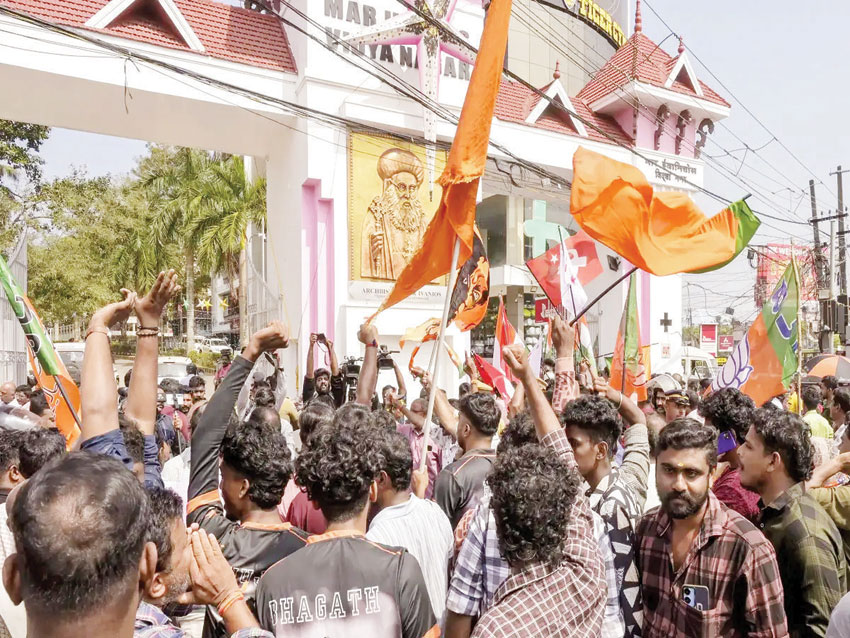
History was rewritten in Kerala’s capital when the Bharatiya Janata Party (BJP) led National Democratic Alliance (NDA) stormed into power in the Thiruvananthapuram Corporation, ending nearly four decades of uninterrupted Left Democratic Front (LDF) rule. In a political landscape long considered impervious to saffron advances, the lotus finally bloomed where it mattered most — the seat of power, perception, and prestige.
Winning 50 of the 101 wards, just one short of an absolute majority, the BJP-led front emerged as the single-largest force in the Corporation. The LDF, which had ruled the civic body for almost 40 years, was reduced to 29 seats, while the Congress-led United Democratic Front (UDF) managed 19. The verdict sent shockwaves through Kerala’s political establishment and forced a fundamental reassessment of long-held assumptions about the state’s electoral behaviour. This was not merely a municipal upset. It was a political rupture.
The Fortress That Finally Cracked
Thiruvananthapuram was never just another corporation. It is Kerala’s administrative heart, home to the Secretariat, national research institutions, a politically conscious middle class, and generations of committed Left voters. For decades, it symbolised the ideological dominance of the Left — a city where BJP ambitions repeatedly stalled. That it has now fallen underscores the scale of the BJP’s achievement.
For the party, the capital’s capture represents the collapse of a psychological barrier that had long constrained its Kerala ambitions. For the Left, it is a sobering reminder that no bastion is immune to voter fatigue, governance failures, and organisational erosion.
A Thirty-Year Siege Strategy
Contrary to claims of a sudden surge, BJP leaders insist the Thiruvananthapuram victory is the culmination of three decades of sustained, carefully calibrated political work. From the early 1990s, when the party barely registered in Kerala politics, Thiruvananthapuram was identified as a long-term target. Over the years, the BJP quietly but persistently built booth-level structures, expanded cadre strength, nurtured local leadership, and embedded itself in civic and cultural spaces.
The party’s approach evolved from sporadic campaigns to continuous political engagement — addressing neighbourhood-level grievances, participating in residents’ associations, and positioning itself as an alternative civic force rather than a protest vote. This election, BJP strategists argue, was the moment when patient groundwork met favourable political conditions.
Validation of a New Politics
Kerala BJP State President Sri Rajeev Chandrasekhar described the capital victory as validation of a new, governance-driven politics in the state. He attributed the result to disciplined organisation, credible local candidates, and a campaign focused squarely on civic issues affecting everyday life.
Chandrasekhar underlined that the verdict was not confined to Thiruvananthapuram alone. Across Kerala, the BJP improved its performance in municipalities, panchayats, and wards where it had once been electorally irrelevant. According to him, the people of Kerala are increasingly willing to look beyond entrenched fronts and reward performance, commitment, and clarity of purpose. For the BJP, his message was clear: Kerala is no longer an exception.
Delhi Takes Note: Modi and Shah Step In
The significance of the result was immediately acknowledged by the BJP’s national leadership. Prime Minister Narendra Modi congratulated the Kerala BJP cadre for their perseverance, describing the victory as a reflection of people’s aspirations for accountable governance and development-focused administration. His message carried symbolic weight: it signalled that the party’s long struggle in Kerala had finally entered a phase of political legitimacy. Union Home Minister Amit Shah echoed the sentiment, highlighting the breakthrough in the capital as a turning point for the BJP’s southern expansion. He praised the organisational discipline of the Kerala unit and pointed out that the results demonstrate the party’s growing acceptance beyond traditional strongholds.
For BJP workers in Kerala, the endorsements from Modi and Shah were more than congratulatory notes — they were political signals.
A Statewide Shift
Though the spotlight remained on Thiruvananthapuram, the BJP’s performance across Kerala reflected a broader trend.
• The party significantly increased its ward tally across municipalities
• It registered notable vote-share growth in urban and semi-urban pockets
• In many areas, BJP candidates emerged as strong runners-up, reshaping contests
While the UDF dominated several corporations and the LDF retained influence in rural belts, the BJP’s expanding footprint altered electoral equations. Kerala’s traditional bipolar contest has now clearly morphed into a triangular battle, with the BJP no longer a marginal presence but a decisive factor.
Why the Left Lost Its Capital
The LDF’s defeat in Thiruvananthapuram is widely attributed to prolonged anti-incumbency and unresolved civic grievances.
Voters repeatedly flagged issues such as waste management failures, deteriorating roads, flooding, bureaucratic delays, and a perceived disconnect between elected representatives and local needs. After decades in power, the Left appeared to many as administratively tired and politically complacent.
The BJP, by contrast, capitalised on hyper-local campaigning, credible candidates, and a narrative centred on accountability and efficiency. In several wards, margins were slim — but the organisational edge proved decisive.
The First 100 Days
Control of the Thiruvananthapuram Corporation gives the BJP a high-stakes opportunity — and an equally high risk.
The civic body controls budgets, infrastructure projects, urban planning, and essential services affecting over a million residents. The BJP leadership has indicated that governance in the capital will be used as a model experiment, with emphasis on visible improvements in the first 100 days.
Success could cement the party’s credibility. Failure would hand ammunition to critics.
Countdown Begins
With the 2026 Kerala Assembly elections barely four months away, the local body verdict has dramatically altered the state’s political momentum. Buoyed by its capital breakthrough, the BJP is all set to make significant electoral gains in the Assembly polls. The psychological advantage, cadre morale, and expanded acceptability have injected fresh confidence into the party’s Kerala campaign.
For the UDF and LDF, the emergence of a competitive BJP complicates arithmetic, alliances, and messaging. The era of predictable two-front politics is clearly over.
A signal, not a fluke
The fall of Thiruvananthapuram is more than a municipal milestone. It is a signal of political transformation, a reward for decades of persistence, and a warning to entrenched powers that Kerala’s electorate is changing.
Whether this moment becomes a watershed or a waypoint will depend on governance delivery and strategic execution. But one conclusion is unavoidable:
The BJP has arrived in Kerala’s power politics — and it is no longer knocking at the door.
How the Left Lost Kerala’s Ground and Faced a HistoricRout
The verdict of Kerala’s three-tier local body elections represents more than an electoral defeat of the Left Democratic Front (LDF). It marks a civilisational reckoning—the visible collapse of a political ideology that ruled Kerala for decades while remaining fundamentally alien to its cultural, spiritual, and national ethos.
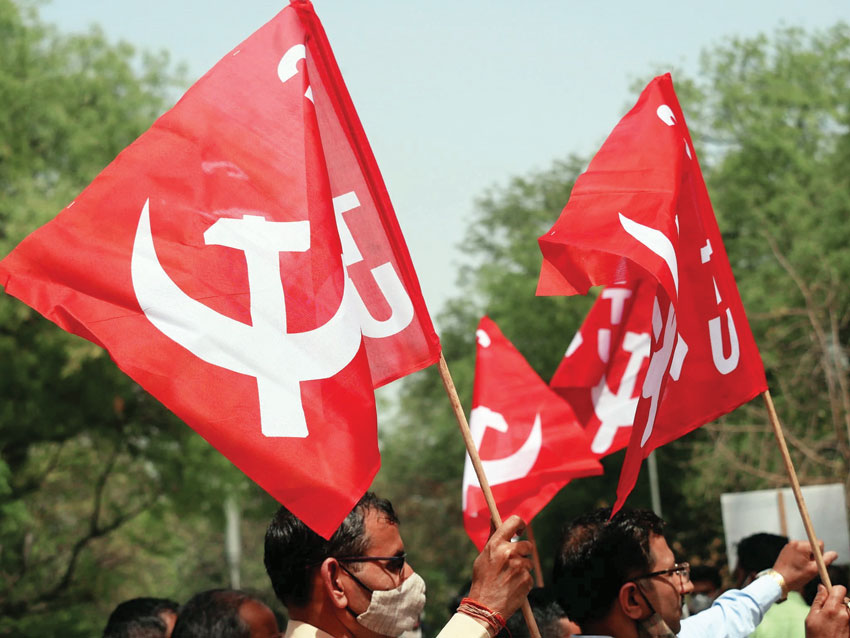
The loss of the Thiruvananthapuram Corporation after nearly forty years of uninterrupted CPI(M) rule is not merely symbolic. It signals the erosion of an ideological monopoly that thrived on intellectual intimidation, cultural deracination, and political entitlement. What has unfolded is not an accident of arithmetic, but the return of a society to its deeper civilisational instincts.
An Ideology Without Roots
Marxism, by its very nature, is an imported ideological construct, disconnected from India’s civilisational experience. In Kerala, the CPI(M) sustained itself not by cultural resonance, but by organisational control, intellectual gatekeeping, and relentless narrative management.
For decades, the party ruled by positioning itself as the sole interpreter of progress, modernity, and morality—while treating Kerala’s spiritual traditions, cultural symbols, and national consciousness with suspicion or outright hostility.
The local body verdict signals that this ideological imbalance has finally been rejected.
Governance Failure Masked as “Progressive Politics”
Under prolonged Left rule, governance steadily decayed even as ideological posturing intensified. Civic collapse—garbage-filled streets, crumbling infrastructure, flooding, fiscal irresponsibility, and bureaucratic high-handedness—became routine.
Instead of correcting course, the CPM responded with rhetoric, slogans, and moral lecturing. Administrative failure was masked as progressive politics. Cultural alienation was justified as enlightenment. The people, however, saw through the charade.
The Sabarimala Moment: When Civilisation Pushed Back
The Sabarimala Temple controversies, culminating in episodes such as the gold theft issue, were not merely administrative lapses or routine law-and-order failures. They struck at the very heart of Kerala’s civilisational consciousness. Sabarimala is not just a place of worship; it is a centuries-old symbol of discipline, renunciation, and collective spiritual memory. When the sanctity of this sacred institution was compromised—through administrative overreach, insensitivity towards devotees, and finally the shocking revelation of organised gold theft from the temple—many felt that something far deeper than misgovernance had occurred.
For the first time, large sections of society began to perceive the Left not as neutral or secular administrators, but as a political force increasingly indifferent, if not openly hostile, to faith, tradition, and sacred institutions. This perception hardened when investigations revealed the direct involvement of CPM-affiliated individuals in the gold theft scandal. The arrest and jailing of senior CPM members by the Special Investigation Team shattered the carefully cultivated image of moral superiority that the party had long projected. The issue was no longer ideological disagreement; it became a question of trust, ethics, and accountability.
The damage, many believe, was irreversible. No amount of ideological justification, legal hair-splitting, or rhetorical defence could erase the deep public impression that a ruling establishment had crossed a civilisational red line. The spectacle of party loyalists exploiting a revered shrine for personal gain was seen as a profound betrayal—not only of devotees, but of Kerala’s cultural soul itself. This was the moment when cultural patience gave way to political resistance, when silent hurt transformed into open dissent, and when faith, long treated dismissively in political discourse, emerged as a powerful axis of social mobilisation.
Appeasement Politics and the Loss of Moral Centre
In its desperation to retain power, the CPM increasingly embraced transactional vote-bank politics, tailoring policies and rhetoric to appease minority blocs while disregarding broader social cohesion.
This strategy failed on two counts. First, Muslim and Christian voters—politically astute and historically aligned with the Congress—largely remained with the UDF. Second, the Left alienated large sections of its traditional Hindu support by appearing indifferent, if not antagonistic, to their civilisational concerns.
What was sold as secularism was increasingly perceived as selective appeasement devoid of cultural balance.
The Ezhava Re-Anchoring: Return to Civilisational Self-Respect
The most decisive shift has come from the Ezhava community, historically mobilised by the Left as a class constituency but now seeking something deeper: cultural dignity and civilisational anchoring.
For decades, the CPM positioned itself as the sole vehicle of Ezhava empowerment. That narrative has now collapsed. Large sections of the community are moving towards the BJP—not merely as a political alternative, but as a platform that affirms identity, heritage, and national belonging. This is not a swing. It is a re-anchoring.
Arrogance of Power and Contempt for Society
The CPM’s response to growing dissent was not humility but arrogance. Voters were lectured, critics vilified, and concerns dismissed as reactionary or manufactured. The party’s intellectual apparatus functioned less as a space for debate and more as an enforcement mechanism for ideological conformity.
This contempt for society proved fatal. A party that once claimed to represent the masses now appeared afraid of the people’s voice.
Kerala and the Bengal Warning
Kerala now mirrors West Bengal’s Left trajectory—a movement that mistook cultural dominance for permanence, dismissed civilisational roots as backwardness, and was eventually rendered politically irrelevant.
Bengal’s Left today survives as a memory. Kerala’s Left is moving in the same direction—towards archaism, sustained by nostalgia rather than relevance.

By Pradeep Krishnan
from Thiruvananthapuram
(The content of this article reflects the views of writer and contributor, not necessarily those of the publisher and editor. All disputes are subject to the exclusive jurisdiction of competent courts and forums in Delhi/New Delhi only)














Comments (1)
S
a great work,a superb write up.great analysis of kerala politics.a gifted journalist for past 40 years.writer of books,spiritual interviews etc.wishing great future.