


The Kerala Assembly Elections 2026 have emerged as one of the most closely watched political contests in the country, reflecting not only the State’s deeply entrenched democratic culture but also a shifting political landscape marked by evolving leadership, changing voter expectations and the growing influence of a third political force.
Traditionally known for its cyclical pattern of power alternation between the Left Democratic Front (LDF) and the United Democratic Front (UDF), Kerala broke convention in 2021 by re-electing the LDF government led by Pinarayi Vijayan.
The 2026 election is therefore widely seen as a referendum on whether the Left can defy history once again or whether anti-incumbency will pave the way for a Congress-led comeback. At the centre of the political contest is Pinarayi Vijayan, whose leadership over the past decade has shaped Kerala’s governance narrative. Projecting himself as a decisive administrator,
Vijayan has built his campaign around stability, welfare delivery and crisis management. His government’s handling of multiple floods, the COVID-19 pandemic and welfare distribution schemes has been highlighted as evidence of effective governance.
However, after two consecutive terms, the challenge of anti-incumbency looms large. Critics have raised concerns over unemployment, allegations of corruption and what they describe as an increasingly centralised style of administration. Despite this, the LDF remains confident that its strong cadre base and welfare-oriented policies will resonate with voters.
A prominent figure reinforcing the LDF’s credibility is K. K. Shailaja, whose international recognition during the Nipah virus outbreak and the pandemic continues to lend moral strength to the Left’s campaign narrative. Though no longer holding the health portfolio, her presence in the campaign underscores the LDF’s emphasis on governance competence and public trust.
On the other side, the UDF, led by the Congress, is mounting a determined challenge with V. D. Satheesan emerging as the principal face of the opposition.
Satheesan has adopted an aggressive campaign strategy, consistently targeting the LDF on issues ranging from alleged corruption to governance failures.
His sharp rhetoric and visible grassroots engagement have helped reposition the Congress as a more assertive opposition compared to its relatively subdued performance in 2021.
Supporting this effort is Sunny Joseph,the state Congress president who has been working to strengthen the party’s organisational machinery and rebuild unity within the Congress ranks.
The role of experienced leaders remains equally significant, with Ramesh Chennithala continuing to play a strategic role in campaign planning and voter outreach.
Chennithala’s administrative experience and familiarity with Kerala’s political landscape provide depth to the UDF’s campaign, particularly in regions where personal connect and legacy politics still matter.
The UDF’s central narrative revolves around the need for change, accountability and clean governance.
It is attempting to consolidate traditional vote banks, particularly among minority communities, while also reaching out to youth and middle-class voters dissatisfied with employment opportunities and economic prospects.
However, the Congress-led alliance continues to face internal challenges, including factionalism and the need to present a unified leadership structure capable of inspiring voter confidence.
Adding a new dimension to the contest is the BJP-led NDA, which is striving to expand its footprint in a State historically resistant to its political ideology.
The alliance is being spearheaded by Rajeev Chandrasekhar, who represents a more modern, technocratic face of the party.
His leadership marks a strategic shift aimed at broadening the BJP’s appeal beyond its traditional base and positioning it as a credible alternative to both the LDF and UDF.
The NDA’s campaign is further strengthened by leaders such as V. Muraleedharan, who continues to play a key role in organisational mobilisation and ideological consolidation.
The BJP’s approach focuses on development, governance reforms and alignment with central government initiatives, while also attempting to consolidate sections of the Hindu vote.
Despite incremental gains in vote share over recent elections, the party still faces significant hurdles in converting this support into assembly seats due to Kerala’s entrenched bipolar political structure.Beyond the major fronts, the election also reflects the importance of individual leaders and constituency-level dynamics.
Leaders such as U. Prathiba represent a growing trend of grassroots political engagement, where local credibility and performance play a crucial role in influencing voter decisions.
The increasing visibility of women leaders across parties further highlights Kerala’s evolving political culture, where representation and performance are gaining prominence over traditional hierarchies.
The issues shaping the 2026 election are multifaceted and deeply rooted in Kerala’s socio-economic context.
Welfare versus development has emerged as a central debate, with the LDF emphasising its social security schemes while the opposition argues for a stronger focus on job creation and economic growth.
Unemployment, particularly among educated youth, remains a pressing concern and is likely to influence voting patterns significantly.
Allegations of corruption and governance lapses have provided ammunition for the opposition, while identity and community-based politics continue to play a subtle yet important role in electoral mobilisation.
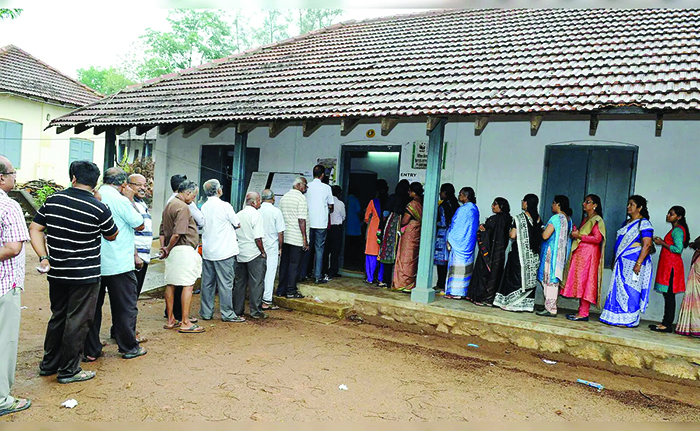
Kerala’s electorate, known for its high political awareness and participation, adds another layer of complexity to the contest. Voters are not only influenced by ideological leanings but also by performance, leadership credibility and local issues.
Minority communities, caste groups, women and first-time voters all constitute critical segments whose preferences could tilt the balance in closely contested constituencies.
Campaign strategies in 2026 reflect a blend of traditional and modern approaches.
While mass rallies and public meetings remain important, there has been a significant emphasis on digital outreach, targeted messaging and direct voter engagement.
The silence period preceding polling has seen candidates intensify door-to-door campaigns, aiming to establish a personal connect with voters in the final stretch.
One of the most notable aspects of this election is the increasing relevance of a triangular contest. While Kerala has historically witnessed bipolar competition between the LDF and UDF, the NDA’s growing presence introduces a new variable.
Even if the BJP does not emerge as a major seat winner, its ability to influence vote shares could have a decisive impact on outcomes in several constituencies, potentially altering the traditional balance of power.
As the State heads to the polls, multiple scenarios are being discussed.
The LDF hopes to secure an unprecedented third consecutive term by banking on governance continuity and welfare delivery.
The UDF is aiming for a comeback by capitalising on anti-incumbency and projecting itself as a credible alternative. The NDA, meanwhile, seeks to expand its influence and establish itself as a decisive force in Kerala politics.
Ultimately, the Kerala Assembly Elections 2026 represent a defining moment in the State’s political journey.
With seasoned leaders, emerging voices and a highly engaged electorate shaping the discourse, the election goes beyond a simple contest for power. It reflects a deeper struggle between continuity and change, ideology and pragmatism, tradition and transformation.
The verdict will not only determine the next government but also signal the future trajectory of Kerala’s political landscape in an increasingly complex and competitive democratic environment.
(The content of this article
reflects the views of writer and contributor, not necessarily those of the publisher and editor. All disputes are subject to the exclusive jurisdiction of competent courts and forums in Delhi/New Delhi only)




















Leave Your Comment