


Nuh district of Haryana is the soul of sacred geography of India. It is a part of the Mewat region, in which there are three Shivlings, dating back to the Mahabharata period. Mewat region of Haryana overlaps those parts of Rajasthan and Uttar Pradesh, which are considered sacred. This is the land of Shiva, the land of Krishna, the land of Radha, venerated by the Pandavas.
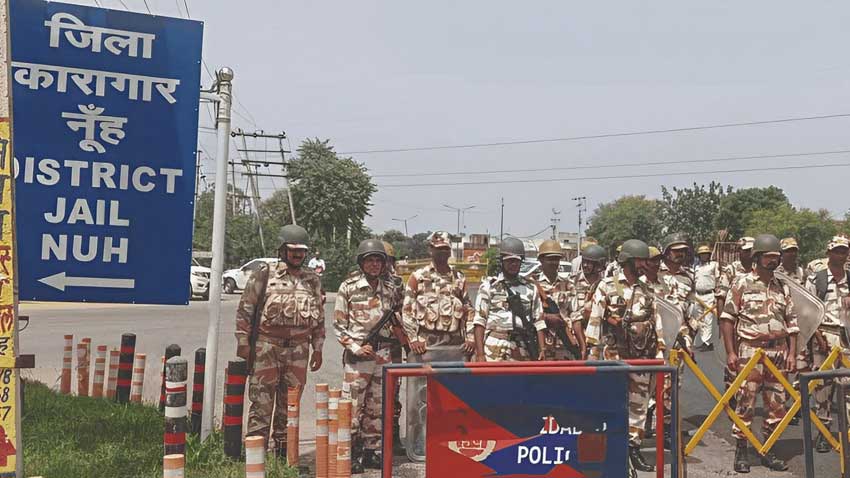
On July 31 this year, some Muslims, who constitute 80 per cent of the population in Nuh district, indulged in menacing stone pelting at the Brajmandal Jal Abhishek Yatra. There were women and children in this 25,000 strong pilgrim yatra. They had congregated from various parts of the region. The history of this yatra traces back to the Mahabharata period. For religious and political reasons, there were interruptions in its continuity. With the coming of the present government in Haryana, history took a major turn and the yatra was resurrected. This yatra starts from Nuh's Nalhar temple, situated in the bosom of the Aravalli Hills. The yatra then passes through Jhirakeshwar temple and Radha-Krishna temple located in Shringar village of Punhana block and culminates at the Shringeshwar Mahadev temple. The yatra begins with jalabhishek at Nalhar temple. There is also an ancient reservoir here, named after the Pandavas. The yatra and its sacred geographical and historical moorings is a testimony to the continuity of Indian civilization.
This flow of Sanatan civilization was interrupted, when the sacred land of Mewat, known as Matsya Desh in Mahabharata period, was attacked by Muhammad Ghori in 1355. As in the case of all Muslim invaders, the attack was on Sanatan as well. Later, when Firoz Shah Tughlaq in 1373 had gained political stranglehold on the region, he gifted the fort of Kotla to Raja Nahar Singh. This kindness was not without price. Raja Nahar Singh had to accept Islam and become Nahar Khan. He and his brother, orthodox Jaduan Rajputs, converted to Islam and the descendants of their clan came to be known as Khanzadas. Nahar Singh became Nahar Khan under compulsion, but the Nahar Singh within him did not die. This phenomenon was palpable in the entire Mewat region till recently.
Most of the Muslims in this region are Meo Muslims, basically converts from Meena Rajputs. They too kept their Hindu past alive. Even today they are demanding Scheduled Tribe status like the Meenas. Meos continued to be called by names like Amar Singh and Shorabh Singh within the precincts of their homes, but to demonstrate their Islamic credentials; they added Khan to their Hindu names. In their marriages, like the Hindus, they performed seven circumambulations of the sacred fire. They wore dhoti, worshiped Bhairav Baba before digging a well, worshiped the cow, celebrated the Govardhan festival, and prohibited intra-gotra marriage. I recollect that a few years back, a friend of mine posted as the Superintendent of Police (SP) of Mewat, now Nuh district, on receiving a phone call, abruptly excused himself from my company owing to information regarding tension in Mewat over a Muslim marriage, wherein the boy and the girl, belonged to the same gotra. This transgression was absolutely unacceptable for the Meo Muslims. I expressed my bewilderment over this Muslim adherence to the Sanatani parameters. He replied that amongst the Meo Muslims, Sanatan was still alive, and added that they have as yet not adopted Islamiat to the extent of marrying their close cousins. But all this began to change. Identity, dress, rituals, and customs all began to change. They, the Meo Muslims, were gradually drifting away from the syncretic culture of Mewat.
The drift actually began in the 1920s. The Deobandi Maulanas, who fancied themselves as custodians of Islam in the subcontinent, realized that the Muslims of Mewat were being attracted back to Sanatan. Maulana Ilyas, a Deobandi, founded the Tablighi Jamaat in 1926 to arrest the backward drift by propagating repackaged Islam of the radical variety. Within a few years, the change was significant and it manifested in 'Meoistan' prominently etched in the pioneer flag of conjured Pakistan, designed by Chaudhary Rehmat Ali in 1934. In 1947 Meo Muslims were unambiguous about their preference for Pakistan. To facilitate their migration to Pakistan, a camp was set up in Gurgaon, which housed 80,000 Meo Muslims. Then Nehru, Gandhi, Vinoba Bhave and Mridula Sarabhai for unfathomable reasons, implored them to change their decision. They relented, but did not jettison the ideology of Pakistan. Their lands and houses, which had been handed over to Hindus or Sikhs, who had fled from Pakistan, were returned. Apart from Nehru and Gandhi, no consequential leader, not even the Congress party as such, was in favour of Meo Muslims staying back in India. Meo Muslims were unabashed devotees of Jinnah, his Muslim League, and the concept of Pakistan. In the general public perception, the Meo Muslims carried doubtful reputation with regard to their loyalty and consciousness. Mostly they acted on the wrong side of the law. Gandhi had lamented on this perception during his address in the Meo Muslims in Gurgaon camp. Even today this area harbours more than 100 notorious criminal gangs operating on pan-India basis.
Tablighi are Deobandi, and so is the Taliban. Jihadi organizations in Pakistan, such as Harkat-ul-Ansar, Harkat-ul-Mujahideen, Jaish-e-Mohammed, Lashkar-e-Jhangvi and Sipahi-e-Sahaba, are all linked to the Tablighi Jamaat. The mastermind of the 1993 blasts in Mumbai, Pakistan's ISI chief Lt. Gen. Javed Nasir, was the biggest benefactor of the Tablighi Jamaat. Today Tablighi Jamaat is the largest missionary organization in the world. Its footprints are spread all over the world. The annual Tablighi conference held in Bangladesh is the largest gathering of Muslims in the world after the Hajj. Once a year, one million Tablighis congregate in Raiwind in Pakistan. Such Tablighi congregations serve as good opportunities for recruitment for Jihadi tanjims in the subcontinent. In 2014, Abdul Subhan Qureshi, a leading Lashkar-e-Taiba operative, and in 2016, Abdul Sami, a key al-Qaeda jihadist, were captured in the Mewat region. Jihadi outfits like Jaish-e-Mohammed (JeM), ISIS in Nuh district and organizations like Ansar-al-Tahweed, have been carrying out indoctrination and recruitment activities in Nuh district.
In December 2022, Saudi Arabia banned the Tablighi Jamaat saying that it is a danger to the society and a gateway to terrorism. Like Saudi Arabia, if India had acted against Tablighi Jamaat in the past, Islamic fundamentalism would not have suffused the Nuh district, and violence against Hindus would not have assumed such vicious proportions. Tablighi Jamaat killed the Hindu inside Meo Muslims. After the 1857 War of Independence, even Deoband was established with the singular purpose of killing the Sanatan within the Indian Muslims. The radical contemporary Muslim view was that the revolt of 1857 was essentially a Jihadi revolution for restoration of Muslim rule over India, and it failed because the Muslims of India had compromised themselves with the Sanatan past and the prevailing Hindu cultural environment, which had diluted their killing spirit.
'Indianization' or more appropriately 'Bhartiyakaran' of Muslims should have been the primary concern for nation building in independent India. However, we failed to act against Deoband, instead we nurtured it, even as it continued to spread Islamic fundamentalism and persisted with attack Hindu-Muslim shared history and culture. It was this Deobandi thinking, which was the impetus for creation of Pakistan. There was indeed a Deobandi faction that was against the idea of Pakistan. It was not for the love for Mother India, but because of their belief that India could better and sooner be transformed from Darul-Harb to Darul-Islam, if it was not partitioned. The pro-partition faction was of the belief that Pakistan, a Darul-Islam, could serve as an unassailable base for unremitting jihadi attacks, both at physical and ideological level, till Hindustan was transformed into Darul-Islam. Pakistan's proxy war against India is a manifestation of the same plan. Due to the unremitting attack on the Hindu-Muslim common culture and because of the dominance of radical Islam, there is an ongoing and persistent clash of civilizations in India. Nuh is the manifestation of this clash of civilizations.
Till a few years ago, the Meo Muslims of Nuh worshiped the cow. Today, beef shops abound the district. It is believed that in this very area of Nuh, Lord Krishna as a young boy grazed his cows. Punhana is a sub-division of Nuh district. It is said that when Krishna was taking leave from there, the people of that place implored him to visit again soon. Such was his divine appeal and his divine sway. Today Nuh district has become the biggest center of cow smuggling and cow slaughter. There are 431 villages in Nuh district, in which 90 are heavily involved in cow slaughter and cow smuggling. The High Court of Haryana on several occasions has issued instructions to the government to act decisively against this menace.
In deference to the sacred geography of the region, Gurgaon was renamed Gurugram in 2016. This area, once a village was gifted to Guru Drona by the Pandavas as Gurudakshina. Ironically, near the same Gurugram, there is a place called Pataudi, the descendant of the erstwhile Nawab, who is also an actor in Bollywood, has named his son, born to his Hindu wife, as Taimur. Taimur for Sanatanis is associated with the plunder loot, rape and massacre that occurred in 1398. Is this not a clash of civilizations?
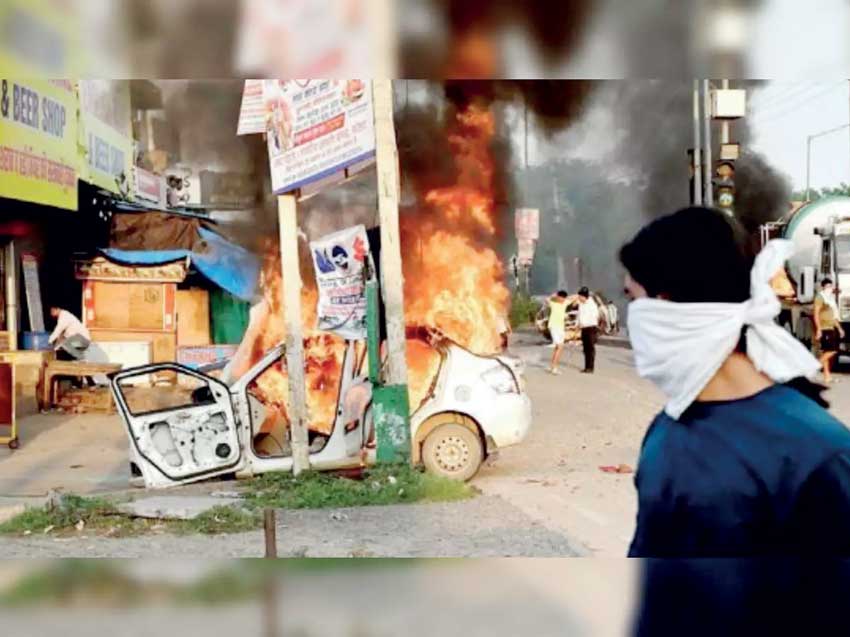
Two months before the violence, police in Nuh busted a massive cybercrime racket. 14 villages and 320 locations were raided. Sim cards, credit cards, smart cards, Aadhaar cards, PAN cards, ATM cards and mobile phones were recovered in huge quantities. These cyber criminals had duped 28000 countrymen of more than 100 crores. In the July 31 communal violence, the cyber police station was specifically targeted. The attack was premeditated and vicious. A bus was commandeered and wielded like a tank to ram through the boundary wall. Once inside, the attackers indulged in wanton vandalism. Destruction of records related to the cybercrime industry, thriving in the area, clearly seemed to be the objective. This objective seems to be main impetus behind the orchestration of communal violence.
Cheek and jowl to Nuh is Gurugram, celebrated for its software industry. The border that demarcates the border of Gurugram and Nuh, also in a way demarcates the proclivities and attitudes of respective civilizations. Gurugram is given to software development and Nuh is given to manipulating software with criminal intent. One civilization is given to science and the other thrives on crime. Can these civilizations coexist?
There are 103 villages in Nuh district from where Hindus have been terrorized into migration. In this, it shares some kind of parallel with the Kashmir Valley, except the fact that this exodus has taken place right under the nose of India's capital, New Delhi. Meo Muslims, like Kashmiri Muslims, were intrinsic part of the Sanatani framework. They drifted apart because of the clash of indigenous and borrowed civilizations.
Gurugram and Manesar region is a major automobile industry hub in India. Motorcycles to trucks are manufactured here. As the automobile industry in the area flourished, Nuh too flourished, but in the opposite way, i.e. it emerged as the hub of the 'vehicle theft industry'. This massive industry includes stolen two-wheelers, four-wheelers, trucks and even earthmoving vehicles. Endemically, the police bust the gangs of this industry, but they have the ability to revive soon, because of their congenital propensity for crime. This industry has a national network. It is these opposing proclivities and propensities between Nuh and Gurugram that engenders clash of civilizations.
In 2011, the Council of Social Science Research, an organization of the Government of India, conducted a study on the education system of children in Nuh (Mewat) district. It emerged that 90 percent of Muslim parents prefer to send their children to madrassas rather than secular schools. In 1947, there were only 14 madrassas in this district, now there are 77. The Islamia Arabiya Dargah Hazrat Sheikh Moosa Madrasa, is the oldest. It was established in 1332. Nuh's Hindu-majority neighborhood, such as Gurugram, Alwar, Palwal and Mathura districts, prefer secular schools and consider madrassas as nurseries of Islamic fundamentalism and jihad. The seeds of the clash of civilizations are thus planted in childhood itself.
Proportionally, Nuh has the second largest Muslim majority district, after Kashmir.
Despite being in the neighborhood of an economic hub like Gurugram, it is the poorest district in India according to NITI Aayog. This district is steeped in jihad and crime. This is nothing but the curse of borrowed civilization. Euphemistically speaking, Nuh mirrors Pakistan and Gurugram is the embodiment of rising Bharat. The clash of civilization is exerting opposite pulls. If not addressed at the level of civilizations, the pull is doomed to create permanent rupture.

By RSN Singh
(The content of this article reflects the views of writers and contributors, not necessarily those of the publisher and editor. All disputes are subject to the exclusive jurisdiction of competent courts and forums in Delhi/New Delhi only)














Leave Your Comment