


After World War II, the question of a Jewish homeland became urgent due to the suffering of Jews during the Holocaust. In 1947, the United Nations proposed the Partition Plan to divide Palestine into separate Jewish and Arab states. Jewish leaders accepted the plan, but Arab leaders rejected it. On 14 May 1948, David Ben-Gurion declared the establishment of Israel. Soon after, neighbouring Arab countries attacked, leading to the Arab–Israeli War of 1948, which ended with Israel surviving and expanding its territory. In the following decades, Israel fought several wars with Arab states, including the Six-Day War in 1967, when Israel captured the West Bank, Gaza Strip, Sinai Peninsula, and Golan Heights. Another major conflict was the Yom Kippur War in 1973, when Egypt and Syria launched a surprise attack on Israel. Despite conflicts, peace efforts were also made. In 1979, Israel signed a peace treaty with Egypt after the Camp David Accords, brokered by Jimmy Carter. Later, Israel signed the Oslo Accords with the Palestine Liberation Organisation (PLO) in the 1990s, aiming for peace with the Palestinians. However, tensions and conflicts with Palestinians continue to shape Israel’s history and politics today.
India and Israel
Relations between India and Israel have developed significantly over time, evolving from limited diplomatic engagement to a strong strategic partnership. India officially recognised Israel in 1950, but full diplomatic relations were established only in 1992. For several decades, India maintained a cautious approach due to its support for the Palestinian cause and its relations with Arab countries. After the establishment of diplomatic ties, cooperation between the two countries expanded rapidly across defence, agriculture, science, and technology. Israel has become one of India’s important defence partners, supplying advanced military equipment, surveillance systems, drones, and missile technology. Joint development projects such as the Barak-8 Surface-to-Air Missile System illustrate the growing defence collaboration between the two nations.
Political relations have also strengthened through high-level visits. In 2017, Narendra Modi became the first Indian Prime Minister to visit Israel, marking a historic milestone in bilateral relations. Later, Israeli Prime Minister Benjamin Netanyahu visited India in 2018, further reinforcing cooperation in security, innovation, and trade.
Apart from defence, Israel has contributed to India’s agricultural development through advanced irrigation techniques, particularly drip irrigation, which has helped improve water management and crop productivity. Collaboration in fields such as cybersecurity, artificial intelligence, space technology, and renewable energy is also increasing.
Trade between the two countries has grown steadily, with cooperation extending to diamonds, pharmaceuticals, and high-tech industries. Today, India and Israel share a pragmatic and mutually beneficial partnership based on strategic interests, technological cooperation, and growing people-to-people ties.
Iran : The modern history of Iran after 1950 has been shaped by political upheavals, revolutions, and conflicts. In 1953, a major turning point occurred with the 1953 Iranian coup, when Prime Minister Mohammad Mosaddegh was overthrown with support from the United States and the United Kingdom. The coup restored the authority of Mohammad Reza Shah Pahlavi, who ruled Iran as a powerful monarch for the next two decades. During the 1960s and 1970s, the Shah introduced modernisation reforms known as the White Revolution, aimed at modernising the economy and society. However, these reforms also created economic inequality and political dissatisfaction. Growing opposition to the Shah’s authoritarian rule led to widespread protests and unrest.
In 1979, the monarchy was overthrown during the Iranian Revolution. The revolution replaced the monarchy with an Islamic republic led by the religious leader Ruhollah Khomeini. This event transformed Iran into a theocratic state based on Islamic principles. Soon after the revolution, Iran faced the Iran–Iraq War (1980–1988), a devastating conflict with Iraq that caused heavy casualties and economic damage. After Khomeini’s death in 1989, Ali Khamenei became the Supreme Leader. Since the 1990s, Iran has faced international tensions over its nuclear program, economic sanctions, and regional conflicts. Despite these challenges, Iran remains an influential country in Middle Eastern politics.
Iran has long supported various militant groups in the Middle East, including Hezbollah in Lebanon, Hamas in Gaza, and the Houthi Movement in Yemen. This support is part of Iran’s regional strategy often called the “Axis of Resistance,” which seeks to expand its influence and oppose Israel and Western allies. Iran provides these groups with financial aid, weapons, training, and strategic guidance. Hezbollah, established in the 1980s, is considered Iran’s strongest ally and receives extensive military and political support. Iran has also funded and armed Hamas since the 1990s to strengthen resistance against Israel. It has supported the Houthis in Yemen by supplying missiles, drones, and military training through the Islamic Revolutionary Guard Corps. Through these groups, Iran seeks to expand its regional influence and challenge its rivals without direct military confrontation. However, this support has increased tensions and conflicts in the Middle East
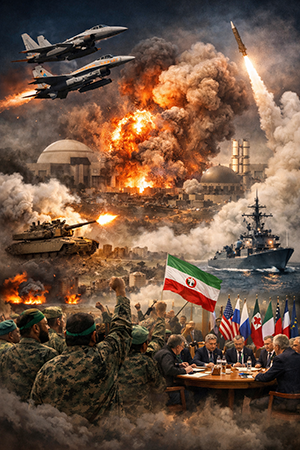
AI Generated Image
India and Iran
Relations between India and Iran have historically been close, underpinned by cultural, economic, and strategic cooperation. The two countries have shared civilizational links for centuries through trade, language, and cultural exchanges. In modern times, diplomatic relations have focused on energy cooperation, regional connectivity, and trade. For many years, Iran was one of India’s major suppliers of crude oil. Energy trade played a crucial role in strengthening bilateral relations, as India depended on Iranian oil to support its growing economy. However, international sanctions on Iran, particularly those imposed by the United States, have at times affected oil trade between the two countries.
A major pillar of cooperation is the development of the Chabahar Port in southeastern Iran. India has invested in this strategic port to improve connectivity with Afghanistan and Central Asia while bypassing Pakistan. The port is also linked to the International North–South Transport Corridor, a major trade route connecting India with Russia, Europe, and Central Asia.
In recent years, India and Iran have expanded cooperation in trade, transport, and regional security. Bilateral trade reached about $1.68 billion in 2024–25, with India exporting pharmaceuticals, rice, tea, and other goods to Iran. Despite challenges such as international sanctions and geopolitical tensions, India and Iran continue to maintain friendly relations. Their partnership remains important for regional connectivity, energy security, and economic cooperation in West and Central Asia.
Iran – Israel Hostility
The relationship between Israel and Iran has changed dramatically over time, shifting from cooperation to deep hostility. In the early decades after Israel’s establishment in 1948, the two countries maintained friendly relations, especially during the rule of Mohammad Reza Shah Pahlavi. Iran informally recognised Israel and cooperated with it in trade, intelligence, and military matters. The two countries even worked together on defence projects such as the Project Flower missile program in the 1970s.
However, relations changed completely after the Iranian Revolution of 1979. The new Islamic government led by Ruhollah Khomeini cut diplomatic ties with Israel and declared it an enemy. Since then, Iran has strongly opposed Israel’s existence and supported groups such as Hezbollah and Hamas that oppose Israel. In recent decades, the rivalry has evolved into a “shadow war” involving cyberattacks, intelligence operations, and proxy conflicts across the Middle East. Israel considers Iran’s nuclear program and regional influence as major security threats. Consequently, tensions between the two countries remain a key aspect of Middle Eastern politics today.
Ayatollah Ali Khamenei
Ali Khamenei, the Supreme Leader of Iran since 1989, has a mixed level of popularity among Muslims worldwide. Among many Shia Muslims, especially in Iran, Iraq, Lebanon, and some communities in South Asia, he is respected as an important religious and political leader who defends Shia interests and opposes Western influence. For many supporters, he symbolises resistance against countries like the United States and Israel.
However, the Muslim world is diverse, and his popularity is not uniform across it. Many Sunni Muslims do not consider him their religious authority because he belongs to the Shia branch of Islam. In addition, even within Iran, there is political criticism of his rule and the Islamic government. Surveys and protests in recent years show that some Iranians oppose the political system led by the Supreme Leader.
Khamenei is admired by many Shia followers but remains a controversial political figure in the wider Muslim world. His killing was uncalled for and has spread a wave of anger among his followers in many countries, including India. The government of India condoled his death. His son Mojtaba has reportedly been anointed as successor. It raises a fundamental question whether the Islamic Republic, which is at its weakest point since its formation, can carry on amid mounting internal unrest and external attacks.
US and Israel
Relations between the United States and Israel are among the closest strategic partnerships in international politics. The United States was one of the first countries to recognise Israel in 1948, shortly after its establishment by David Ben-Gurion. Since then, the relationship has developed into a strong alliance based on shared democratic values, security cooperation, and economic ties. The United States has consistently supported Israel in diplomatic, military, and economic matters. Washington provides significant military assistance to Israel, including advanced weapons systems, missile defence technology, and financial aid. One example of this cooperation is the development of the Iron Dome Air Defence System, which helps protect Israel from rocket attacks.
Political support for Israel remains strong in the United States. Leaders such as Joe Biden and previous presidents have emphasised Israel's strategic importance as a key ally in the Middle East. In addition to defence cooperation, the two countries collaborate in technology, intelligence sharing, trade, and scientific research. The U.S.–Israel relationship remains a cornerstone of American foreign policy in the Middle East and continues to influence regional security and diplomacy.
US – Israel attack on Iran
The United States and Israel attacked Iran mainly because of security and strategic concerns. One major reason was Iran’s nuclear program, which the US and Israel believe could lead to the development of nuclear weapons. They argued that the strikes were necessary to destroy nuclear facilities and prevent Iran from becoming a nuclear-armed state.
Another reason was Iran’s missile development and support for militant groups such as Hezbollah and Hamas, which oppose Israel. The US and Israel claim that Iran’s military activities posed a direct threat to their security and to their allies in the Middle East. The attacks were also described as a pre-emptive strike intended to weaken Iran’s military infrastructure and prevent future attacks on Israel and US forces in the region. The conflict reflects long-standing hostility between Iran on one side and the US-Israel alliance on the other.
In retaliation, Iran launched missile and drone attacks on Israel and US military bases in several Gulf countries, such as Bahrain, Qatar, Saudi Arabia, the UAE, and Oman. The aim is to weaken American military presence in the region and pressure these countries to stop supporting attacks on Iran. Another goal was to show that any attack on Iran could spread the conflict across the Middle East, affecting energy routes, military bases, and regional stability. Iran’s attacks are intended as retaliation, deterrence, and a warning that the war could expand beyond Iran if foreign powers continued military operations against it.
Impact of this war
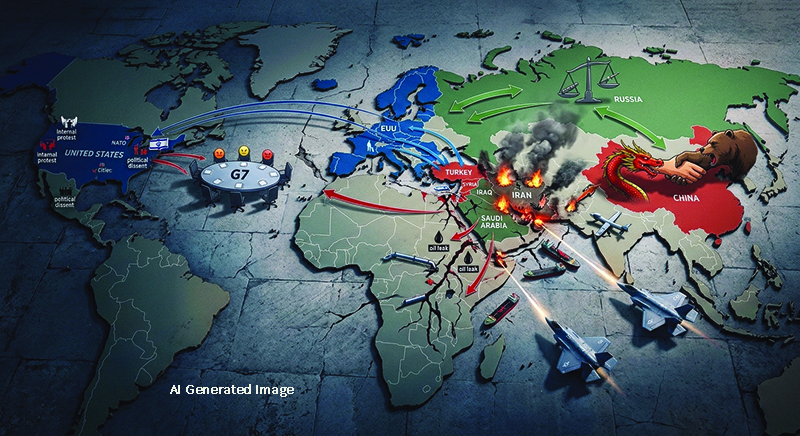
The war involving Iran, Israel, and the United States will have serious global consequences. One major impact is a rise in oil and energy prices, since the Middle East is a key supplier of global energy. Disruptions in the Strait of Hormuz, through which a large share of the world’s oil passes, could affect global trade and increase inflation. The conflict may also destabilise the wider Middle East, drawing in other countries and armed groups. Financial markets will become volatile, and international trade routes might be affected. This war risks increasing geopolitical tensions, slowing global economic growth, and significantly reshaping the global geopolitical landscape. It may deepen divisions between rival power blocs, with countries aligning either with the U.S.–Israel partnership or with Iran and its regional allies. The conflict could strengthen Iran’s ties with countries such as Russia and China, while reinforcing security cooperation among U.S. allies in the Middle East.
Regional organisations such as the Gulf Cooperation Council may also adopt firmer security policies. This conflict will heighten global polarisation, strengthen military alliances, and alter the strategic balance in the Middle East and beyond.
Conclusion
The US is the most powerful nation in the world and plays a significant role in international affairs. It is the country that dropped the nuclear bombs on Japan in 1945 and preaches to others not to make nuclear bombs. It attacked Iraq and killed Saddam Hussein on the pretext of weapons of mass destruction (WMD), which did not exist there, and killed Gaddafi of Libya. They fought in Afghanistan for 20 years without any result. Recently, what Trump has done in Venezuela is condemnable. The United Nations has become an 80-year-old, weak organisation and is unable to resolve disputes, primarily because of the veto power of the five permanent members of the Security Council. The US always seeks oil, rare-earth minerals, and locations to build its military bases. Trump’s policies have done more harm than good America and rest of the world.
India has adopted a neutral and balanced stance, not supporting military action by any side, and instead advocating for restraint, dialogue, and peaceful resolution. India maintains significant relationships with all three countries. It has strong strategic and defence cooperation with Israel, energy and connectivity links with Iran—particularly through the Chabahar Port—and a major strategic partnership with the United States. Because of these interests, India prefers diplomacy over taking sides. The government is also focused on safeguarding Indian citizens and economic interests in the Middle East while encouraging all parties to reduce tensions and prevent a broader regional conflict.
Iran faces internal unrest, with nearly a third of its population living below the poverty line. Supporting militias like Hizbollah, Hamas, and Houthis while neglecting its own people cannot be justified. The country should prioritise internal development rather than excessive spending on missile production and uranium enrichment. The next leader of Iran should be elected by its citizens, not by Donald Trump.
Israel faces an existential threat, but it can exist peacefully by promoting dialogue, mutual recognition, and long-term political solutions with its neighbours and the Palestinians. One key step is to pursue a negotiated settlement with the Palestine Liberation Organisation (PLO) based on earlier frameworks, such as the Oslo Accords. The two-nation theory must be adopted. Building trust through ceasefires, humanitarian cooperation, and economic development can reduce hostility. Regional diplomacy with countries like Egypt and Jordan—who already have peace treaties with Israel—can also strengthen stability. International mediation by the United Nations and other global powers can help encourage negotiations, security guarantees, and peaceful coexistence in the Middle East. We hope and pray that wisdom prevails and the war will
end soon.
The US and Israel underestimated Iran and did not anticipate this kind of retaliation. As a superpower, the US should promote peace and stability everywhere and avoid getting involved in wars. However, there appears to be a power imbalance and decisions made unilaterally that overlook the interests of smaller nations. A multipolar world, where multiple major powers share influence, would lead to more balanced global governance.

Manoj Dubey
(The content of this article reflects the views of writer and contributor, not necessarily those of the publisher and editor. All disputes are subject to the exclusive jurisdiction of competent courts and forums in Delhi/New Delhi only)




















Comments (9)
A
Good write-up.
L
Xcellent
S
Commendable articulation ????
S
ईरान और इजरायल के सम्बन्ध हमेशा से खराब नहीं थे।1979 में ईरान क्रांति के बाद शाह पहलवी को सत्ता से बाहर निकालने के बाद ईरान की सत्ता इस्लामी कट्टरपंथी नेताओं के हाथ आ गया। उसके बाद से ही समस्त विश्व अशांति को झेल रहा है। विश्व में अशांति का कारण हमेशा कट्टरपंथी विचारधारा ही रहा है। मैं इसे ईश्वर का ही विधान मानता हूं। इस माया जगत में, समस्त भौतिक संसाधनों से सम्पन्न रहते हुए भी,लोग सुखी और सुरक्षित नहीं रह सकते हैं। माया जगत के विषय में यह भगवान कृष्ण का स्पष्ट उद्घोष है। लेखक के प्रयासों की मैं सराहना करता हूं।
Y
Israel, the country surrounded by Muslim countries and has the conflict with them. Iran is the major country which helped hizbullah, Hamas and Houthis terrorist groups against Israel and cause of conflict. India has good relations to both the countries and developing Chabahar port of Iran for access to central Asia. US and Israel attacked Iran and the war is causing the damage to economy worldwide including India due to oil and gas hurdles. The article is very informative and present problem. Congratulation to Author.
N
The article authored by Mr. Manoj Dubey provides a comprehensive analysis of the deep-seated ideological and strategic friction between Iran and Israel, detailing how their regional power struggle increasingly dictates the stability of the Middle East. It effectively highlights the transition from proxy warfare to direct military confrontation, emphasizing the profound risks this escalation poses to global energy security and international geopolitical alignments. Geopolitical Analysis of the Iran-Israel Conflict This video provides expert insight into how the escalating tensions between these two nations create a difficult diplomatic challenge for global powers and regional stability. Overall interesting reading for all.
N
The article authored by Mr. Manoj Dubey provides a comprehensive analysis of the deep-seated ideological and strategic friction between Iran and Israel, detailing how their regional power struggle increasingly dictates the stability of the Middle East. It effectively highlights the transition from proxy warfare to direct military confrontation, emphasizing the profound risks this escalation poses to global energy security and international geopolitical alignments. Geopolitical Analysis of the Iran-Israel Conflict This video provides expert insight into how the escalating tensions between these two nations create a difficult diplomatic challenge for global powers and regional stability. Overall interesting reading for all.
N
The article authored by Mr. Manoj Dubey provides a comprehensive analysis of the deep-seated ideological and strategic friction between Iran and Israel, detailing how their regional power struggle increasingly dictates the stability of the Middle East. It effectively highlights the transition from proxy warfare to direct military confrontation, emphasizing the profound risks this escalation poses to global energy security and international geopolitical alignments. Geopolitical Analysis of the Iran-Israel Conflict This video provides expert insight into how the escalating tensions between these two nations create a difficult diplomatic challenge for global powers and regional stability. Overall interesting reading for all.
s
Mr. Dubey has thrown light on the war scenario in a comprehensive manner. A good read .