


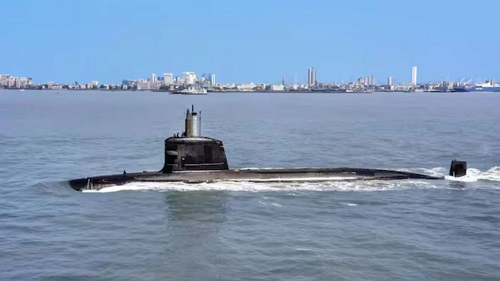
India is poised to take a significant leap in its maritime defence capabilities as Defence Minister Rajnath Singh hinted at the imminent induction of the country’s third indigenously built nuclear-powered submarine, INS Aridhaman. In a post on X, Singh described the vessel with a powerful phrase: “not a word, it’s power, ‘Aridhaman’,” underscoring its strategic importance.
The submarine has successfully completed its final sea trials and is expected to soon join the Strategic Forces Command, which oversees the nation’s nuclear arsenal. Its induction will mark another milestone in India’s journey toward a robust and credible nuclear triad.
INS Aridhaman follows the earlier deployments of INS Arihant (commissioned in 2016) and INS Arighaat (commissioned in August 2024). Slightly larger than its predecessors, Aridhaman displaces around 7,000 tonnes and features a more streamlined hull, significantly enhancing stealth and reducing acoustic signatures—critical for underwater survivability.
At its core lies an upgraded 83 MW pressurised water reactor developed by the Bhabha Atomic Research Centre, enabling long-endurance patrols without the need for surfacing. This advancement ensures that India can maintain a persistent and concealed underwater presence.
One of Aridhaman’s most notable upgrades is its expanded missile capacity. Equipped with eight vertical launch tubes—double that of INS Arihant—it can carry either eight K-4 long-range ballistic missiles with a range of 3,500 km or up to 24 K-15 missiles with a range of 750 km.
This capability enables continuous at-sea deterrence, ensuring that at least one nuclear-armed submarine remains on patrol at all times. Such readiness significantly strengthens India’s second-strike capability, a cornerstone of nuclear deterrence.
Ship, Submersible, Ballistic, Nuclear (SSBN) platforms like INS Aridhaman are central to maintaining strategic stability. Their ability to remain hidden deep underwater makes them virtually undetectable, ensuring survivability even in the event of a first strike on land-based or aerial assets.
With INS Arihant and INS Arighaat already operational, the addition of Aridhaman—and a planned fourth submarine—will allow the Indian Navy to maintain a continuous patrol cycle. This ensures that while one submarine is deployed, others can undergo maintenance or remain on standby.
Speaking during his visit to Visakhapatnam, India’s key hub for nuclear submarine operations, Rajnath Singh highlighted the broader importance of maritime power. He emphasized that with over 11,000 kilometres of coastline and nearly 95% of trade conducted via sea routes, India’s economic and energy security is deeply tied to naval strength.
He praised the Indian Navy for its role in protecting commercial shipping and oil tankers, especially during periods of geopolitical tension. Singh also stressed the need to secure not just territorial waters but also critical sea lanes, choke points, and even digital infrastructure linked to national interests.
The Defence Minister’s visit also marked the commissioning of the advanced stealth frigate INS Taragiri, built by Mazagon Dock Shipbuilders Limited. Featuring a Combined Diesel or Gas (CODOG) propulsion system, Taragiri boasts a sleek, low-radar-signature design and high-speed endurance.
Its arsenal includes supersonic surface-to-surface missiles, medium-range surface-to-air missiles, and an advanced anti-submarine warfare suite integrated through a modern combat management system. Beyond combat roles, the frigate is also capable of humanitarian assistance and disaster relief operations, reflecting its operational versatility.
As India aspires to become a developed nation by 2047, strengthening maritime capabilities remains a strategic priority. The induction of INS Aridhaman represents not just a technological achievement but a clear signal of India’s intent to safeguard its interests across the seas.
With a growing fleet of advanced submarines and warships, India is steadily reinforcing its position as a responsible and formidable maritime power in the Indo-Pacific region.



















Leave Your Comment