


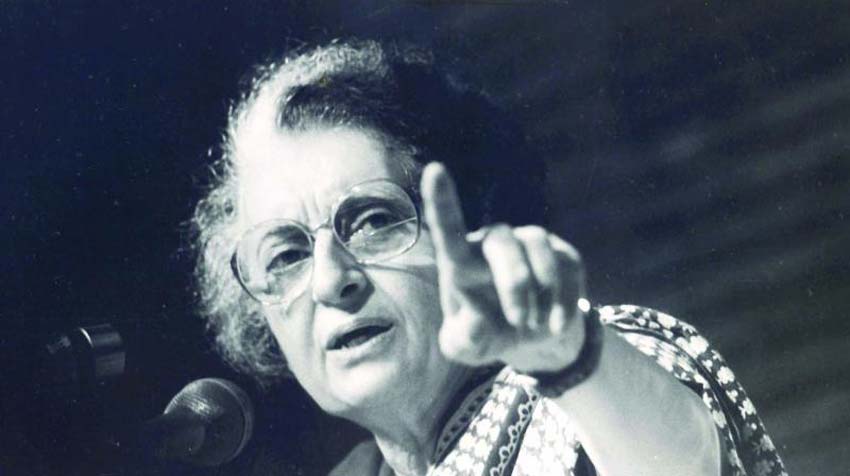
Indira Gandhi defeated Raj Narain in the 1971 Lok Sabha election. He lodged the case of election fraud against her in the Allahabad High Court. On 12th June 1975, the court found her guilty of the charges of misuse of government machinery and declared her election as null and void, and unseated her from the Lok Sabha. She was also disqualified from contesting any election for six years. This judgement of High Court was upheld by the Supreme Court on 24th June 1975, and an emergency was imposed the next day in the country.
President Fakhruddin Ali Ahmad under article 352 of the Constitution, declared this emergency on the advice of Prime Minister Indira Gandhi, citing the reason of prevailing imminent internal and external threats to the country. Nearly a week later, she announced a twenty-point programme to solve the country’s problems. This Presidential order bestowed upon the Prime Minister to ‘rule by decree’, allowing elections to be cancelled and suspended the civil liberties. The press was censored, and political opponents of Indira Gandhi including Atal Bihari Vajpayee, Chandra Shekhar, Jai Prakash Narayan, Devi Lal, George Fernandes, Karunanidhi, Mulayam Singh Yadav, Lalu Prasad Yadav, Sharad Yadav, Morarji Desai etc were imprisoned. MISA (Maintenance of Internal Security Act), the draconian law, was put in place, giving administration of Indira Gandhi very broad powers such as indefinite preventive detention of individuals, search and seizure of property without warrants, phone tapping to quell the civil and political disorder in the country. Over one lakh people were arrested and detained for no fault of their own, and basic democratic rights were denied to the people during the dark period of emergency. The law was amended several times during the emergency and used for supressing political dissents. The 39th amendment of the Constitution placed MISA in the 9th schedule of the Constitution, thereby making it totally immune from any judicial review.
The 42nd Constitution Amendment Act 1976, regarded as the most controversial amendment, also known as the mini constitution due to its size, brought about the most widespread changes to the Constitution in its history. The powers of the judiciary were curtailed, the Preamble of the Constitution was changed by adding the words Secular and Socialist. The Parliament was given unrestrained power to amend any part of the Constitution without judicial review. This essentially invalidated the 1973 Supreme Court judgement in the Keshavananda Bharti case, which stated that the Parliament did not have the power to destroy or emasculate the basic elements or fundamental features of the Constitution. Indira Gandhi took decisions in consultations with some close party members and her younger son Sanjay Gandhi, who played an important role in the arrest of senior opposition leaders, and during the subsequent elections, attained great deal of notoriety for forced sterilisation and moving people of the minority community out of New Delhi. MISA was a much abused statute; Lalu Prasad Yadav named his first daughter Misa after the much-maligned law. Thousands of people endured inhumane sufferings during this period. On 21st March 1977, the government lifted the emergency and announced elections. In the 1977 elections, the Congress was ousted (a ruling party was unseated through the democratic process for the first time), and the Janta Party gained an absolutely majority. Morarji Desai became the first non-congress Prime Minister of India. The new government brought about the 43rd and 44th constitution amendments to restore pre 1976 position to some extent, and MISA was also repealed.

National emergency in India has been declared three times- in 1962 during the China war, in 1971 during the Pakistan war, and in 1975 due to internal disturbances. But it is widely seen as an attempt by Indira Gandhi to retain her power, justifying it by citing a ‘deep and widespread conspiracy’ against her government. She, in a brazen display of dictatorial mindset, strangled the soul of democracy. Later, she accepted that the imposition of emergency was a mistake. Serious charges were levelled against her government during the emergency, including the detention of people without charges, torture of detainees and political prisoners and large-scale enactment of laws. The Shah Commission was appointed by the Janata Party government in 1977 to inquire into all the excesses committed during emergency. The Commission, headed by Justice J.C. Shah found that, there was no economic crisis and no crisis of law and order, and the decision to impose emergency was taken by Indira Gandhi alone, without consulting her cabinet colleagues, and was not justified.
The emergency affected the lives of millions of Indians and plunged the western press in to controversy. Editorials in the Pravda (Russian newspaper) accused Indira Gandhi of overplaying her hand. US media described India as a ‘legitimate police state’. Headlines such as ‘The Indian Dictator’ in The Times of London, India’s ‘Iron Curtain’ in The New York Times and ‘India’s Puritan Nanny’ in The Guardian drew attention of the people globally.
The Modi government has designated June 25, the day of imposition of emergency as ‘Samvidhan Hatya Diwas’ (Constitution Murder Day) to mark the 1975 emergency. This day will serve as a reminder of what happened when the Constitution of India was trampled upon. The government notification said ‘this is to pay tribute to all those who suffered and fought against the gross abuse of power during the period of emergency and to recommit to the people of India to not support in any manner such gross abuse of power, in future’.
The people of India have abiding faith in the Constitution and the power of its resilient democracy.

By Manoj Dubey
Principal (Retd.) Delhi Public Schools
(The content of this article reflects the views of writers and contributors, not necessarily those of the publisher and editor. All disputes are subject to the exclusive jurisdiction of competent courts and forums in Delhi/New Delhi only)














Leave Your Comment