


When India and the United States announced that they had agreed on a framework for an interim trade pact, it didn’t come with dramatic visuals or headline-grabbing soundbites. But make no mistake—this is one of the most consequential economic developments in recent years. Beneath the diplomatic language and technical clauses lies a clear signal: India and the US are serious about resetting their trade relationship, and this reset could work decisively in India’s favour.
For years, India–US trade talks have been stuck in a familiar loop. There were disputes over tariffs, disagreements on market access, and periodic flare-ups that saw both sides slap duties on each other’s goods. Yet trade kept growing despite the friction. Today, bilateral trade is already well over $190 billion, making the US India’s largest trading partner. What this interim framework does is remove the irritants that were holding this relationship back and replace them with predictability, intent, and direction.
At its core, the interim trade pact is a bridge. It is not the final Bilateral Trade Agreement that both sides are working towards, but it sets the rules of the road until that bigger deal is sealed. More importantly, it changes the tone of engagement—from defensive bargaining to forward-looking cooperation.
One of the biggest takeaways from the framework is the sharp easing of tariff pressure on Indian exports. Over the last few years, Indian goods entering the US had faced steep effective tariffs, especially after Washington moved to a more protectionist posture. Under the new framework, US tariffs on Indian goods are capped at around 18 percent, a dramatic drop from earlier levels that were, in effect, choking competitiveness. For Indian exporters—especially small and medium enterprises—this matters enormously. Lower tariffs translate directly into better pricing, higher demand, and greater room to scale.
This is particularly significant because Indian exports to the US are not dominated by one or two mega corporations. They are spread across thousands of firms dealing in textiles, engineering goods, pharmaceuticals, gems and jewellery, auto components, and increasingly, high-value manufacturing. For these exporters, the US market is both lucrative and unforgiving. Any cost disadvantage can mean losing shelf space. The interim deal gives them breathing room.
Equally important is what India gets in terms of certainty. Trade is not just about tariffs; it is about confidence. When exporters know that rules won’t change overnight, they invest more, hire more, and plan for the long term. This framework signals that the US is willing to treat India not as a temporary partner of convenience, but as a serious, long-term economic ally.
On the other side of the table, India has agreed to reduce or eliminate tariffs on a wide range of American industrial goods and select agricultural products. Critics will inevitably ask whether this opens Indian markets too much. But the reality is more nuanced. India has been careful to protect its core agricultural interests—staples like rice, wheat, and dairy remain outside the scope of concessions. What India is opening up are segments where domestic demand is rising and where imports can actually help industry and consumers.
Take industrial goods. Cheaper access to high-quality American machinery, components, and technology inputs directly supports India’s manufacturing ambitions. If “Make in India” is to succeed in the next phase, it cannot be built behind tariff walls alone. It needs access to advanced inputs at competitive prices. This deal quietly facilitates that.
There is also a strategic layer to this agreement that often gets overlooked. India has committed to importing substantial quantities of US goods over the next few years, including energy, aircraft parts, and technology products. This is not a concession made under pressure; it is a calculated choice. Diversifying energy imports, securing reliable supplies of aircraft components, and accessing advanced tech all serve India’s long-term interests. At a time when global supply chains are being reshaped, locking in dependable partners matters.
Perhaps the most underappreciated aspect of the framework is its focus on non-tariff barriers. For Indian exporters, paperwork, standards mismatches, and regulatory delays are often bigger obstacles than tariffs. The agreement acknowledges this reality and commits both sides to working on regulatory alignment, smoother customs procedures, and clearer compliance pathways. This may sound technical, but it is where real trade expansion happens.

For sectors like pharmaceuticals and medical devices, this is especially crucial. India is already the pharmacy of the world, but entry into the US market involves navigating one of the most complex regulatory environments anywhere. Any move towards smoother processes without diluting standards is a major gain. The same applies to ICT products, electronics, and emerging technology sectors.
From a broader economic perspective, the deal fits neatly into India’s current growth story. India is trying to move up the value chain—from exporting raw materials and low-value goods to selling more sophisticated products and services. Access to the US market accelerates that transition. It forces Indian firms to meet global benchmarks, which in turn improves their competitiveness everywhere else.
There is also a clear employment angle. Export-led growth has always been one of the most reliable ways to generate jobs, especially in labour-intensive sectors. Apparel, leather, handicrafts, food processing—these industries employ millions, many of them women and first-time workers. Easier access to the US market could translate into more orders, more factories running at full capacity, and more jobs on the ground.
Politically and diplomatically, the timing of the interim pact is just as important as its content. The global trade environment is uncertain. Protectionism is no longer taboo, and major economies are increasingly willing to weaponise trade. In this context, India securing a relatively favourable framework with the US sends a strong message: New Delhi is not isolated, and it has leverage.
It also reinforces India’s position as a trusted partner in efforts to build resilient supply chains. The framework talks explicitly about cooperation on economic security and countering non-market practices. While China is never named, the subtext is obvious. For India, being part of this conversation is a strategic upgrade. It moves the country from being a passive participant in global trade to an active shaper of its rules.
Of course, no trade agreement is without risks. Domestic industries will need to adjust, and some sectors will feel competitive pressure. Implementation will matter as much as intent. If regulatory reforms stall or if promised facilitation does not materialise, enthusiasm could fade. But these are challenges of execution, not of direction.
What stands out is that India has negotiated this framework from a position of confidence. Unlike earlier decades, when trade deals were often signed under economic stress, today India is growing, markets are expanding, and alternatives exist. That changes the balance at the negotiating table. The interim pact reflects that shift.
In many ways, this agreement is less about immediate numbers and more about momentum. It clears the logjam that had built up over years of mistrust and signals that both sides want a comprehensive trade deal sooner rather than later. For India, that momentum is invaluable.
The interim trade pact between India and the United States is more than a policy document — it is a strategic milestone that could reshape India’s economic trajectory.
By lowering trade barriers, opening vast markets, and deepening cooperation on standards and technology, the pact promises to deliver export growth, job creation, and global integration. For India’s vibrant MSME sector, a growing services economy, and ambitious digital and manufacturing aspirations, this framework could be a springboard into a new era of economic dynamism.
As negotiations continue toward a full Bilateral Trade Agreement, the immediate onus will be on effective implementation, ensuring benefits flow across sectors and regions — from small exporters on India’s coasts to innovators in its tech hubs.
In an increasingly interconnected global economy, this interim trade deal stands as a testament to the possibilities that arise when strategic vision meets diplomatic resolve.
If handled well, this interim framework could be remembered as the moment when India–US economic ties stopped being transactional and started becoming genuinely strategic. For Indian exporters, manufacturers, workers, and consumers, that is a future worth betting on.
What the India–US Interim Trade Agreement Really Says
India and the United States have agreed on a framework for an Interim Trade Agreement—a stopgap arrangement that lays the foundation for a full-fledged Bilateral Trade Agreement (BTA). The emphasis is clear: reciprocal, balanced, and mutually beneficial trade, not one-sided concessions.
This is about opening markets both ways, strengthening supply chains, and delivering concrete outcomes—not press-release diplomacy.
Manufacturing & Industrial Goods
India has agreed to reduce or eliminate tariffs on select U.S. industrial goods. In return, the United States will apply a reciprocal tariff of 18% on Indian exports in key sectors such as:
• Textiles and apparel
• Leather and footwear
• Plastics and rubber products
• Organic chemicals
• Home décor, handicrafts, and certain machinery
This is a negotiated middle ground—not free entry for American goods.
Agriculture & Food Products
India will lower duties on a limited but wide-ranging basket of U.S. agricultural and food items, including:
• Animal feed like DDGs and red sorghum
• Tree nuts and fruits (fresh and processed)
• Soybean oil
• Wine and spirits
Crucially, this is tariff rationalisation—not dismantling India’s farm protections.
Pharmaceuticals & Medical Devices
The U.S. has agreed to remove retaliatory tariffs on Indian generic medicines, subject to final closure of the agreement.
Some pharma-related outcomes will depend on ongoing U.S. national security reviews—but India retains leverage here.
India, on its part, will address long-pending regulatory and market-access issues in medical devices, an area where disputes have lingered for years.
Aviation & Aerospace
Washington will roll back national security tariffs imposed earlier on certain Indian aircraft and parts.
India will also significantly expand purchases of U.S.-made aircraft and components, strengthening long-term aviation cooperation.
Automobiles & Auto Components
India secures a preferential tariff-rate quota for auto parts affected by U.S. Section 232 tariffs—within America’s national security framework. This ensures Indian exporters aren’t shut out.
Energy & Strategic Resources
India plans to purchase $500 billion worth of U.S. products over five years, spanning:
• Energy
• Coking coal
• Precious metals
This is strategic diversification, not dependence.
Technology, Digital Trade & Innovation
Both sides will step up trade in advanced technology, including GPUs and data-centre equipment.
They’ve also agreed to:
• Deepen joint tech cooperation
• Address discriminatory digital trade practices
• Create a pathway for robust digital trade rules under the future BTA
India will remove restrictive ICT import licensing and quantitative curbs—unlocking faster tech flows.
Standards & Market Entry
Within six months, both countries will decide whether U.S. or international standards can be accepted for Indian market access in agreed sectors—cutting red tape without diluting sovereignty.
Market Access & Trade Safeguards
Both sides commit to:
• Sustained and preferential market access
• Removal of non-tariff barriers
• Clear rules of origin to prevent third-country misuse
• Safeguards allowing either side to adjust commitments if the other backtracks
Economic Security & Supply Chains
India and the U.S. will align on:
• Supply chain resilience
• Countering non-market practices by third countries
• Coordination on investment screening and export controls
This is as much geopolitics as it is trade.
The Road Ahead
The Interim Agreement will be rolled out quickly, while negotiations continue toward a comprehensive Bilateral Trade Agreement. Importantly, the U.S. has agreed to consider further tariff reductions for Indian goods during BTA talks.
Bottomline:
India negotiated. India held its ground.
This is leverage, not capitulation—and the real deal is still being written.
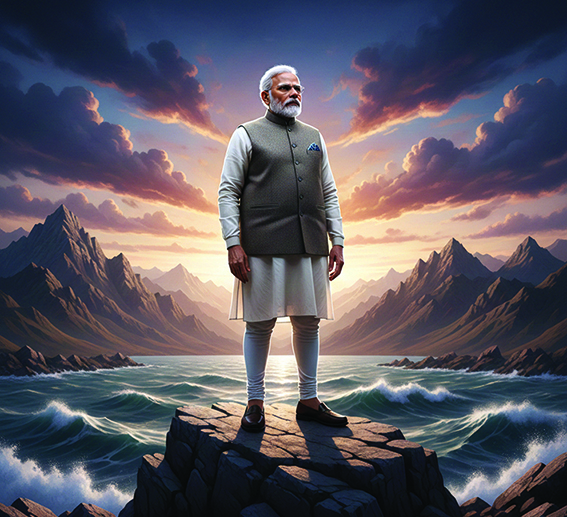
Standing Like a Rock: How Modi Turned Patience into Power
For years, India was told to hurry up, to soften its stance, to accept that the world’s biggest economies set the terms and everyone else falls in line. Narendra Modi did the opposite. He waited. He absorbed the pressure. He refused to blink. And in doing so, he has pulled off something many in the diplomatic world once dismissed as impossible: forcing the global system to negotiate with India on India’s terms.
What makes this moment extraordinary is not just that India got a good deal—but that it got a better deal than countries long seen as America’s gold standard partners. Japan, South Korea, the European Union, the United Kingdom—each of them accepted early compromises to lock in certainty. India didn’t. Modi’s message was blunt and unapologetic: India is not desperate, India is not weak, and India will not sign anything that limits its future growth. That single posture—hold your ground, don’t rush, don’t bargain from fear—changed the entire balance of power at the table.
This was not stubbornness for the sake of optics. It was strategic patience. While Washington expected India to fall in line, New Delhi quietly widened its options. Deals with Australia and New Zealand strengthened India’s access to raw materials and agriculture-linked supply chains. Engagements with Europe and the UK signalled that India had alternatives—serious ones. The message to America was unmistakable: if you want India, you negotiate fairly. If not, India will move on.
And eventually, the realization dawned in Washington. India was not weakening with time; it was becoming more indispensable. Supply chains were shifting out of China. Global companies were hunting for scale, stability, and democratic credibility. India had all three. By holding out, Modi ensured that India was no longer treated as a junior partner but as a pillar of the new economic order.
So what exactly did India gain from this approach? First, policy space. India did not surrender its ability to protect critical sectors—agriculture, MSMEs, digital data, and pharmaceuticals. Where others locked themselves into rigid frameworks, India retained flexibility. That matters enormously for a country still climbing the development ladder.
Second, market access without humiliation. Indian professionals, startups, and manufacturers gained improved entry into global markets without New Delhi having to dismantle its domestic safeguards overnight. This balance—opening up while defending national interest—is rare, and India pulled it off precisely because it refused to be rushed.
Third, recognition of India’s strategic weight. Trade is no longer just about tariffs; it’s about technology, clean energy, semiconductors, defence manufacturing, and trusted supply chains. India ensured that it entered these conversations not as a rule-taker, but as a rule-shaper. That is a qualitative shift in India’s global standing.
The economic benefits will compound over time. Stronger export opportunities, deeper integration into global manufacturing networks, and greater investor confidence are already visible. But the bigger win is psychological. India has broken the old habit of negotiating from insecurity. It has shown that a developing country can say “no” to pressure—and be rewarded for it.
Critics will scoff, as they always do. They’ll say Modi delayed too long, or that India could have signed earlier. But history rarely remembers those who sign quickly. It remembers those who change the rules of engagement. Modi didn’t just negotiate a deal; he renegotiated how India is negotiated with.
By standing still when everyone expected him to move, Modi forced the world to move toward India. That is not just a diplomatic victory. It is a statement of national self-belief. And in today’s fractured, anxious global order, that belief may be India’s most valuable asset of all.
From ‘Won’t Buy’ to ‘Will Sell’: India’s Strategic Trade Reset
• India’s recent trade engagements with the US and the EU mark a decisive break from decades of trade hesitancy and defensive economic policymaking.
• The shift reflects a conscious change in India’s trade philosophy—from a protection-heavy “won’t buy” mindset to a more confident, export-driven “will sell” approach.
• This transition has been achieved through strategic sequencing, not rushed liberalisation, allowing India to safeguard sensitive sectors while expanding global market access.
• Instead of sweeping free trade agreements, India opted for phased frameworks, interim deals, and reciprocal commitments to rebuild credibility as a reliable trade partner.
• Engagement with the US, including negotiations under Donald Trump’s transactional approach, demonstrated India’s new assertiveness—willing to walk away from unfair terms while confidently pitching its own strengths.
• India signalled that access to its vast domestic market would be matched by meaningful opportunities for Indian producers in global markets.
• The evolving trade track with the European Union connects India to one of the world’s largest and most sophisticated consumer markets, enhancing export potential and value-chain integration.
• Beyond trade volumes, the EU engagement helps India align with advanced standards, attract technology, and embed itself deeper into global manufacturing networks.
• Together, US and EU trade pathways link India to the world’s two largest markets at a time of global supply-chain realignment and geopolitical fragmentation.
• As companies diversify away from China-centric supply chains, India is positioning itself as a credible, stable, and scalable alternative.
• The new trade posture redefines trade not as a vulnerability but as a source of strategic leverage in a geopolitically charged global economy.
• While caution remains for politically and economically sensitive sectors, the overall trajectory is clear: India is embracing outward-oriented growth on its own terms.
• India’s trade reset signals a broader economic identity shift—from a cautious rule-taker to a confident rule-shaper in global commerce.

Nilabh Krishna
(The content of this article reflects the views of writer and contributor, not necessarily those of the publisher and editor. All disputes are subject to the exclusive jurisdiction of competent courts and forums in Delhi/New Delhi only)





















Leave Your Comment